What Is Natural Language Search and How It Works
You've got a six-hour dashcam upload, an incident report, and a deadline. Manually scrubbing the recording for “the moment the white sedan ran the red light” is slow, and searching for exact words won't help if nobody said those words aloud. Natural language search turns that ordinary sentence into a request for relevant evidence, then points you to the part of the recording where the event appears.
That distinction matters. The system isn't merely chatting about the video, and it isn't matching a handful of tokens in a transcript. It's trying to understand the query, compare its meaning with available content, and return a grounded result such as a timestamp, frame, transcript segment, or sensor event. The same idea applies to meeting archives, media libraries, robot memories, smart glasses, and security footage.
Table of Contents
- What Natural Language Search Means
- Query understanding
- Semantic matching
- Result grounding
- A Short History From Ask Jeeves to BERT
- How Natural Language Search Works Step by Step
- First, normalize the request
- Next, represent meaning
- Then, retrieve candidates
- Rerank for precision
- Ground the result
- Natural Language Search vs Keyword Search
- Multimodal Search for Video, Image, and Audio
- Shared representations, different evidence
- Where systems break
- Why Physical AI and Robotics Depend on It
- Physical AI is a unified stack
- Search closes the memory loop
- Pain Points and Open Challenges Developers Face
- Audio quality contaminates retrieval
- Ambiguity produces confident errors
- Language coverage is uneven
- Pipelines drift apart
- Evaluation is often informal
- Re-embedding is operational work
- Choosing the Right Natural Language Search Stack
- Questions to answer before implementation
What Natural Language Search Means
Natural language search is a retrieval approach that lets people describe what they want in everyday language. A user can state a goal without knowing an index field, tag, filename, or exact phrase. The system interprets the request as a whole and finds content that matches its meaning.
Consider the query, “show me the moment the white sedan ran the red light.” A literal search might look for white, sedan, red, and light. A natural language system parses the request as one event:
- An object: a white sedan
- An action: running a red light
- A temporal target: a specific moment
- A retrieval goal: show the relevant video segment
The query is like a compact incident description. Search must identify its parts, connect them, and locate evidence in the right data source. That work rests on three capabilities.
Query understanding
The system identifies entities, actions, relationships, constraints, and implied context. “Find where the operator discusses the damaged conveyor” asks for speech or text about a topic. “Find damaged conveyor footage” asks for visual content. The terms overlap, but the intended evidence differs.
References across turns add another layer. A user might ask, “Find the inspection where the robot stopped,” then follow with, “Show me the frame before that.” The second request depends on the first result, so the system must retain conversational context and resolve “that,” an ongoing challenge discussed in research on conversational search.
Semantic matching
The system compares the query's meaning with candidate content instead of relying only on exact wording. A recording may show a vehicle crossing an intersection even when its transcript contains none of the query's words.
Modern systems commonly use semantic retrieval. Query and content representations are mapped into a shared vector space, where similarity helps rank candidates. BEIR evaluations cover 18 public datasets and compare dense, sparse, late-interaction, and reranking architectures. Their results show that no single method leads across every domain, so production search often combines lexical retrieval, dense retrieval, and neural reranking, as described in this BEIR architecture discussion.
Result grounding
A fluent answer does not prove that the search found the right evidence. The result should point to inspectable material, such as a video timestamp, a frame containing an object, an audio interval, or a sensor reading.
Compare “the sedan ran the light at the intersection” with “the event appears from 02:14:08 to 02:14:16 in camera feed A.” The first is a claim. The second ties the claim to a location that a reviewer can inspect.
Practical rule: Treat natural language search as a way to locate evidence, not as a license for a model to invent an answer.
The target may also be outside spoken language. A query can refer to a collision sound, a person waving, a machine vibration, or an object disappearing behind another object. In Physical AI, the relevant event may span time-aligned video, audio, motion, and environmental signals. Search must connect those streams before it can return a useful moment, rather than treating each modality as an isolated text document.
A Short History From Ask Jeeves to BERT
A user asking, “Which films did Nolan direct?” expects a search engine to interpret a relationship, not merely match the words “films,” “Nolan,” and “direct.” Natural language search reached that goal through several stages, each improving how systems connect phrasing with meaning and evidence.
In 1993, the MIT Artificial Intelligence Lab created START, a natural-language question-answering system that let users query an online encyclopedia in everyday language. Ask Jeeves launched in 1996 as the first web search engine to support natural-language searching on the internet. These systems made full-sentence queries practical, although their retrieval still relied heavily on phrases, rules, and manually defined mappings. This history of natural language search shows the shift from accepting conversational wording to interpreting what a query refers to.
The next stage connected language with structured entities and relationships. A query such as “movies directed by Nolan” could map Nolan to a person, movies to a set of works, and directed to a director relationship. Knowledge graphs and entity-aware systems improved this linking. They also introduced a trade-off: teams had to design schemas, maintain entity records, and tune pipelines for the domains they covered.
Transformer models changed how search systems represented context. Google's 2019 BERT update improved the interpretation of words in relation to their surrounding query, rather than treating each word independently. “Open” may describe a business status, a physical action, or an unresolved question. Nearby words provide the clues needed to choose among those meanings.
Each stage addressed a different limitation:
- Natural-language interfaces accepted complete questions.
- Entity and relationship systems connected language to structured facts.
- Contextual encoders represented words according to surrounding language.
The same progression now applies beyond web pages. A query can refer to a video timestamp, an audio event, or a time-aligned Physical AI sensor stream. The enduring idea is simple: natural language search turns human phrasing into an intent that systems can connect to inspectable evidence across content types.
How Natural Language Search Works Step by Step
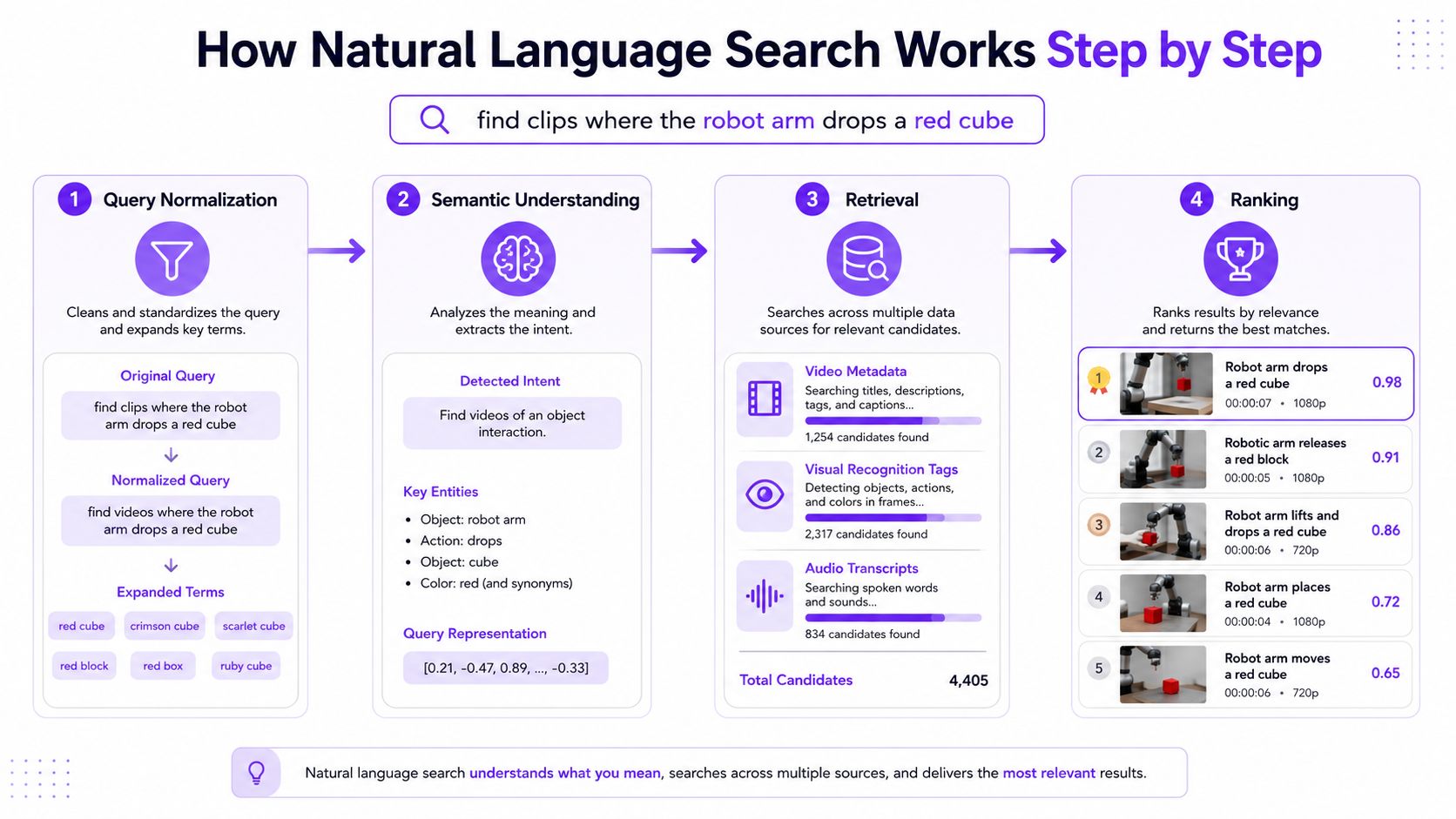
A request such as “find clips where the robot arm drops a red cube” contains several constraints. A production system processes them through a chain of decisions: clean the wording, represent the event, find candidates, compare them closely, and return evidence that a developer can inspect.
First, normalize the request
Normalization cleans the input while preserving its intent. The system may correct spelling, separate tokens, identify “clips” as video segments, and map “red cube” to the object vocabulary used by the application.
This step handles variation between user language and index labels. One person may write “robot arm,” another “manipulator,” and a third “pick-and-place arm.” The system needs comparable representations without erasing the original query, which remains useful for display, auditing, and later ranking.
Next, represent meaning
The query describes an event. A robot arm interacts with an object, the object is red and cube-shaped, and the action is dropping it. Semantic representations let the search system compare that event with indexed video, images, transcripts, audio, or sensor records.
The available evidence limits what the system can infer. A video can show the release and the cube's movement. An audio track may contain an impact sound. A transcript by itself may contain none of those signals, so a text-only index can return a plausible discussion while missing the physical event.
Then, retrieve candidates
Retrieval collects content that might satisfy the request. Semantic retrieval helps with varied wording, while lexical signals remain useful for exact terminology. A financial retrieval benchmark covering 23,088 queries and 7,318 documents reported that hybrid retrieval with neural reranking reached Recall@5 of 0.816 and MRR@3 of 0.605. It also found BM25 outperforming state-of-the-art dense retrieval on financial documents. Exact terms therefore remain valuable for numerically precise and domain-specific searches.
Rerank for precision
Initial retrieval favors recall, so the candidate set can contain clips where the arm holds a red cube, approaches one, or drops another object. A reranker compares the query with each candidate in greater detail and places the strongest matches higher.
Ground the result
A useful result preserves the boundary between a match and the evidence supporting it. For video, that evidence can include start and end timestamps, key frames, detected objects, and motion intervals. For robotics, it can also include synchronized camera frames, audio cues, and action or state records.
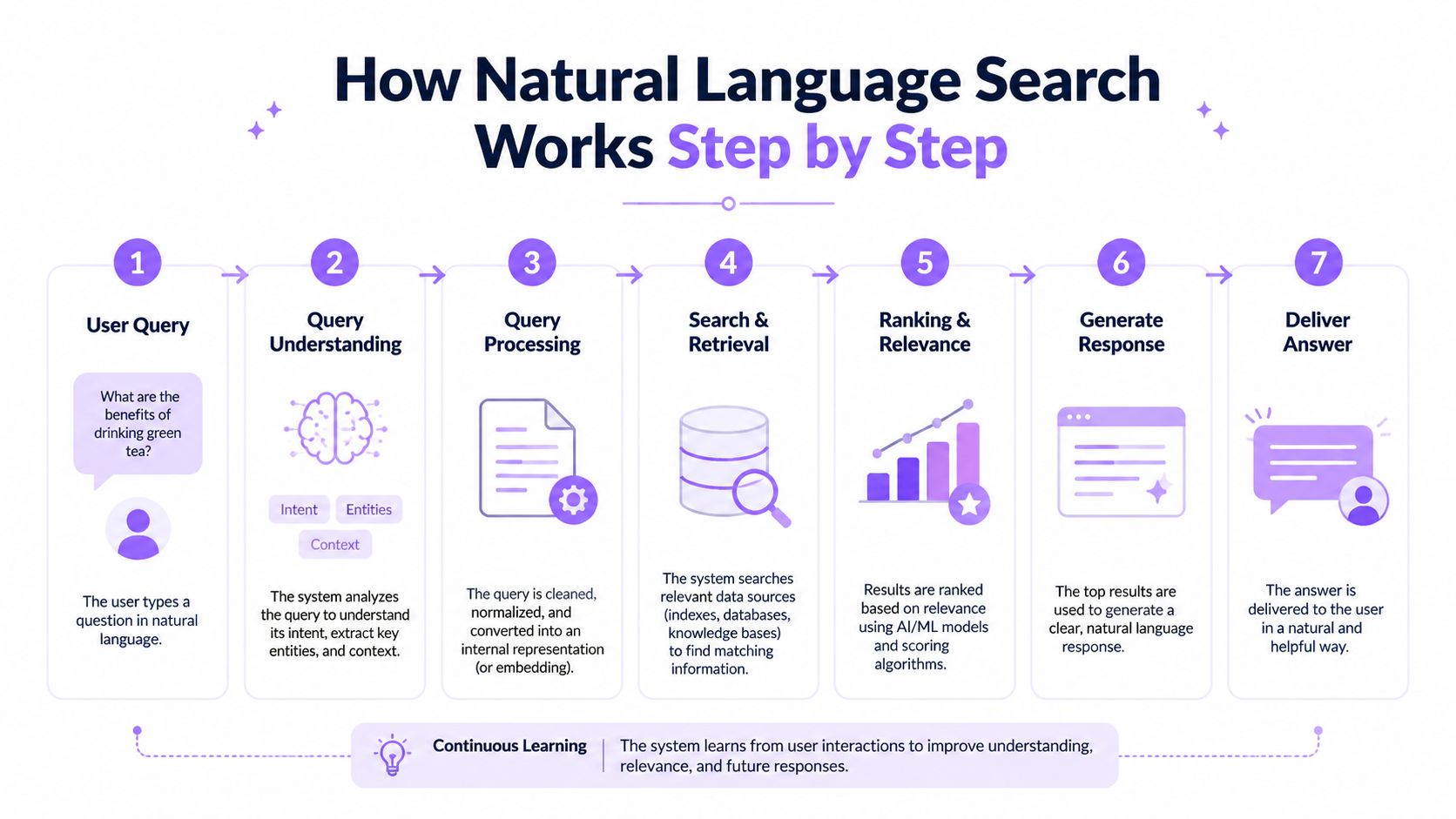
Users do not need to see every internal component. Developers do need the evidence chain. A result that cannot be inspected is difficult to trust, debug, or connect to an operational workflow, especially when the source is a time-stamped video, audio recording, or Physical AI sensor stream.
Natural Language Search vs Keyword Search
A transcript search for “show me meetings where the team disagreed on the launch date” exposes the difference quickly. A keyword engine can find launch and date, yet miss the discussion if participants said “we can't agree,” “the release timeline is disputed,” or “marketing wants a later ship date.”
Keyword retrieval remains direct and predictable. BM25-style methods work well when the exact token carries the meaning, such as a product SKU, error code, serial identifier, or technical class name. They do not need to infer that “disagreed” may appear as “objected,” “pushed back,” or “couldn't reach consensus.” That makes lexical search easier to inspect and useful for filtering.
Natural language search adds semantic matching. It compares the request with candidate passages based on meaning, then may use reranking to place stronger matches first. A transcript can therefore match even when nobody says “disagreed,” provided the conversation contains opposing proposals about the release schedule. The trade-off is a larger system with more configuration points and a higher risk of returning a plausible but incorrect match.
| Dimension | Keyword Search | Natural Language Search |
|---|---|---|
| Query understanding | Matches terms and phrases | Interprets intent, context, entities, and relationships |
| Ranking signal | Lexical overlap and term importance | Semantic similarity, often combined with lexical signals |
| Typos and paraphrasing | Usually limited unless explicitly configured | Typically more tolerant of wording variation |
| Long queries | Can become noisy as more terms are added | Can preserve relationships across a full request |
| Best-fit use cases | SKUs, error codes, filenames, exact identifiers | Conversational discovery, media retrieval, support, and ambiguous requests |
The choice is usually a system-design decision, not a binary replacement. A transcript may require exact names and dates, while a search over time-stamped video, audio, or Physical AI sensor streams must connect language with events, sounds, frames, and recorded states. A hybrid stack combines lexical BM25 retrieval with dense retrieval and a neural reranker. Exact matching protects precision in structured domains, while semantic retrieval helps recover paraphrases and unstructured evidence.
Engineering judgment: Use semantic search when users describe intent. Keep lexical search when users already know the identifier. Combine both when the query includes precise fields and an event described in ordinary language.
Multimodal Search for Video, Image, and Audio
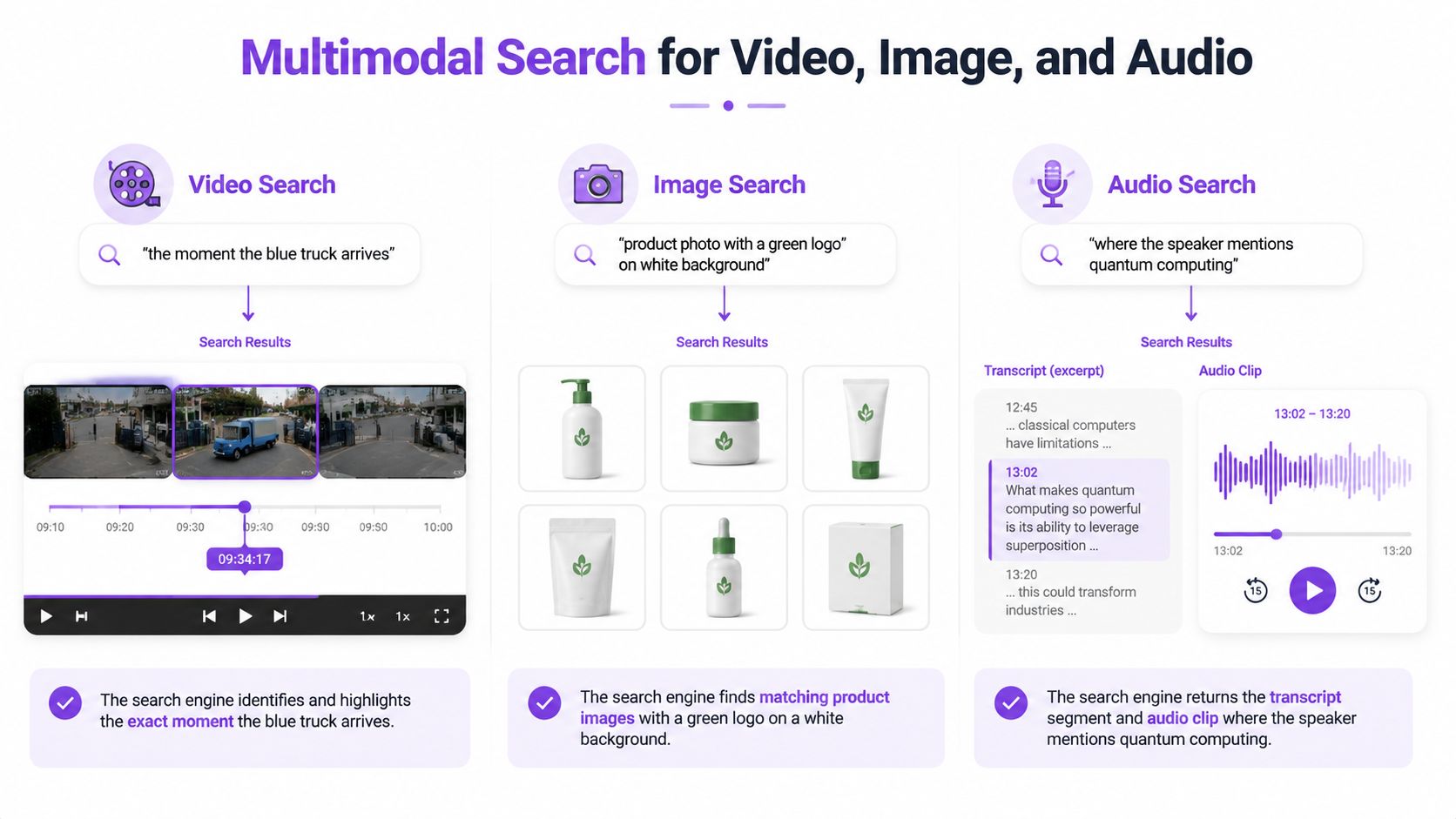
A video editor may remember a visual moment, a security analyst a vehicle and an action, and a podcast producer a topic discussed in speech. Their queries describe different evidence, yet multimodal search connects language with video, images, audio, and other time-based records.
Consider a security developer reviewing a long recording and searching for “the moment the red truck backed into the dumpster.” The system must connect those words to visual events and return a timestamped segment. Transcript search cannot do this reliably if nobody says what happened aloud. The retrieval result needs both the relevant content and the time at which the event occurred.
An image search has a different problem. A designer might enter, “minimal Scandinavian chair, warm wood, no metal frame.” An image representation can encode visual characteristics that filenames and tags often miss. Matching should reflect the overall composition and appearance, rather than isolated terms such as chair or wood.
Audio introduces another distinction. An editor could search for “every time the guest mentions pricing.” The system can transcribe speech, separate speaker turns, and associate each passage with a time range, letting the editor open the relevant clips directly. Nonverbal audio requires another path: applause, a door slam, and an alarm may have no transcript at all.
Shared representations, different evidence
A multimodal stack can use separate encoders for each medium, then place their outputs in a shared representation space. A text query can therefore retrieve visual, audio, or combined audio-visual content. The search system still needs modality-specific processing, but users do not have to operate a separate product for every media type.
WAVE-7B multimodal retrieval describes a unified audio-visual embedding model that places text, audio, silent video, and synchronized audio-video inputs in a shared space and supports any-to-any retrieval. Its documented scenarios include finding clips from natural-language descriptions of sound and motion in surveillance, robotics, and inspection footage.
This design addresses a weakness in transcript-centered media search. A transcript indexes spoken words, while embeddings can represent silent visuals, timed sound cues, and the relationship between a machine movement and an accompanying noise.
Where systems break
Latency, chunk boundaries, and shot changes directly affect retrieval quality. A segment that is too long can bury the relevant moment. One that is too short can separate an action from the sound that explains it. Video results also need accurate timing, because “the clip where the machine fails” is less useful than a result that opens near the failure event.
The harder engineering question is whether the result is anchored to the correct sensory evidence. A fluent description can still point to the wrong frame, sound, or event.
Why Physical AI and Robotics Depend on It
A robot inspecting a factory floor may record a camera view, a motor sound, a lidar change, and an operator's comment within the same minute. Later, someone needs to ask, “Find the sound that preceded the motor stall,” without knowing which file or sensor label contains the answer. Natural language search turns that request into a way to retrieve a time-stamped event from the robot's experience.
The same pattern supports questions such as:
- “Have I seen this type of curb before?”
- “Where did I last open a door with this handle?”
- “What did the operator say about this zone?”
- “Find the sound that preceded the motor stall.”
These are memory queries. The useful record includes actions, observations, environmental conditions, and outcomes, not just media files. Retrieval can provide relevant history to a planning or control system, while an operator can inspect the evidence that led to a decision.
Physical AI is a unified stack
Physical AI connects language with images, video, audio, sensor readings, actions, and three-dimensional data. AWS describes multimodal reasoning as processing text, images, video, and audio together, while NVIDIA describes omni-models that also handle physical-world signals and actions (multimodal AI for robotics).
The engineering reason is alignment. A robot may see a component fall, hear an impact, detect a change in vibration, and begin recovery at nearly the same time. Search must connect these observations on a shared timeline. If each system stores its output separately, a query about the event may retrieve one clue while missing the others.
Search closes the memory loop
A practical architecture follows four stages:
- Perception records events from cameras, microphones, and other sensors.
- Memory stores those events with time, location, and surrounding conditions.
- Language retrieves relevant history when an operator or policy requests it.
- Grounded context informs action or supports human review.
The system still has to operate within device limits. Mobile devices, smart glasses, autonomous vehicles, and robots may require local processing, bounded storage, and predictable response times. The search layer therefore needs representations that connect modalities without forcing every query through a remote service.
The same design applies to video advertisement editing. An editor can search for shots where a product is lifted, a logo appears, or a person reacts, then open the matching time ranges instead of scrubbing the entire archive. The domain changes, but the retrieval target remains an event anchored to evidence and time.
Pain Points and Open Challenges Developers Face
Natural language search can look accurate in a controlled demo, then fail on long recordings with inconsistent metadata, noisy audio, or weak timestamps. The difficult part is keeping the user's words connected to the right evidence across video, sound, and sensor streams.
Audio quality contaminates retrieval
Automatic speech recognition struggles with background noise, overlapping speakers, accents, code-switching, and sound effects. Research on audiovisual search highlights these weaknesses, especially when searching for nonverbal events rather than spoken words (audiovisual natural language search research).
Domain-adapted ASR and custom vocabulary can improve transcripts, but transcripts should remain only one part of the index. A dropped tool, an alarm, a change in motor noise, or a visible action may carry the evidence that speech misses. Store audio and visual representations separately, then connect them through shared timestamps.
Ambiguity produces confident errors
“Find the failure” does not identify the retrieval target. The user might mean visible breakage, an error sound, a policy violation, or an operator's description of a problem. A system that guesses can return a plausible clip with the wrong interpretation.
Conversational search systems still need to manage query reformulation, clarification, contextual retrieval, and response generation (context management in conversational search). Developers should evaluate whether the system asks for clarification when intent is unclear, not only whether it returns results quickly.
Language coverage is uneven
A monolingual embedding model can lose meaning when users mix languages, use local terminology, or switch languages within one request. Cross-lingual encoders and multilingual test sets help, but domain-specific evaluation remains necessary. A robotics team and a video-editing team may use the same everyday word for different events.
Pipelines drift apart
Independent ingestion, transcription, embedding, ranking, and serving services can create mismatched timestamps, duplicate processing, and unpredictable latency. A shared content schema and coordinated indexing reduce these failures. Observability should let developers trace the source segment, modality, timestamp, and ranking steps behind each result.
Evaluation is often informal
Without labeled query-to-video or query-to-audio pairs, teams may inspect a small set of results manually and ship. A maintained evaluation harness, built from curated examples and synthetic queries, provides a repeatable way to detect missed events, false matches, and relevance drift.
Re-embedding is operational work
Changing an embedding model can require processing a large media corpus again. Plan for versioned representations, staged migration, and side-by-side ranking comparisons. Model replacement changes retrieval behavior, so it belongs in deployment planning rather than a simple configuration update.
Design constraint: Noisy evidence, ambiguous intent, changing models, and imperfect time alignment are normal operating conditions.
Choosing the Right Natural Language Search Stack
A useful stack starts with the evidence a user must inspect. A text-only knowledge base can rely on documents and passages. An advertising video archive needs frames, transcripts, and time ranges. A robot's continuous sensor memory also needs synchronized audio, video, and environmental signals.
Use four layers:
- Ingest: Convert video, audio, images, OCR, transcripts, and sensor streams into searchable units. Preserve timestamps, source identifiers, and provenance at this stage.
- Index: Store lexical and semantic representations. One vector per segment may work for broad retrieval, while multi-vector methods can represent separate objects, speakers, tokens, or moments.
- Serve: Retrieve candidates quickly, combine lexical and semantic ranking, then apply a neural reranker where precision justifies the added latency.
- Evaluate: Measure relevant segments, false matches, clarification behavior, response time, and relevance drift as models change.
Questions to answer before implementation
- Managed or in-house: Do you need control over models, storage, and deployment, or would a managed service reduce operational work?
- Single-vector or multi-vector: Can one representation describe the whole segment, or do separate signals need to represent different objects, speakers, and moments?
- Ingestion fidelity: Are frames sampled often enough to capture actions? Are speakers separated in audio? Does OCR recognize the text shown on screen?
- Serving constraints: Can the system return a useful timestamp within the application's latency budget, including on mobile or edge hardware?
- Evidence display: Can users open the exact frame, audio range, transcript passage, or sensor interval that supports a result?
- Replaceability: Can you change an encoder or reranker without rebuilding every stored asset and downstream integration?
Physical AI adds a data requirement that model choice alone cannot solve. Human Signal describes calibrated, time-aligned RGB streams alongside spatial, multi-channel, ambient audio in its Physical AI data services. The audio is treated as an environmental sensor, not only as a speech layer (synchronized Physical AI data).
V-Modal AI offers a Search Layer for Physical AI with multimodal video and audio retrieval, natural-language video search, edge-oriented memory, and SDK options for mobile and cross-platform applications. It is one option to assess when a product must search synchronized visual, auditory, and environmental content instead of maintaining separate media indexes.
The practical rule is ingest, index, serve, evaluate. Keep these layers modular, carry timestamps and source identifiers through each step, and make every result open onto inspectable evidence. That design makes it easier to compare models, diagnose retrieval errors, and preserve grounded search as the media corpus grows.