Bi-Encoder vs Cross-Encoder for Physical AI Search
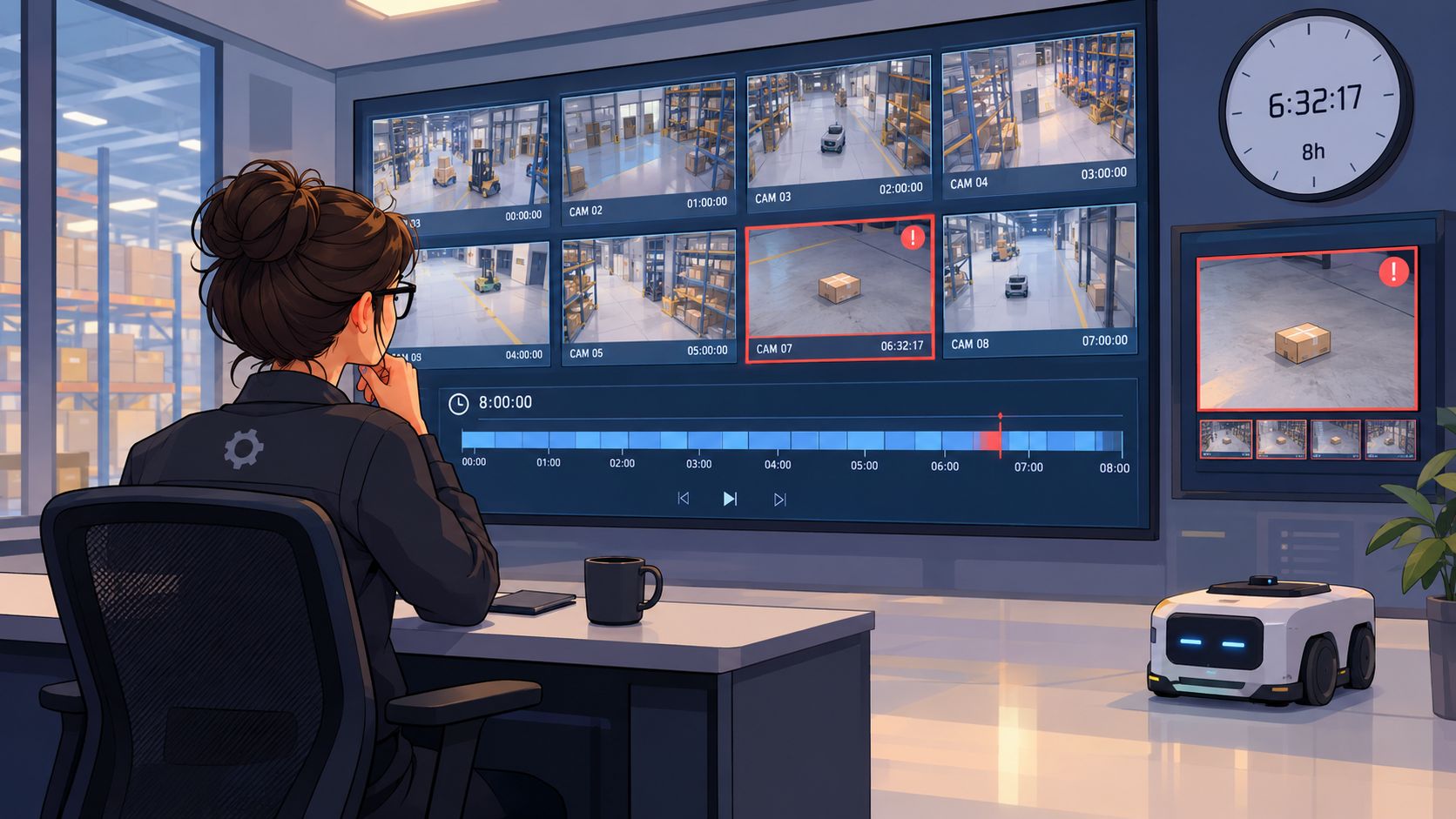
A robotics engineer has eight hours of warehouse footage and one urgent question: when exactly did the package fall from the conveyor? A smart-glasses user wants to recover a conversation from yesterday's meeting, but remembers only the topic and a few surrounding sounds. Neither problem looks like conventional text search. The useful evidence is distributed across video frames, audio timestamps, motion, and sensor streams, often on hardware with limited compute, battery, memory, and network access.
That's where the bi-encoder vs cross-encoder decision becomes operational rather than theoretical. Bi-encoders make broad retrieval practical. Cross-encoders improve the ordering of a shortlist by examining each query and candidate together. On physical AI systems, the right architecture must fit the device, the response budget, and the consequences of a missed moment.
Table of Contents
- The Retrieval Challenge in Physical AI Systems
- Why physical devices change the decision
- The real production question
- How Bi-Encoders and Cross-Encoders Work
- Data flow at a glance
- Latency vs Accuracy Trade-Offs in Production
- Side-by-side pipeline choices
- Multimodal Search Use Cases in Video and Audio
- Video for robotics
- Audio for robotics and smart glasses
- Where the two stages fit
- Implementation Tips for Edge and Mobile Deployments
- Keep the first pass close to the data
- Reduce the cross-encoder workload
- Protect synchronization
- Choosing the Right Architecture for Your Use Case
- Use a bi-encoder alone when speed dominates
- Add a cross-encoder when precision pays
- Account for physical-system pain points
- Beyond the Classic Two-Stage Pipeline
The Retrieval Challenge in Physical AI Systems
A warehouse robot can record continuous camera footage, microphone input, and movement data while it operates. Later, an engineer may search for “the moment the package slipped after the arm turned left.” The system must connect a natural-language intent with visual events, audio context, and time. A text-only comparison between embedding quality and ranking quality misses the central problem: the corpus is a living stream of multimodal observations, not a static folder of documents.
The same constraint appears in media workflows. An editor searching advertisement footage may need product placement, a clean logo view, a spoken phrase, or a specific gesture. Manually scrubbing long recordings is slow and unreliable, particularly when the relevant clue appears in one modality and the final confirmation appears in another.
Why physical devices change the decision
Cloud search can absorb more compute, but a mobile companion app, smart-glasses platform, IoT camera, or robotics computer often can't assume a constant connection. Battery draw, thermal limits, storage pressure, and intermittent bandwidth shape the retrieval design before model quality enters the discussion.
A bi-encoder processes the query and stored content separately, which makes broad candidate generation efficient. A cross-encoder examines the pair jointly, which gives it more room to distinguish subtle relevance, but makes exhaustive comparison impractical. In a continuous stream, that difference affects whether search feels immediate, whether an autonomous system can react in time, and whether historical memory remains available offline.
The real production question
The practical question isn't “which model wins?” It's which stage can afford to do what. A fast model should narrow a large multimodal history, while a more interactive model should spend its compute only where ranking precision matters.
Practical rule: Design retrieval around the device's worst operating conditions, not the strongest server in the lab.
How Bi-Encoders and Cross-Encoders Work
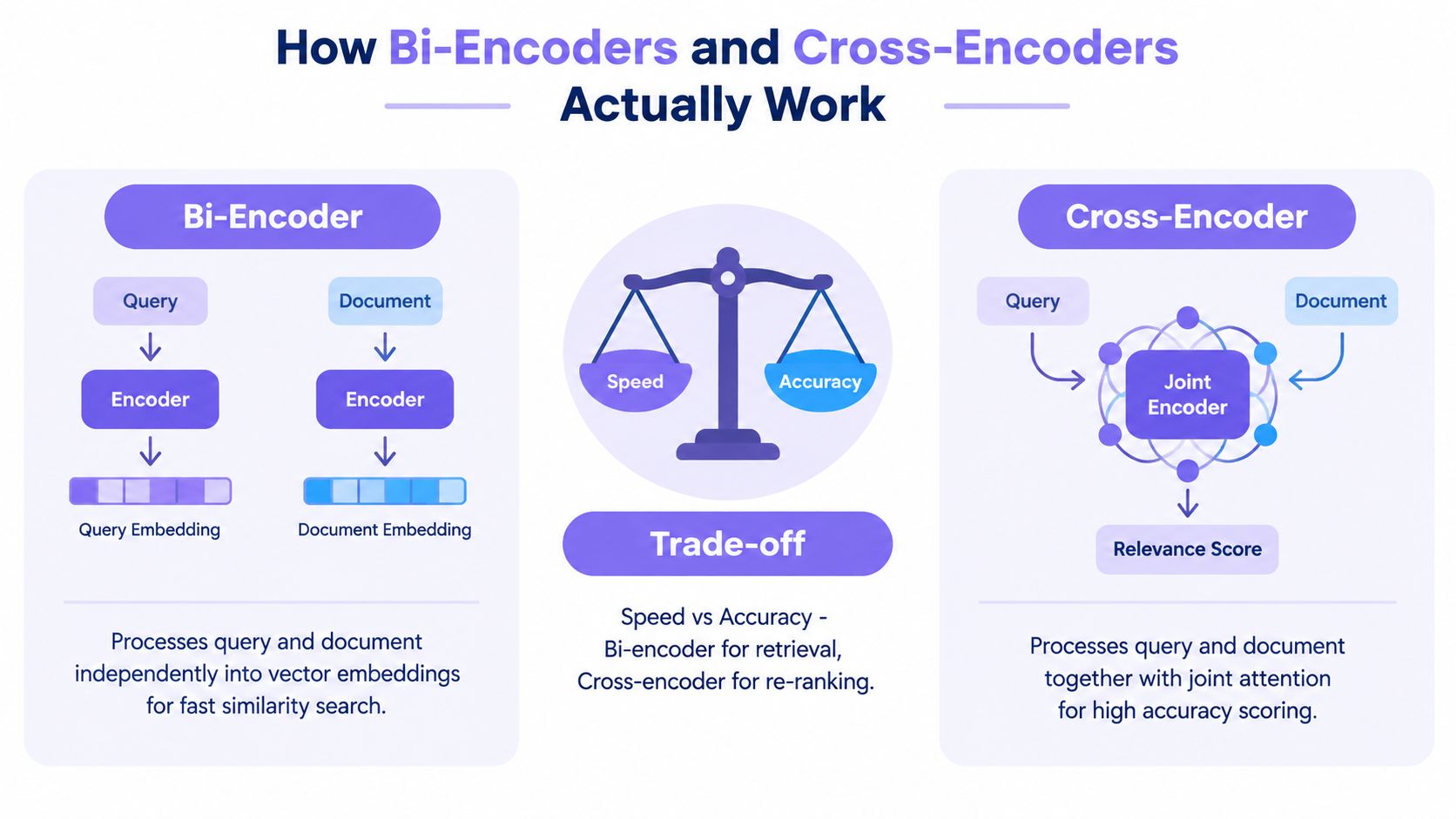
A bi-encoder, also called a dual encoder, sends the query and each stored item through separate encoders. Each produces a fixed-size vector. Stored vectors can be generated ahead of time and placed in an approximate nearest neighbor index, so a new query can locate candidates without reprocessing the corpus.
For continuous video, the stored representation may describe a frame group, video segment, audio interval, timestamped event, sensor window, or fused observation. The query receives its own representation, then the system compares it with indexed candidates. This separation makes the bi-encoder suitable for the first retrieval layer, including local search on mobile and robotics hardware.
A cross-encoder receives the query and one candidate together. Its transformer layers model relationships between both inputs directly, then produce a relevance score for that pair. This interaction helps distinguish whether a clip contains the requested action, whether speech at a specific timestamp matches the query, or whether sensor patterns support the same event rather than merely sharing related terms.
Data flow at a glance
| Architecture | Query handling | Candidate handling | Best role |
|---|---|---|---|
| Bi-encoder | Encodes the query independently | Uses stored vectors and ANN lookup | Broad first-stage retrieval |
| Cross-encoder | Reads query and candidate jointly | Scores each pair separately | Shortlist reranking |
| Two-stage pipeline | Retrieves, then compares | Applies expensive scoring selectively | Production search |
The engineering trade-off is substantial. One documented pattern retrieves the top 100 candidates in about 5 ms with a bi-encoder, then reranks them with a cross-encoder in about 50 ms, as described in this bi-encoder and cross-encoder engineering overview. Another source describes a bi-encoder searching a 1M-document corpus in about 5 ms through ANN lookup, while reranking 100 candidates takes roughly 100 ms with a cross-encoder, as reported in this cross-encoder reranking reference.
For edge systems, the distinction affects more than ranking quality. It determines whether the first pass can run locally, whether the reranking stage should move to an edge gateway, and whether video, audio timestamps, and sensor history can be searched without interrupting the device's primary workload. Cross-encoders gain accuracy from direct interaction, while every additional candidate adds another query-candidate evaluation.
Latency vs Accuracy Trade-Offs in Production
A bi-encoder is good at finding a broad neighborhood. It isn't always good at deciding which item deserves the first position. Cross-encoders often improve that final ordering because they examine the query and candidate jointly, especially after retrieval has reduced the search space.
The benchmark evidence supports that division. In a 2022 zero-shot retrieval study, the largest cross-encoder exceeded a state-of-the-art bi-encoder by more than 4 average points on BEIR, which spans 18 datasets across domains including web, biomedical, and financial search. The same BEIR study reported a sharper difference in biomedical retrieval, where direct top-10 retrieval produced MAP@10 of 0.1895, while retrieving 1,000 candidates and reranking them with a fine-tuned cross-encoder produced MAP@10 of 0.4337.
Those results don't mean every system should run a cross-encoder everywhere. In one comparison, applying a cross-encoder to 64 bi-encoder candidates took 260.84 ms, which illustrates why exhaustive cross-encoding is a poor fit for large corpora. A production deployment described by Roku Engineering also contrasts cross-encoder reranking at about 100–200 ms with LLM reranking at 2–3 seconds per query, a difference that matters for interactive video and audio search.
Side-by-side pipeline choices
| Pipeline Configuration | Latency | Accuracy Gain | Use Case Fit |
|---|---|---|---|
| Bi-encoder only | About 5 ms for broad retrieval in the documented pattern | Lower ranking precision than joint scoring | Large-scale recall, exploratory search, real-time first pass |
| Bi-encoder plus cross-encoder | About 100–800 ms in common hybrid configurations, depending on shortlist and batching | Roughly 5–13 nDCG points or 8–13 percentage points in answer accuracy, depending on dataset and reranker size | Precision-sensitive production retrieval |
| Cross-encoder over 64 candidates | 260.84 ms in one comparative analysis | Stronger ordering on the candidate pool | Evaluation, constrained reranking, not full-corpus search |
| LLM reranking | 2–3 seconds per query in one media-search deployment | Potentially rich reasoning, but too slow for many interactive experiences | Offline review or workflows with generous latency budgets |
The production reranking analysis describes a common pattern where ANN retrieval takes about 5 ms, then reranking the top 20–100 candidates adds roughly 100–200 ms. A separate hybrid retrieval guide places production hybrid latency around 100–800 ms, depending on shortlist size and batching.
The conclusion is architectural: recall and precision belong in different stages. A robotics system can use the fast layer during operation, then apply more expensive ranking during post-processing. An advertisement editor can accept additional ranking latency if it returns the exact clip instead of a merely similar shot.
Multimodal Search Use Cases in Video and Audio
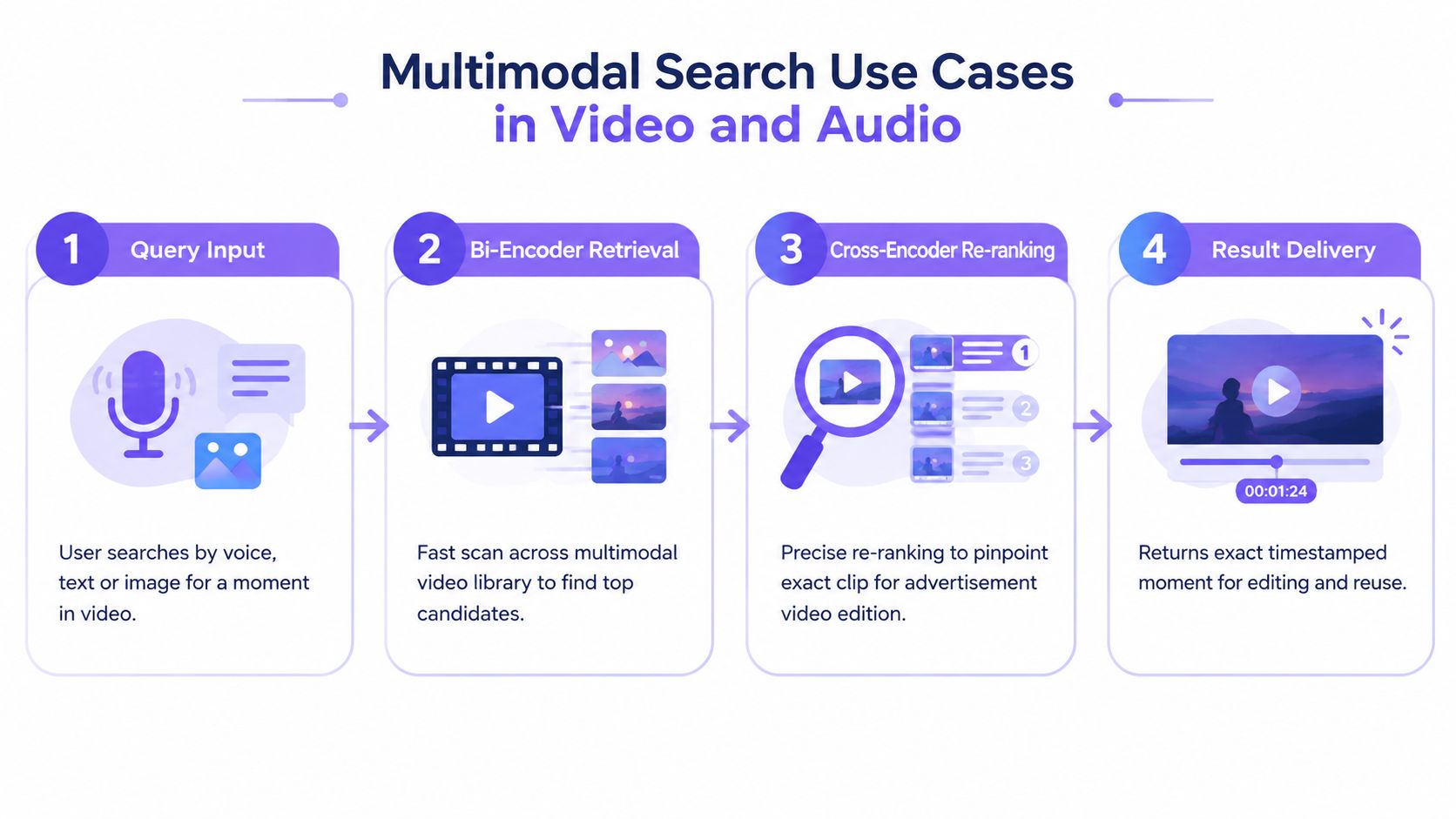
The useful unit in multimodal search isn't always a document. It may be a timestamped video segment, a short audio interval, a visual event, or a synchronized group of sensor observations. That changes how the bi-encoder and cross-encoder divide work.
Consider advertisement video editing. An editor asks for “the product held in the right hand while the presenter says the launch phrase.” A broad first pass can identify candidate moments from visual and audio representations. A cross-encoder or another joint reranker can then distinguish the clip where the hand position, product identity, and spoken context align.
Video for robotics
A robot's visual memory can support questions such as:
- Object recovery: Find the last segment where a pallet appeared near a loading bay.
- Event review: Locate the moment an arm moved around an obstruction.
- Scene recall: Retrieve prior views of a doorway, shelf, or charging area.
For real-time navigation, broad retrieval must remain lightweight. The robot can't pause its control loop while a large model compares every historical frame. A cross-modal reranker is more useful after the system has narrowed the memory to plausible scenes, particularly during diagnostics, route review, or object-specific recall.
Audio for robotics and smart glasses
Audio adds a temporal precision problem. A voice query may refer to a sentence, a warning tone, a machine sound, or a conversation that occurred alongside a visual event. Separate audio transcription and visual analysis can produce fragmented results, especially when their timestamps drift or their outputs don't share a common retrieval layer.
A unified search experience can connect “the alarm that sounded when the package fell” with both the sound interval and the corresponding camera moment. For smart glasses, a user might search for “the discussion about the supplier from yesterday's meeting,” then refine the result with a visual cue such as the person standing beside a presentation screen.
Where the two stages fit
A mobile app developer implementing natural-language video search usually benefits from broad multimodal candidate generation followed by precise timestamp ranking. A security integrator reviewing surveillance footage needs the same pattern for visual indicators, spoken phrases, and environmental sounds.
The first stage finds plausible moments. The second stage decides which moment actually answers the request.
Frame-level and audio-timestamp understanding reduce dependence on manual tags and static file descriptions. The architecture still needs a disciplined candidate budget, because continuous video and audio create far more possible matches than a conventional text collection.
Implementation Tips for Edge and Mobile Deployments
Edge retrieval fails in predictable ways. Large uploads exhaust memory, live streams create spikes, audio and video pipelines drift apart, and cloud calls become unreliable with poor connectivity. Choosing a bi-encoder or cross-encoder cannot solve those constraints alone. The surrounding pipeline must fit the hardware.
Keep the first pass close to the data
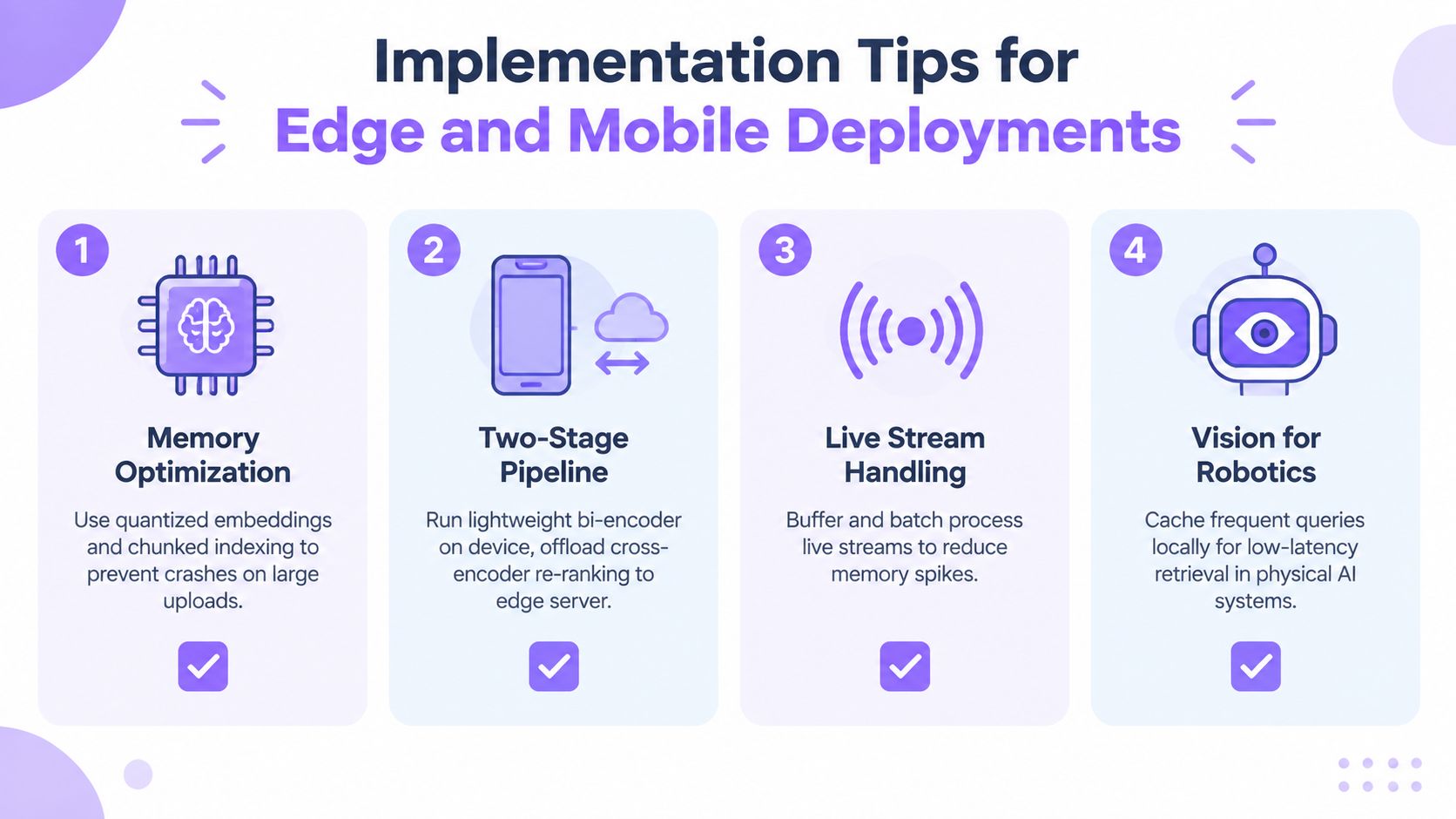
Localized indexing lets a device or nearby edge computer search without sending every request to the cloud. That supports offline operation and reduces dependence on network availability. It also limits how much raw video, audio, and sensor data crosses a constrained connection.
For mobile applications, use a memory-aware ingestion path instead of loading a large recording into one process. Chunked multipart uploads, signed streaming URLs, and bounded buffers keep capture, transfer, and playback from competing for the same memory pool. Android teams can integrate through a native Kotlin layer, while Flutter teams can expose the same behavior through a cross-platform wrapper.
Reduce the cross-encoder workload
Treat cross-encoder scoring as a scheduled compute task, not a service that runs indiscriminately on every incoming frame or sensor event. Trigger reranking after a stable query arrives, after a temporal window closes, or when a user requests more precise results. This avoids repeatedly scoring near-duplicate observations from continuous streams.
Use the device for the lightweight stage when its thermal and battery profile allows it. Offload expensive joint scoring to a nearby edge server when local hardware cannot meet the response budget. For robotics, cache frequent queries and recurring scene representations locally, so common recalls remain available when the network disappears. These deployment choices follow edge-focused reranking guidance.
Protect synchronization
Fragmented audio-visual analysis creates a subtle failure mode. The system may find the right sound but return the wrong frame, or identify the right frame while missing the nearby spoken explanation. A unified multimodal layer should preserve relationships among visual moments, audio timestamps, and environmental signals instead of treating each modality as a separate search product.
Cross-platform developer toolkits help standardize behavior across Android, Flutter, and embedded Linux environments. Test live capture, interrupted uploads, offline recall, thermal throttling, and long-running memory behavior on the actual mobile or robotics hardware, not only on a powerful development machine.
Choosing the Right Architecture for Your Use Case
The best answer to the bi-encoder vs cross-encoder question starts with the failure you can tolerate. If missing a candidate is unacceptable, prioritize broad first-stage recall. If the system returns only a few results and the top result must be exact, spend more compute on final ranking.
Use a bi-encoder alone when speed dominates
A bi-encoder is the natural choice for:
- Real-time robotics navigation, where the system must retrieve relevant visual memory without disrupting active behavior.
- Large media libraries, where a fast first pass matters more than perfect ordering.
- Exploratory browsing, where users can inspect several plausible clips.
- Offline or battery-sensitive devices, where repeated joint scoring would be too expensive.
This approach can still produce useful results, but it may rank visually or linguistically similar items above the moment that satisfies a nuanced request.
Add a cross-encoder when precision pays
Cross-encoder reranking makes more sense when the final ordering affects a human or operational decision. Advertisement video editing benefits when the returned timestamp must contain the exact product action and spoken context. Surveillance review benefits when an investigator needs a short, trustworthy shortlist instead of a broad set of similar-looking scenes.
The candidate count should follow the response budget. Retrieve more broadly when recall is weak, rerank fewer items when latency is strict, and move the expensive stage to an edge server when the device can't handle it locally. The two-stage pattern remains the practical default, but it isn't a fixed recipe.
Account for physical-system pain points
Physical AI teams often face three connected problems:
- Opaque physical data: Cameras, microphones, and sensors produce evidence that conventional applications can't query naturally.
- Disconnected device history: Each device may hold useful context that isn't available to the user or another machine.
- Bandwidth constraints: Cloud-only retrieval introduces delays and can fail when connectivity is poor.
A localized search layer addresses the operational shape of those problems, but architecture still depends on the job. Use the bi-encoder for immediate robotics recall. Add cross-encoder reranking for post-processing, investigation, and editing workflows where ranking precision justifies the extra wait.
Beyond the Classic Two-Stage Pipeline
Bi-encoder retrieval followed by cross-encoder reranking is a strong baseline, but it isn't automatically the cheapest design for every multimodal workload. A recent candidate-comparison study inserted a lightweight stage between retrieval and cross-encoding. On ZeSHEL, that design improved recall@64 by 6.7 points with less than 7% slowdown, according to the EMNLP 2024 candidate-comparison paper.
The idea matters because the cross-encoder's candidate burden is often the bottleneck. A comparator can inspect relationships among candidates and remove weaker options before the expensive joint scorer runs. That creates a possible three-stage architecture: broad bi-encoder retrieval, lightweight candidate comparison, then selective cross-encoder reranking.
Multimodal systems add another alternative. A 2026 multimodal reranking paper reported that a listwise reranker achieved competitive or superior quality while reducing LLM inference latency by up to an order of magnitude, as described in the multimodal reranking research. An ICLR 2026 proceedings paper also reflects active work on fused-modal ranking rather than simple pairwise text-document scoring.
The question for continuous video, audio timestamps, smart-glasses memory, and robotics logs is therefore more precise than “bi-encoder or cross-encoder?” Ask: what's the cheapest stage that can prune candidates before expensive cross-modal reasoning? Sometimes the answer is a conventional cross-encoder. Sometimes a comparator, late-interaction model, or listwise reranker better matches the device's latency, storage, and power constraints.
Teams deploying on edge hardware should benchmark the full pipeline, not isolated model scores. Measure candidate recall, ranking quality, synchronization, memory pressure, and behavior during degraded connectivity. The architecture that wins on a static text benchmark may not win when every query touches frames, audio segments, timestamps, and sensors.
V-Modal AI provides a Visual Memory Layer for Physical AI with multimodal video and audio search, continuous memory, and a search layer designed for robotics, mobile devices, and edge hardware. Visit V-Modal AI to evaluate natural-language retrieval across visual, auditory, and environmental streams and explore SDK options for integrating that memory into physical systems.