Understanding the JSON Media Type: A 2026 Guide
A robotics developer is wiring a camera, microphone, and environmental sensors into one edge system. The camera sends visual observations, the microphone captures sound events, and the robot needs a reliable way to associate both with the right moment. If one service declares JSON while another expects a different media type, the system can reject requests, misread metadata, or lose the relationship between an image, an audio event, and an action.
That's where the JSON media type, application/json, becomes more than a familiar HTTP header. It provides a clear contract for structured metadata moving between video, audio, robotics, and multimodal search services. Used carefully, it helps teams describe media segments, timestamps, sensor context, search results, and processing status without forcing every system to understand the underlying media in the same way.
Common pain points include:
- Fragmented content negotiation: Clients and servers disagree about which representation is acceptable.
- Audio and video synchronization problems: Separate streams carry unclear or inconsistent timing metadata.
- Interoperability gaps: Edge devices, mobile applications, and cloud services interpret payloads differently.
- Unclear domain meaning: Generic JSON can carry data, but it doesn't automatically explain whether a field describes a robot state, an advertisement scene, or a sound event.
- Payload confusion: A request may contain valid JSON but use a media type the endpoint doesn't support.
The practical benefit is straightforward. A well-selected media type lets an advertisement editor retrieve scenes by visual context, a robot connect camera observations to motion decisions, and an audio pipeline identify sounds in a continuous stream. The media type doesn't perform the search itself, and it doesn't replace video or audio formats. It tells connected systems how to interpret the structured information surrounding those streams.
Table of Contents
- Introduction to JSON Media Type
- A familiar integration failure
- History and Evolution of JSON Media Type
- A sequence of formal milestones
- Why the timeline matters for Physical AI
- Understanding Media Type Variants and Suffixes
- Start with the core declaration
- Understand what +json adds
- Use Cases in Physical AI and Multimodal Search
- Advertisement video edition
- Vision for robotics
- Audio for robotics
- Best Practices for Video Audio and Metadata Payloads
- Keep the representation unambiguous
- Preserve time relationships
- Separate large media from compact metadata
- Design for device diversity
- Keep metadata useful for retrieval
- Conclusion and Next Steps
Introduction to JSON Media Type
A media type identifies the format and intended processing model of content exchanged between systems. For JSON data, the official registration is application/json, which is used when the body contains JSON structured according to the JSON data model. The payload might describe a video segment, a detected object, a sound event, or the current state of a robot.
Consider a small multimodal record:
{
  "segment": {
    "start": "00:02:14.500",
    "end": "00:02:18.200"
  },
  "video": {
    "objects": ["robotic arm", "package"]
  },
  "audio": {
    "events": ["motor sound", "impact"]
  }
}
The JSON doesn't contain the video or audio itself. It carries structured context that another service can use to locate, filter, or describe the relevant media. That distinction matters in edge robotics, where large media files may remain on a device while compact metadata travels between components.
A familiar integration failure
Suppose a robotics service sends the object above but labels the request as text/plain. The body may still look correct to a human, yet the receiving endpoint can refuse it because the declared media type doesn't match its supported input. The reverse problem also occurs when a service expects JSON but receives a binary media upload under an inappropriate declaration.
A developer should therefore treat the media type as part of the API contract, not as decorative metadata. The body, the Content-Type header, the endpoint documentation, and the receiving parser need to agree.
Practical rule: Use
application/jsonfor a JSON document, and use a media type that accurately describes binary video or audio when you transmit the media itself.
This approach supports three related workflows. Advertisement video edition can use JSON to describe scenes, transitions, products, and sound cues. Vision for robotics can use it to represent observations and environment context. Audio for robotics can use it to associate machine sounds, speech, alarms, or impacts with a time range.
The key idea is simple: JSON is the structured envelope around multimodal information. Selecting the correct JSON media type helps every participant understand that envelope consistently.
History and Evolution of JSON Media Type
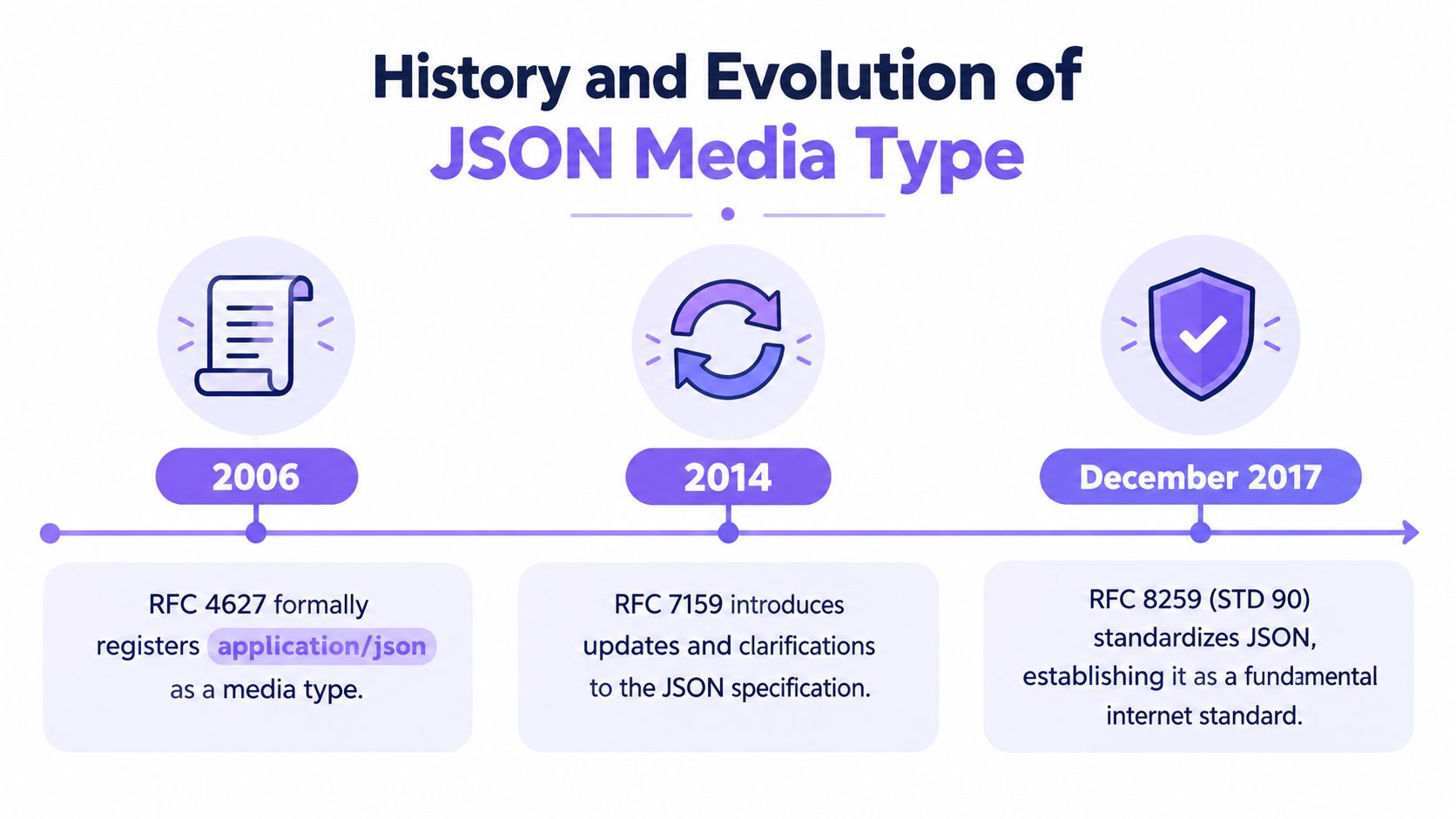
The history of application/json explains why developers can rely on it across APIs, messaging systems, and data exchange workflows. The media type was formally registered in RFC 4627 in July 2006, then updated through later specifications before reaching its current standardized form in RFC 8259. The RFC 8259 specification records that RFC 8259 obsoleted RFC 7159, which had itself obsoleted RFC 4627.
A sequence of formal milestones
The path from registration to Internet Standard status took 11 years, from the initial media-type registration in 2006 to RFC 8259 in December 2017. That timeline reflects iterative clarification rather than a single declaration that settled every implementation question.
- July 2006: RFC 4627 formally registered
application/json. - 2013: JSON was standardized as ECMA-404 in October.
- 2015: RFC 7159 updated the earlier JSON specification and obsoleted RFC 4627.
- 2017: JSON was standardized as ISO/IEC 21778:2017, while RFC 8259 became the current Internet Standard, STD 90, on December 13.
- December 2017: RFC 8259 obsoleted RFC 7159 and incorporated resolutions to earlier errata.
The Library of Congress JSON overview notes that RFC 8259 addressed multiple errata from prior RFCs, including two associated with RFC 4627 and four associated with RFC 7159. Those corrections show how a widely implemented format matures through review, clarification, and alignment across standards communities.
Why the timeline matters for Physical AI
A robot rarely operates inside one software ecosystem. Its sensors, edge computer, mobile companion app, storage layer, and remote services may come from different vendors. A stable JSON media type gives those systems a common way to exchange structured observations without requiring identical internal implementations.
That stability supports practical tasks such as API messaging, media indexing, robot telemetry, and search-result exchange. JSON didn't become useful because one document solved every problem. It became dependable because formal specifications and implementation experience gradually reduced ambiguity.
Understanding Media Type Variants and Suffixes
The core type application/json is only the starting point. Developers also need to understand parameters, profiles, and the +json structured syntax suffix. These concepts solve different problems, and confusing them can create interoperability errors.
A parameter adds information to a media-type declaration. A profile can point consumers toward a particular data model or schema interpretation. A structured syntax suffix signals that the representation follows the processing rules of a known underlying format.
Start with the core declaration
For an ordinary JSON request, the sender can declare:
Content-Type: application/json
IANA's official application/json registration lists no required or optional parameters and notes that no charset parameter is defined for this registration. The registration also describes the encoding considerations as binary. Under the broader RFC 8259 model, interoperability is highest when JSON is transmitted as UTF-8.
That doesn't mean every system will reject a charset hint. It means producers shouldn't depend on charset negotiation as the mechanism that makes JSON understandable. Consumers should follow the endpoint contract and parse the declared representation consistently.
Understand what +json adds
The +json suffix communicates that a specialized media type follows JSON semantics. A generic JSON parser can process the representation, while application-specific code still validates the fields and meaning required by that domain.
The RFC 6839 structured syntax suffix guidance explains why types such as application/ld+json, application/problem+json, and application/schema+json can inherit JSON processing rules. The suffix doesn't make every domain payload interchangeable. It provides a shared syntactic foundation.
| Variant | Syntax | Use Case |
|---|---|---|
| Core JSON | application/json |
General API responses, metadata, search requests, and structured robot observations |
| Linked-data JSON | application/ld+json |
JSON representations that carry linked-data meaning |
| Problem JSON | application/problem+json |
Structured error details returned by an API |
| Schema JSON | application/schema+json |
JSON content associated with schema-oriented validation or description |
| Profiled JSON | application/json with a documented profile |
A JSON representation whose domain interpretation follows an identified profile |
A useful mental model is a shipping label. application/json says what kind of package is inside. A suffix or profile adds information about how a particular service should interpret the contents. The parser can open the package, but the application still needs domain rules to decide whether a field is valid for a robot, a video segment, or an audio event.
Use Cases in Physical AI and Multimodal Search
Physical AI connects software decisions to the physical world. A video search system may identify a package entering a scene, a robot may need to recognize an obstacle, and an audio pipeline may flag an unusual impact. In each case, JSON can carry the structured description that connects raw media to an action or retrieval request.
The wider Physical AI stack is already layered rather than concentrated in one model. A 2026 industry analysis mapped 1,030 companies across 15 company roles and 19 value-chain layers, with perception and sensing, systems integration, robot hardware, and cloud, communications, and data infrastructure among the largest layers, as described in the Physical AI industry analysis. That structure supports treating search as a dedicated layer, not merely as a feature inside a generic media tool.
Advertisement video edition
An editor working on an advertisement may need to find moments showing a product, a human reaction, a particular environment, or a clean audio cue. JSON can describe each candidate segment with time ranges, visual labels, audio events, and editorial status.
The search service can return structured results that an editing application understands. The application can then place the selected clip on a timeline without forcing the editor to scrub through an entire recording manually. JSON is useful here because editorial metadata changes frequently even when the underlying media file remains unchanged.
Vision for robotics
A robot's vision workflow can represent observations such as detected objects, approximate locations, scene conditions, and confidence information. The exact internal search and analysis process depends on the product, but the exchanged result can remain a readable JSON document.
For edge systems, separating media from metadata is especially valuable. A camera may retain local footage while another component receives only the structured observation needed for navigation, review, or later retrieval.
Audio for robotics
Audio adds another sensing channel. A robot may need to associate a motor sound, alarm, voice command, or impact with what its camera saw at approximately the same time. JSON can carry event labels and timestamps alongside visual metadata, giving applications one representation for multimodal retrieval.
Recent research describes practical systems that combine video, audio, and metadata in one retrieval system, including audiovisual collection search and audio-driven omni-modal deep search, as summarized in recent industrial AI research coverage. The important point is not that JSON performs the retrieval. It provides a consistent structure for the results, context, and cross-modal relationships that retrieval applications need.
Best Practices for Video Audio and Metadata Payloads
Good media typing prevents avoidable confusion, but effective payload design requires more than choosing application/json. Teams need consistent encoding, explicit timing, clear separation between media and metadata, and a versioning strategy that works across mobile devices, IoT cameras, smart glasses, and robots.
Keep the representation unambiguous
Use application/json when the request body is a JSON document. If a request contains a binary video or audio object, declare that representation according to the endpoint's contract rather than disguising it as JSON. A JSON companion document can describe the upload, but it isn't the same thing as the media payload.
UTF-8 is the practical choice for JSON interoperability. It supports ordinary text, multilingual labels, device names, and transcribed speech without requiring consumers to infer an alternate character encoding.
Encoding rule: Make the declared representation, actual body, and parser assumptions agree. A valid JSON document under the wrong declaration can still fail at the API boundary.
Use a +json type when the domain needs a specialized media type with JSON processing semantics. For example, an application may define a domain-specific representation for robot observations or structured search results, then document the validation rules separately. The suffix helps generic tooling recognize the syntax, while the application remains responsible for interpreting domain fields.
Preserve time relationships
Multimodal systems depend on timing. A video segment, audio event, and sensor observation should use a documented time convention and consistent units. Avoid ambiguous fields such as time when the consumer can't tell whether the value is a wall-clock timestamp, a stream offset, or a device-relative counter.
A clearer structure might distinguish:
- Stream identity: Which camera, microphone, or sensor produced the observation.
- Start and end: The boundaries of the relevant media segment.
- Event time: When the sound, object, or state change occurred.
- Clock context: Whether the value comes from device time or a shared timeline.
- Relationship: Whether the audio event overlaps the video segment or merely follows it.
This isn't a recommendation to expose the internal mechanics of a search system. It's a payload-design principle. Consumers need enough context to place returned results in the right moment without guessing.
Separate large media from compact metadata
Live video and audio can overwhelm a device or connection if every component copies the complete stream. A cleaner design keeps the media transfer path distinct from the JSON control and metadata path. The JSON can identify a segment, upload part, signed resource, or processing state while the binary content follows the media endpoint's rules.
Chunked multipart uploads can help mobile and edge applications manage interrupted transfers, but the exact multipart contract must come from the receiving API. The JSON part should describe the upload or segment clearly, while the binary part should retain its proper representation.
Design for device diversity
Mobile devices, smart glasses, IoT cameras, and robots don't share identical memory, connectivity, or processor limits. Keep metadata fields purposeful, avoid duplicating large text or media content, and allow consumers to ignore fields they don't understand when the contract permits it.
Backward compatibility depends on disciplined evolution:
- Add rather than implicitly repurpose: A new field should carry new meaning instead of changing an existing field's definition.
- Document optionality: Consumers need to know whether a missing field is acceptable.
- Validate at boundaries: Check required fields before a payload reaches a downstream robotics or editing component.
- Test representative streams: Include video-only, audio-only, and combined cases, along with incomplete or delayed metadata.
- Keep examples executable: A working request is easier to maintain than an isolated prose example.
Content negotiation also deserves care. A client can use Accept to indicate the response representations it can process, while the server uses Content-Type to describe what it sends. Those headers serve different roles. Confusing them can lead to a request that looks reasonable but fails before application logic runs.
Keep metadata useful for retrieval
For video search, describe the information users will query, such as a product appearance, a hand movement, a machine state, or a distinctive sound. For robotics, include the context needed to connect perception to a physical event without turning every payload into an opaque dump of internal data.
A strong JSON contract gives each field one clear purpose. It doesn't reveal proprietary search internals, and it doesn't require every consumer to understand how indexing or ranking works. It makes the exchange between media systems predictable.
Conclusion and Next Steps
The JSON media type is a small protocol decision with broad consequences. application/json provides a stable foundation for structured metadata, while UTF-8 practices, documented profiles, and +json suffixes help specialized applications support multimodal video, audio, and Physical AI workflows. Clear declarations reduce parsing surprises and make it easier for edge devices, robots, mobile applications, and editing tools to exchange context. Start by auditing the media type, timestamps, and validation rules in one real workflow, then extend the same discipline across your connected systems.
V-Modal AI offers a Visual Memory Layer for Physical AI, with multimodal video and audio search, robotics edge memory, natural-language video queries, and Android and Flutter SDK options for connected devices. Visit V-Modal AI to review its public repositories and evaluate how structured media metadata can fit into your robotics or edge-search workflow.