Best Digital Asset Management: 7 Platforms for Media
Teams managing long-form video, audio, sensor streams, and brand files face a discovery problem that conventional image-first DAM systems can't always solve. Manual scrubbing, fragmented audio and visual analysis, inconsistent metadata, rights restrictions, bandwidth limits, unclear pricing, and disconnected workflows all slow down the search for one exact moment. That moment might be a spoken phrase in an advertisement edit, a visual event in surveillance footage, or an audio cue captured by a robot.
The digital asset management market is forecast to grow from USD 6.23 billion in 2025 to USD 14.51 billion by 2031, with a 15.4% CAGR, according to MarketsandMarkets' digital asset management forecast. Yet the best digital asset management platform depends less on market momentum than on the search problem you need to solve. This comparison covers V-Modal AI, Bynder, Brandfolder, Cloudinary Assets, Adobe Experience Manager Assets, Acquia DAM, and MediaValet, comparing governance, video and audio discovery, integrations, developer access, workflow execution, pricing transparency, and emerging Physical AI requirements.
Table of Contents
- 1. V-Modal AI
- Why developers may choose it
- 2. Bynder
- Where it fits in media workflows
- 3. Brandfolder by Smartsheet
- The operational trade-off
- 4. Cloudinary Assets
- Why commerce and engineering teams choose it
- 5. Adobe Experience Manager Assets
- The ecosystem decision
- 6. Acquia DAM
- Metadata is the buying question
- 7. MediaValet
- Where it outperforms a general-purpose DAM
- Top 7 Digital Asset Management Platforms Comparison
- Choose the DAM That Matches the Search Problem
1. V-Modal AI
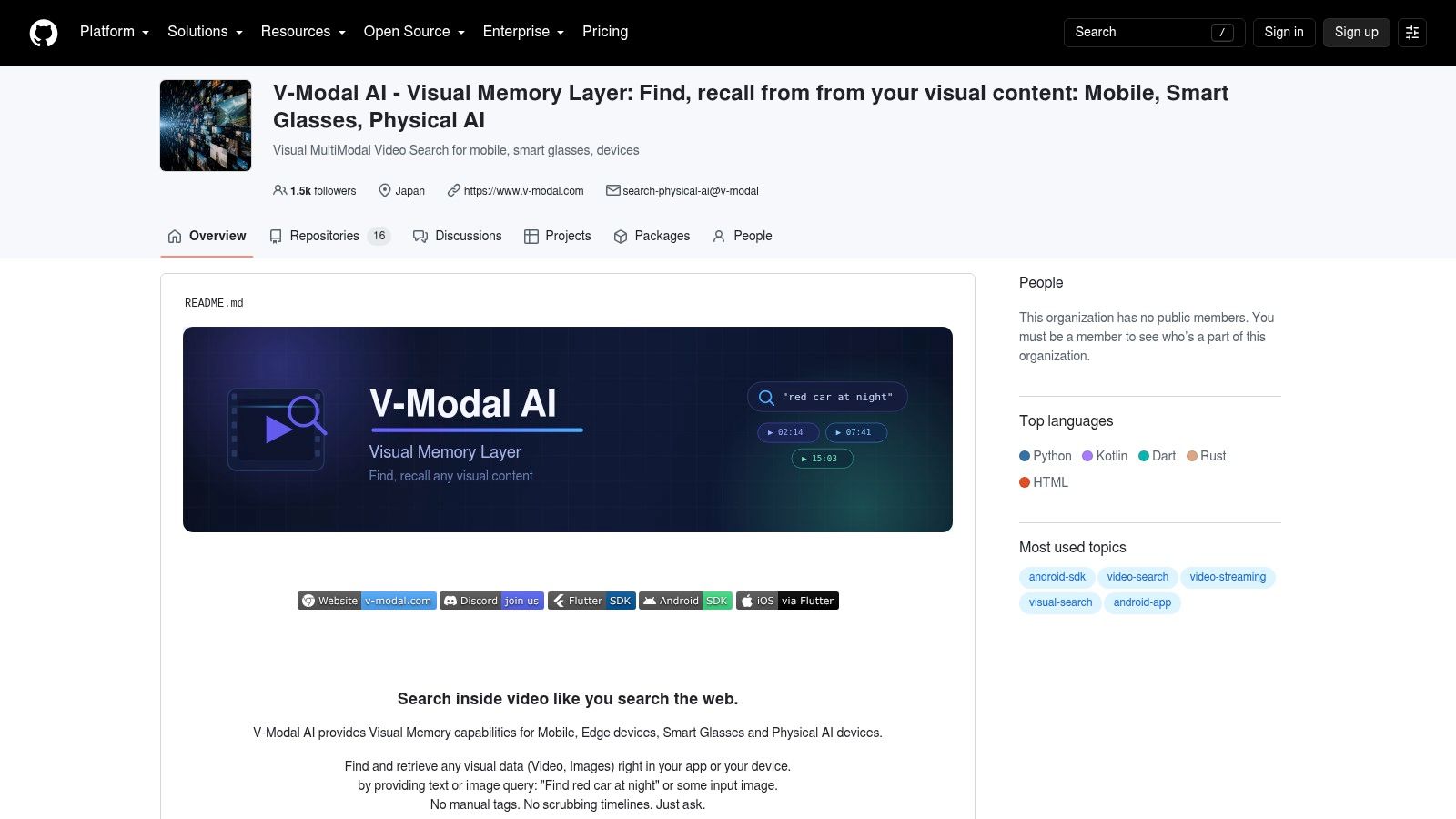
V-Modal AI isn't a conventional enterprise repository competing primarily on brand portals, approval chains, or centralized file administration. It acts as a Visual Memory Layer and Search Layer for Physical AI, built for teams that need to retrieve moments from video, audio, spatial sensor streams, and contextual inputs on mobile devices, smart glasses, robots, IoT cameras, and edge systems.
That distinction matters for teams building systems that continuously observe the physical world. A conventional DAM can help a marketing department find an approved campaign video. V-Modal AI is designed to help a robot, mobile application, or smart-glasses experience recall what it saw and heard, using natural-language, image, voice, or environmental queries. Its multimodal approach supports use cases such as text-to-video, image-to-video, voice-to-audio, and environment-based retrieval, returning relevant time segments rather than forcing users to depend on filenames or static tags.
Research from Princeton provides a useful indication of why combined modalities matter. Its multimodal data-search paper reports average precision reaching 0.79 when audio and visual features are combined in the Princeton technical report. IBM's multimodal video-search research also describes late fusion between speech-based and visual retrieval for broadcast-video search. For advertisement video editing, that means a team can search for a spoken phrase, a product shot, a logo, or a scene without treating audio and video as unrelated archives.
Why developers may choose it
V-Modal AI is strongest when the search layer must sit close to hardware or inside a mobile product. Native Android SDK support in Kotlin, a Flutter SDK, public repositories, example code, signed streaming URLs, and chunked multipart uploads reduce the integration burden for teams handling large uploads, live streams, or unstable mobile connections.
The platform's edge orientation also addresses a problem conventional cloud DAMs don't fully solve. The World Economic Forum's Physical AI technology-stack report separates robotic hardware, edge hardware, operating systems, simulation and training tools, and application interfaces. That stack highlights why Physical AI products need low-latency processing, hardware interoperability, and memory close to the device, not only a remote content repository.
Best fit: Choose V-Modal AI when the core question is “what happened in this environment, and when?” rather than “which approved file belongs to this campaign?”
V-Modal AI suits robotics teams working on vision for robotics, where a system must retrieve a visual state or event from operational history. It also supports audio for robotics, where impact sounds, spoken instructions, alarms, or ambient signals may provide context that camera frames alone miss. The open-source audiovisual search engine WISE illustrates the direction of practical search across visual, audio, and metadata streams in one workflow.
The trade-off is procurement and platform maturity. No public pricing is listed, so teams must contact V-Modal AI for API or enterprise terms through V-Modal AI's contact route. Web, certain smart-glass targets, and some embedded toolkits are still maturing, while heavier on-device workloads require careful planning around compute, storage, and retention. V-Modal AI is therefore best evaluated as a complementary search layer for Physical AI, or as a specialized multimodal retrieval service, rather than as a complete replacement for every governance-heavy DAM.
2. Bynder
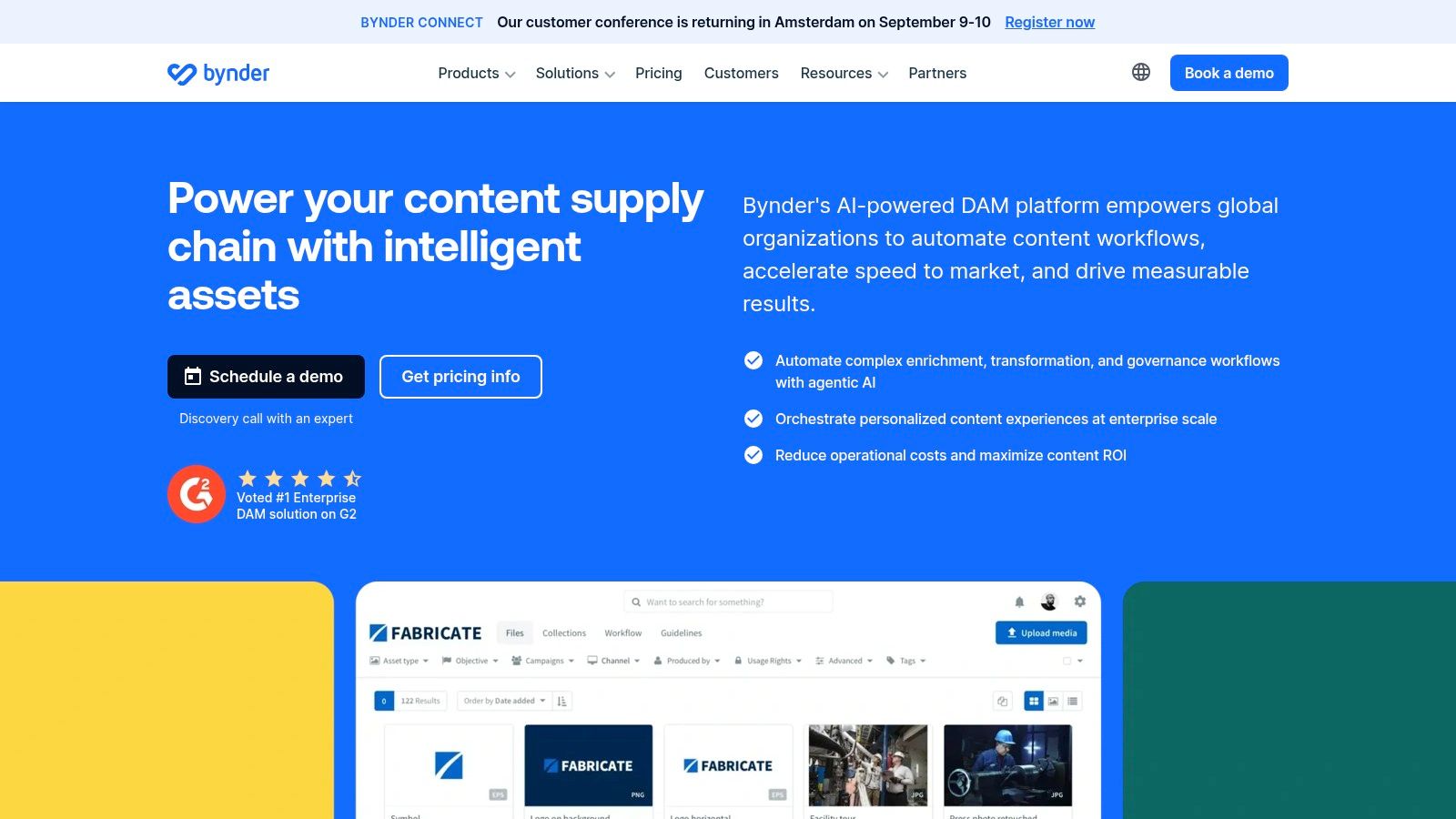
Bynder is the strongest candidate here for organizations whose primary challenge is brand control across complex creative operations. Its value isn't that it stores images and videos. It gives brand, marketing, and creative teams a structured environment for metadata, permissions, templates, brand guidelines, analytics, and controlled distribution.
Bynder's AI Search supports custom vocabulary management and Smartfilters, which is important when generic tagging doesn't match an organization's internal language. A global brand may need to distinguish regional campaigns, product families, approved claims, usage rights, and channel-specific variants. A controlled vocabulary makes those distinctions more reliable than asking every contributor to invent their own tags.
Where it fits in media workflows
Bynder also connects with creative and video workflows, including Frame.io through its i‑Hub integration, alongside export automation. That makes it useful when editors need to move approved assets between a governed library and production tools. For advertisement video editing, Bynder can help teams locate the correct campaign source, logo treatment, product variation, or approved brand element before distribution.
The limitation is that brand DAM search and multimodal Physical AI memory are different categories. Bynder is oriented toward managed enterprise assets and controlled reuse. It isn't positioned here as an edge memory layer for robots, smart glasses, or continuous sensor streams. If the search target is an exact moment inside an ambient recording, buyers should test whether the platform meets that need or pair it with a specialized multimodal Search Layer.
Bynder's release cadence and enterprise integration focus are advantages for organizations that need ongoing platform development and governance depth. The trade-off is commercial flexibility. Pricing is custom, and some buyers report higher quotes, so procurement teams should request a full cost model covering storage, users, integrations, implementation, and future media growth rather than comparing license figures alone.
3. Brandfolder by Smartsheet
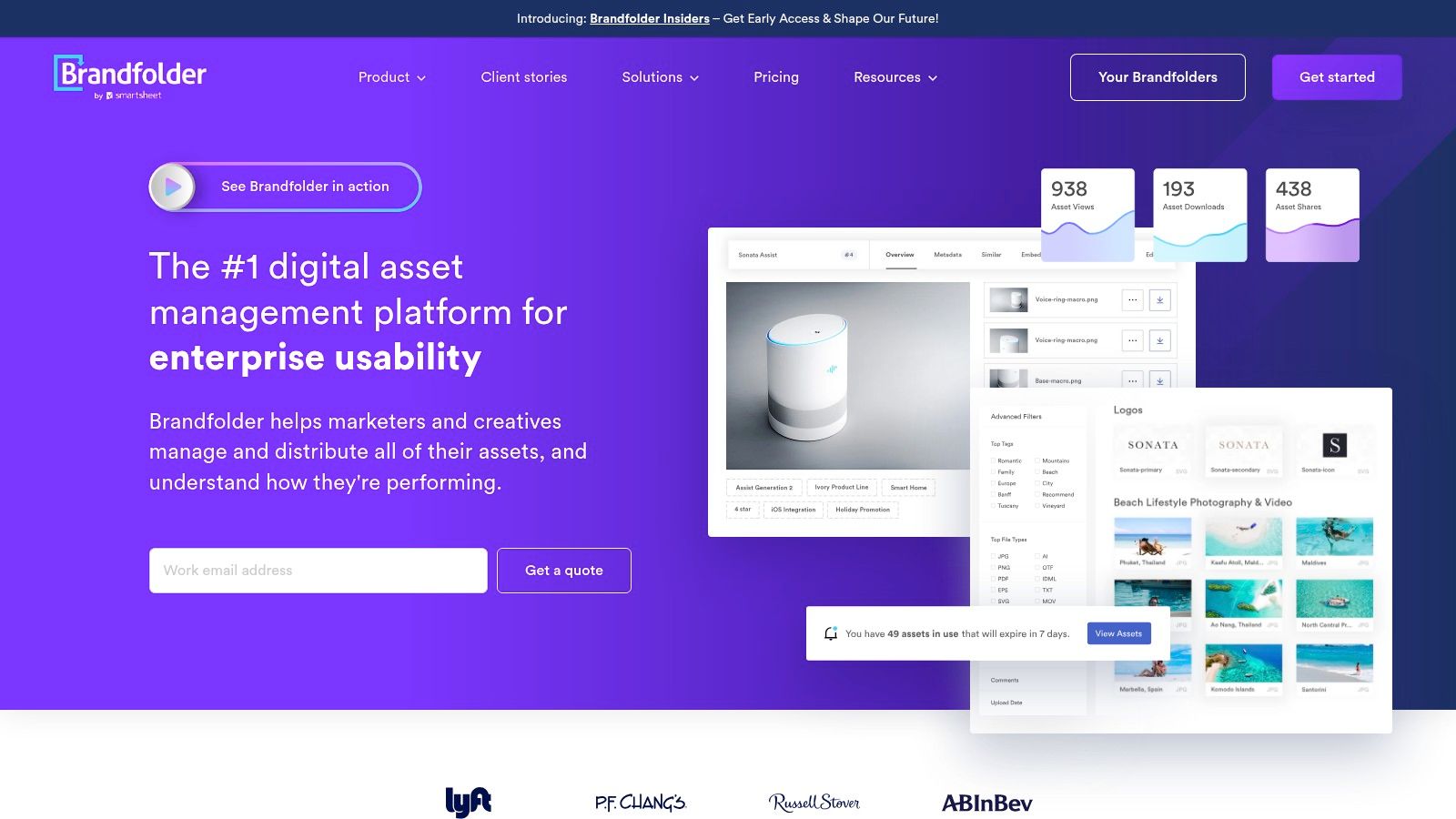
Brandfolder by Smartsheet takes a more approachable route to scalable DAM. Its interface is designed to reduce training friction, while labels, custom fields, asset organization, sharing, and Adobe Creative Cloud integrations give marketing and creative teams a practical way to manage a large media library.
Its Brand Intelligence capabilities support auto-tagging, content insights, and analytics. That can help a team move from an unstructured folder collection toward a searchable library, especially when high-resolution video and campaign materials arrive from many contributors. Brandfolder also supports broad sharing, including unlimited guest users, which is useful when agencies, distributors, regional teams, or external partners need access without becoming full internal users.
The operational trade-off
Brandfolder becomes more compelling when the organization already uses Smartsheet for work management. Intake, review, assignment, approval, and distribution can sit closer together, reducing the handoffs that often cause duplicate uploads or unclear ownership. A campaign manager might request an asset, route it for review, and distribute the approved version from one connected operational environment.
That doesn't make Brandfolder a dedicated multimodal search engine. Its strengths sit in organization, brand sharing, and workflow coordination. Teams working on advertisement video editing should test whether search can identify the precise spoken or visual moment required by an editor, rather than only locating the correct video file or metadata record.
A user-friendly DAM still depends on a disciplined metadata model. If labels, custom fields, rights information, and naming conventions remain inconsistent, a smoother interface only makes an inconsistent library easier to browse.
Brandfolder is a sensible choice for teams prioritizing adoption and collaboration over edge deployment or deep developer control. Pricing is custom and oriented toward enterprise buyers, so buyers should clarify how storage, guests, video processing, integrations, support, and implementation affect the final agreement. It may be less suitable for a robotics developer who needs a lightweight SDK, on-device recall, or continuous retrieval from device history.
4. Cloudinary Assets
Cloudinary Assets is the clearest fit when DAM requirements are inseparable from product media delivery and application development. It combines a central media library with APIs, SDKs, transformations, optimization, CDN delivery, and AI capabilities for images and video. That makes it less like a standalone brand archive and more like a media infrastructure layer for websites, commerce experiences, mobile applications, and engineering teams.
A product team might use Cloudinary to manage product imagery and video, transform assets for different contexts, and deliver them through an application without creating separate manual export workflows. Faceted search, tags, attributes, and API access support the organizational side, while on-the-fly transformations address the delivery side.
Why commerce and engineering teams choose it
Cloudinary's developer ecosystem and documentation are major advantages for teams that want media capabilities embedded directly into an existing stack. Its plan structure includes self-serve options, which gives buyers a clearer starting point than quote-only enterprise DAMs. The credits model covers storage, processing, and delivery, with optional external storage backup.
That model also creates the main commercial risk. Heavy video bandwidth and repeated transformations can increase costs, and an enterprise DAM license obtained through marketplaces may be expensive. Procurement should model actual delivery and processing patterns rather than treating storage as the only cost driver.
Cloudinary can support video-centric commerce and content operations, but its primary distinction is not Physical AI memory. A robotics team needing local recall across camera, microphone, and environmental streams may still need a specialized Search Layer such as V-Modal AI. Likewise, a security integrator searching for an event across long footage should validate timestamp precision, modality fusion, device-side operation, and network behavior directly.
For teams building digital experiences, Cloudinary is often the practical choice when APIs, transformations, delivery, and product media pipelines dominate. It becomes less compelling when governance teams need a structured enterprise operating model or when developers need continuous, edge-resident memory rather than application-facing media infrastructure.
5. Adobe Experience Manager Assets
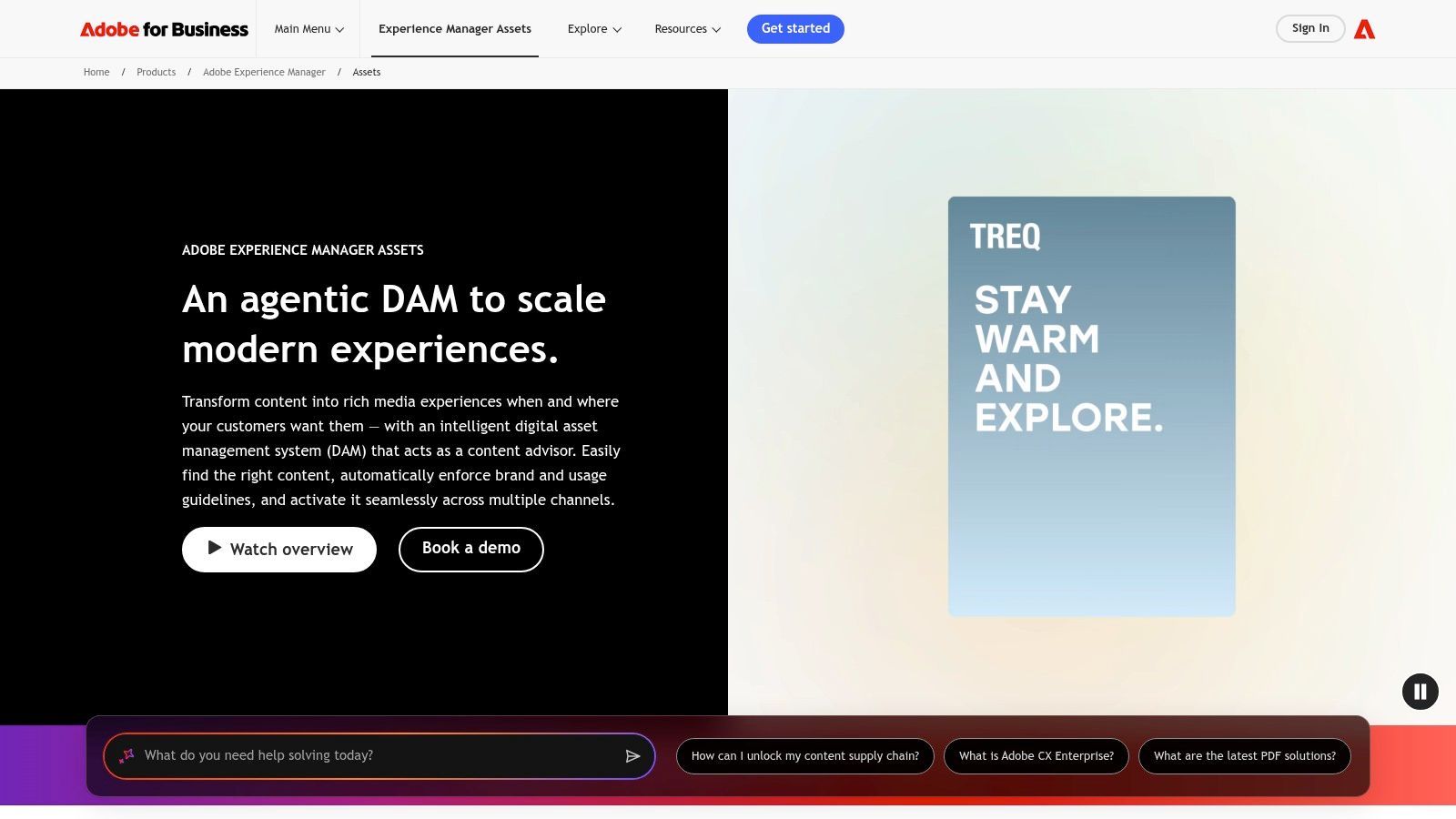
Adobe Experience Manager Assets is built for enterprises already committed to Adobe Creative Cloud and Adobe's broader marketing, content, and commerce ecosystem. Its advantage comes from depth across the asset lifecycle, not from being the simplest tool to deploy.
AEM Assets supports AI-powered tagging, cropping, alt-text generation, and visual search. Its cloud service also supports bulk asset import from major cloud environments, while Content Hub and generative AI connections help teams create variations and distribute content across channels. For large organizations, that combination can connect creation, governance, adaptation, and activation more tightly than a separate repository would.
The ecosystem decision
AEM is particularly strong when a company already relies on Adobe workflows and wants asset governance close to its experience-management stack. Creative teams can work within familiar tools, while administrators manage metadata, permissions, workflows, and distribution rules. Marketing teams can then activate approved assets in connected commerce or experience channels.
The downside is implementation complexity. Quote-only pricing makes early comparison harder, and administrators may face a steeper learning and ownership curve. AEM can be excessive for a smaller team that mainly needs simple sharing, fast search, or a developer-accessible video library.
AEM's visual search and AI-assisted metadata can improve discovery, but buyers with long-form audio and video should run their own tests. Search quality depends on whether the system identifies the moments users need, how well metadata stays governed, and whether rights and expiration rules follow an asset through downstream channels.
Adobe's platform is a strong choice for enterprise governance and ecosystem alignment. It isn't automatically the best digital asset management option for robotics or smart glasses. Those products need edge hardware, offline-capable behavior, and device-local memory, concerns that sit outside the conventional Adobe DAM decision.
6. Acquia DAM
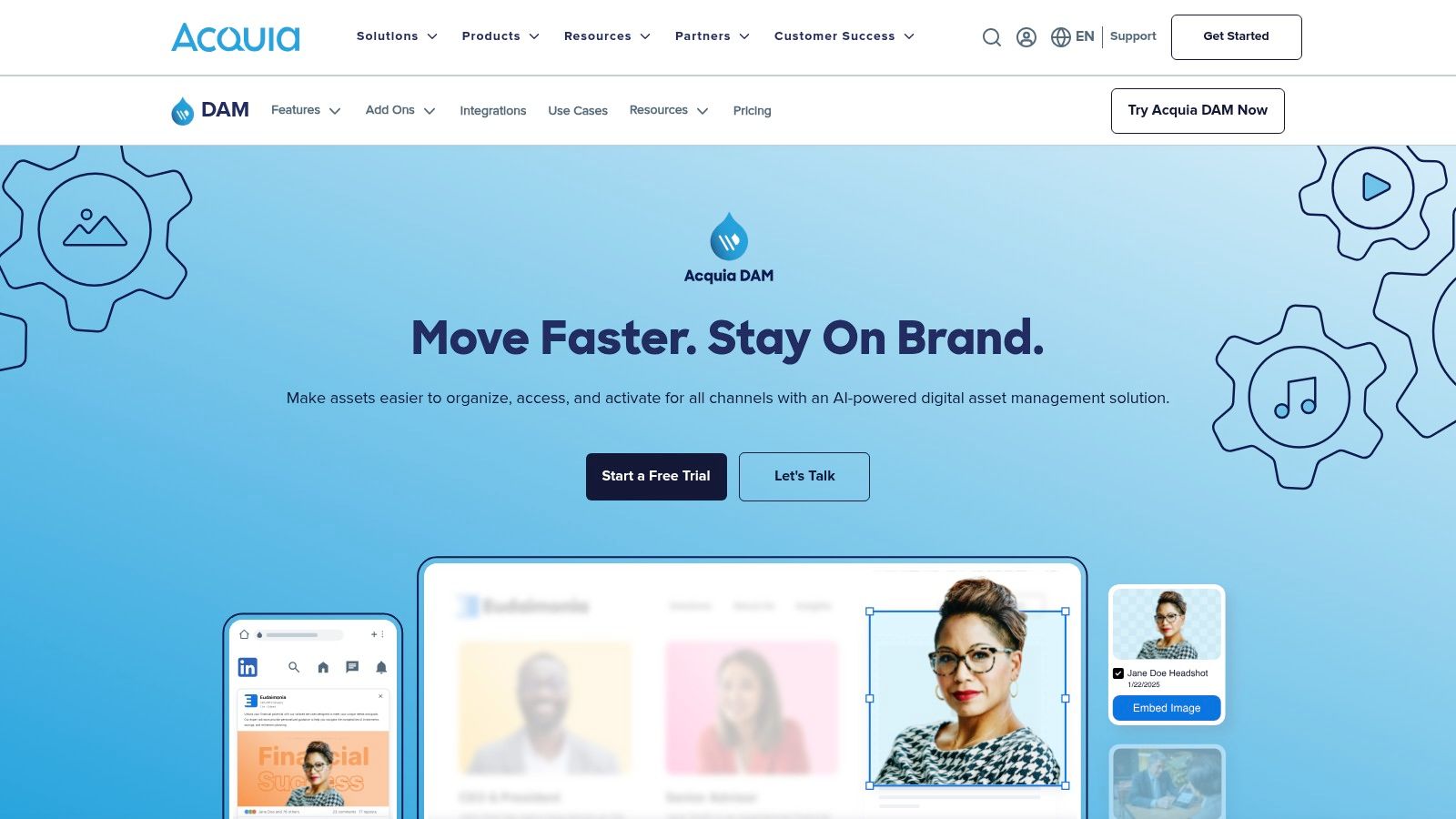
Acquia DAM, formerly Widen, is suited to organizations that need a broad enterprise DAM with configurable metadata, portals, rights management, and product-content alignment. Its position within Acquia's Open DXP makes it particularly relevant to companies using Drupal or Acquia marketing tools.
The platform supports role-based permissions, share links, delivery tooling, and governance structures for complex brand libraries. Optional PIM capabilities can help organizations align rich media with product information, which is valuable for retailers and manufacturers managing product assets across marketing, commerce, regional teams, and external partners.
Metadata is the buying question
Acquia DAM's main strength isn't necessarily the flashiest search interface. It is the ability to structure a library so that users can distinguish approved content, product variants, regional usage, rights status, and workflow ownership. That matters because discovery failures often begin before a user enters a query. If an organization can't reuse, update, or retire existing content reliably, the repository may contain the answer while the operating model prevents people from finding or trusting it.
Forrester-linked coverage reports that 67% of DAM decision-makers struggle to reuse, update, or retire existing content, while 64% cite legal or regulatory compliance as a major challenge and 36% plan to prioritize digital rights management in the next year in the cited DAM content-operations analysis. Those findings make Acquia's governance and rights capabilities more important than a feature-count comparison suggests.
Acquia DAM is less developer-centric than Cloudinary and less specialized for Physical AI than V-Modal AI. Its pricing is sales-led, with plan details and tiers requiring contact with sales. Buyers should ask for a demonstration using real metadata, rights, product, and video workflows instead of accepting a generic asset-library tour.
7. MediaValet
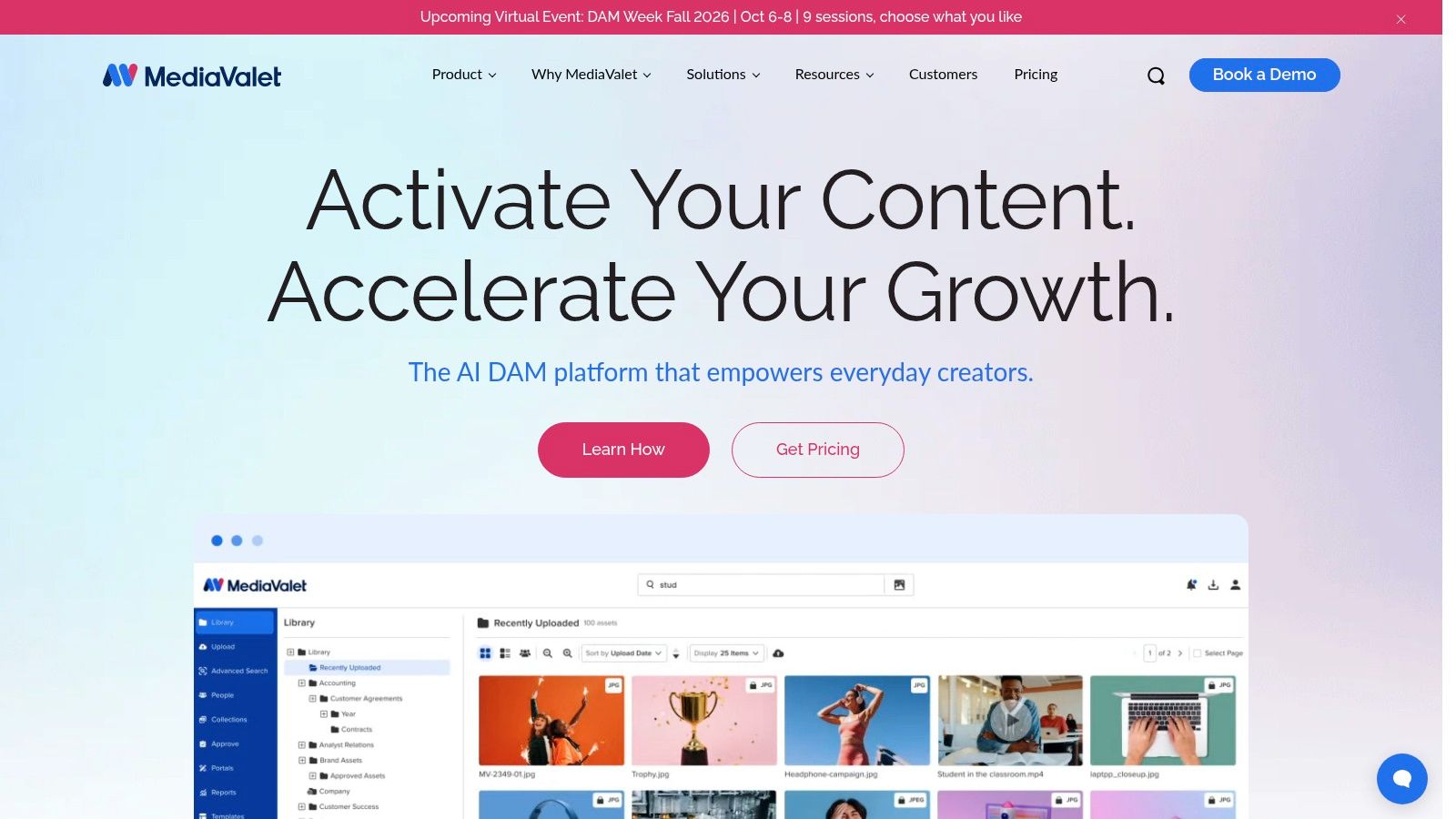
MediaValet is the most directly aligned with organizations whose DAM problem is large-scale video discovery. Built on Azure, it combines cloud DAM capabilities with audio and video intelligence, including speech-to-text, on-screen text, scene and topic detection, and people and object detection. Downloadable transcripts can support review and handoff to teams that need searchable records beyond the original video file.
For media, sports, cultural, education, and marketing organizations, that feature mix addresses a familiar problem. An editor or archivist doesn't want to watch an entire recording to find a phrase, scene, person, or topic. MediaValet's AI tagging, similar-image search, and rendition automation are aimed at making large libraries easier to search, share, and distribute.
Where it outperforms a general-purpose DAM
Brand portals and integrations such as Wrike support collaboration beyond the core library. Enterprise support and the Azure foundation may also appeal to organizations with global performance and compliance requirements. The platform's video orientation gives it a clearer advantage than brand-first tools when the archive contains substantial audiovisual material.
MediaValet still differs from V-Modal AI in deployment philosophy. MediaValet is a cloud-native DAM for organizational media operations. V-Modal AI is a developer-first Search Layer for continuous memory on edge devices and Physical AI systems. A surveillance integrator may use MediaValet to govern and distribute approved footage, while using V-Modal AI to retrieve an event from an IoT camera or mobile device close to where the event occurred.
Pricing is quote-based and requires contacting sales. Compared with developer-first tools, MediaValet offers fewer self-serve and developer-oriented levers, so technical teams should validate APIs, SDK requirements, ingestion patterns, export behavior, and integration ownership before committing.
Top 7 Digital Asset Management Platforms Comparison
| Product | 🔄 Implementation complexity | ⚡ Resource requirements | ⭐📊 Expected outcomes | Ideal use cases | 💡 Key advantages |
|---|---|---|---|---|---|
| V-Modal AI | Moderate, mobile/edge SDKs ready; some embedded/web targets maturing | Edge-focused: moderate on-device CPU/storage; reduces cloud bandwidth | ⭐ High, 📊 Precise frame-/timestamp-level multimodal recall and low-latency search | Mobile apps, smart glasses, robots, surveillance, e‑commerce discovery | Unified multimodal indexing (video/audio/sensors); mobile-first SDKs and chunked streaming uploads |
| Bynder | High, enterprise deployment and governance setup | SaaS enterprise: governance and integration costs; vendor-led pricing | ⭐ High for brand control, 📊 Strong metadata-driven discovery | Large marketing/brand teams standardizing assets and approvals | Robust metadata, permissions, templating and enterprise integrations |
| Brandfolder by Smartsheet | Low–Moderate, intuitive UI with scalable config | Cloud SaaS: supports large libraries (including high‑res video) | ⭐ High UX, 📊 Auto-tagging and analytics for scaled libraries | Organizations needing easy DAM + workflow automation via Smartsheet | User-friendly interface, Brand Intelligence auto-tagging, strong sharing controls |
| Cloudinary Assets (DAM) | Low for developers, API/SDK-first; DAM features require config | Processing/CDN costs scale with transformations and bandwidth | ⭐ High delivery/optimization, 📊 Fast on-the-fly transformations and search | Product, e-commerce, engineering teams needing media pipelines | Excellent developer tools, real-time transformations, clear self-serve plans |
| Adobe Experience Manager (AEM) Assets | High, complex enterprise implementation and governance | Enterprise-grade: significant licensing and integration effort | ⭐ Very high for Adobe ecosystems, 📊 Powerful AI tagging/workflows at scale | Large enterprises invested in Adobe Creative Cloud and commerce stacks | Deep Creative Cloud integration, mature metadata, AI and workflow capabilities |
| Acquia DAM (formerly Widen) | Moderate–High, configurable enterprise DAM with portals | Enterprise SaaS: sales-led pricing; integrates with Acquia/Drupal stack | ⭐ High stability and governance, 📊 Strong portal and rights management | Organizations aligning DAM with PIM/product content and Drupal sites | Comprehensive metadata, brand portals, and product-content integrations |
| MediaValet | Moderate, cloud-native Azure platform with video AI features | Video-heavy: processing, transcription and storage costs can be high | ⭐ High for video discovery, 📊 Strong AV search (transcripts, scene/person detection) | Media, sports, archives, education, marketing teams with heavy video | Robust video intelligence (speech-to-text, scene/person detection) and enterprise-scale performance |
Choose the DAM That Matches the Search Problem
There isn't one universal winner among the best digital asset management platforms. The correct choice depends on whether your central problem is brand governance, product-media delivery, enterprise workflow control, video discovery, or retrieval from physical environments.
Choose Bynder when brand governance, permissions, custom vocabulary, templates, and creative operations are the priority. Brandfolder by Smartsheet makes more sense when user adoption, intuitive organization, sharing, and workflow automation matter more than specialized edge retrieval. Adobe Experience Manager Assets is the natural fit for enterprises already invested in Adobe Creative Cloud and the Adobe marketing and commerce stack. Acquia DAM suits organizations that need configurable metadata, rights governance, portals, product-content alignment, and Acquia or Drupal integration.
Choose Cloudinary Assets when APIs, transformations, CDN delivery, and application-facing product media pipelines drive the decision. Its developer-first model is particularly relevant to e-commerce and engineering teams that need to manage and deliver media inside digital products. Choose MediaValet when video-heavy discovery, transcription, scene understanding, brand portals, and enterprise media operations are central.
V-Modal AI belongs beside these systems when the search problem extends beyond a governed repository. Its Multimodal Video and Audio Search capabilities, edge-optimized memory layer, natural-language retrieval, timestamp awareness, and mobile SDKs address use cases conventional DAMs aren't designed to own. In advertisement video editing, it can help narrow long footage to moments associated with speech, sound, or visual context. In vision for robotics, it can help systems recall what a camera observed. In audio for robotics, it can connect operational memory to spoken commands, alarms, impacts, or ambient signals.
AI adoption makes governance more important, not less. Survey coverage reports that only 33% of organizations have a dedicated AI strategy, while 41% report fully integrating or scaling AI in DAM. The same coverage identifies data privacy and security at 41%, skill development at 36%, and integration complexity at 35% among implementation barriers, with independent DAM trend coverage identifying AI integration strategy as a challenge for 58% of respondents and organizational restrictions as a blocker for 41% in the Bynder State of DAM report. The practical conclusion is that the best platform may be the one that gives your team the strongest review, rights, integration, and human-oversight controls.
Test representative video and audio before choosing. Define metadata, taxonomy, provenance, rights, and retention requirements. Compare workflow integrations and developer access, validate pricing assumptions with realistic storage, processing, delivery, and support needs, then measure how quickly users can retrieve the exact moment they need.
V-Modal AI provides a dedicated Search Layer for Physical AI, with Multimodal Video and Audio Search, edge memory, mobile SDKs, and retrieval across visual, auditory, and environmental streams. If your DAM evaluation includes advertisement video editing, vision for robotics, audio for robotics, smart glasses, or IoT camera memory, visit V-Modal AI to explore the platform and its public developer resources.