Search Engine for Videos Compared for Physical AI Apps
You've got hours of dashcam footage, livestream recordings, or robot-captured video, and someone asks for one moment: the frame where an obstacle first appears, the spoken phrase that confirms a fault, or the soundtrack cue that belongs in an advertisement cut. The file exists. The problem is finding the moment without scrubbing through everything.
That distinction changes the product you need. A viewer-facing video platform ranks complete videos for discovery and watch time. A search engine for videos used by developers must retrieve precise moments from long, noisy, non-editorial content. Metadata and filenames rarely describe every visual event, spoken word, sound, or environmental change that matters.
Video discovery is already embedded in mainstream search. A 2026 industry analysis reported that video appeared in 38.5% of tracked Google results on 20 July 2026, after peaking at 53.7% in the prior 90 days, while Google-owned video continued to dominate search-driven viewing. The same analysis reported $78.0 billion in U.S. digital video ad revenue in 2025, up 25.4% year over year. These figures describe the media market, not operational retrieval, but they explain why video has become a primary search surface. (Video SEO statistics and market analysis)
For Physical AI, the more important question is narrower: can a robot, smart-glasses app, or edge camera recall the right audiovisual moment under real latency, bandwidth, and connectivity constraints? This guide compares on-device versus cloud indexing and multimodal fusion versus separate pipelines, then applies those choices to advertising video edition, vision for robotics, and audio for robotics.
Table of Contents
- "Introduction Why Finding the Right Moment Matters More Than Finding the Right File"
- Why metadata breaks down in physical environments
- The comparison lens
- "What a Modern Search Engine for Videos Actually Does"
- Four jobs define the search layer
- Discovery search is not moment retrieval
- "On Device Versus Cloud Indexing for Video Search"
- The production trade-off
- "Multimodal Fusion Versus Separate Pipelines for Video and Audio"
- Separate pipelines preserve flexibility
- Fusion matches compound queries
- "Indexing and Retrieval Strategies That Shape Latency and Accuracy"
- Evaluate the whole retrieval path
- "Industry Use Cases Where Video Search Delivers Real Value"
- Advertisement video edition
- Vision for robotics
- Audio for robotics
- "How to Choose the Right Search Engine for Videos Approach"
- Start with deployment constraints
- Match the pipeline to the query
"Introduction Why Finding the Right Moment Matters More Than Finding the Right File"
A media team may remember that a product spokesperson said a particular claim near the end of an interview. An editor may also need the shot where the packaging rotates, the background changes, and the music reaches a transition. Searching by filename can identify the source interview, but it can't reliably return the exact segment containing all those signals.
The same failure appears in robotics. A warehouse operator reviewing a robot's run might ask, “Find the moment when the pallet blocked the left aisle.” A technician may need the audio event that accompanied a motor fault. A driver-safety team may want every clip where a cyclist entered the vehicle's path while a warning was spoken. Manual scrubbing forces people to inspect footage sequentially, even when the request is semantic and multimodal.
Why metadata breaks down in physical environments
Operational video rarely arrives as clean editorial content. It can include changing lighting, motion blur, overlapping speech, wind, machinery noise, repeated routes, partial occlusion, and long stretches with no obvious event. User-generated clips, livestreams, dashcam footage, and ambient device recordings are especially difficult because the useful context may not exist in a title, description, or manually assigned tag.
Natural-language search has become the expected interface for these conditions. You might describe a visual moment, submit an image as a reference, ask for a spoken phrase, or combine a sound with a scene. The retrieval target isn't “the warehouse video.” It's the timestamp where a specific condition becomes visible or audible.
The comparison lens
A production design has two separate decisions. First, decide where indexing and memory should live, on the device, in the cloud, or across both. Second, decide whether audio and video should remain separate or participate in a fused retrieval experience.
Practical rule: Treat video search as a memory and retrieval layer for a physical system, not merely as a way to improve media pages for viewers.
That framing is useful because Physical AI is described as a layered stack involving hardware and edge compute, operating systems and middleware, simulation, perception, world models, policies, and deployment infrastructure. (Physical AI technology stack overview) A search layer must connect perception, historical memory, and deployment conditions without becoming another isolated media subsystem.
"What a Modern Search Engine for Videos Actually Does"
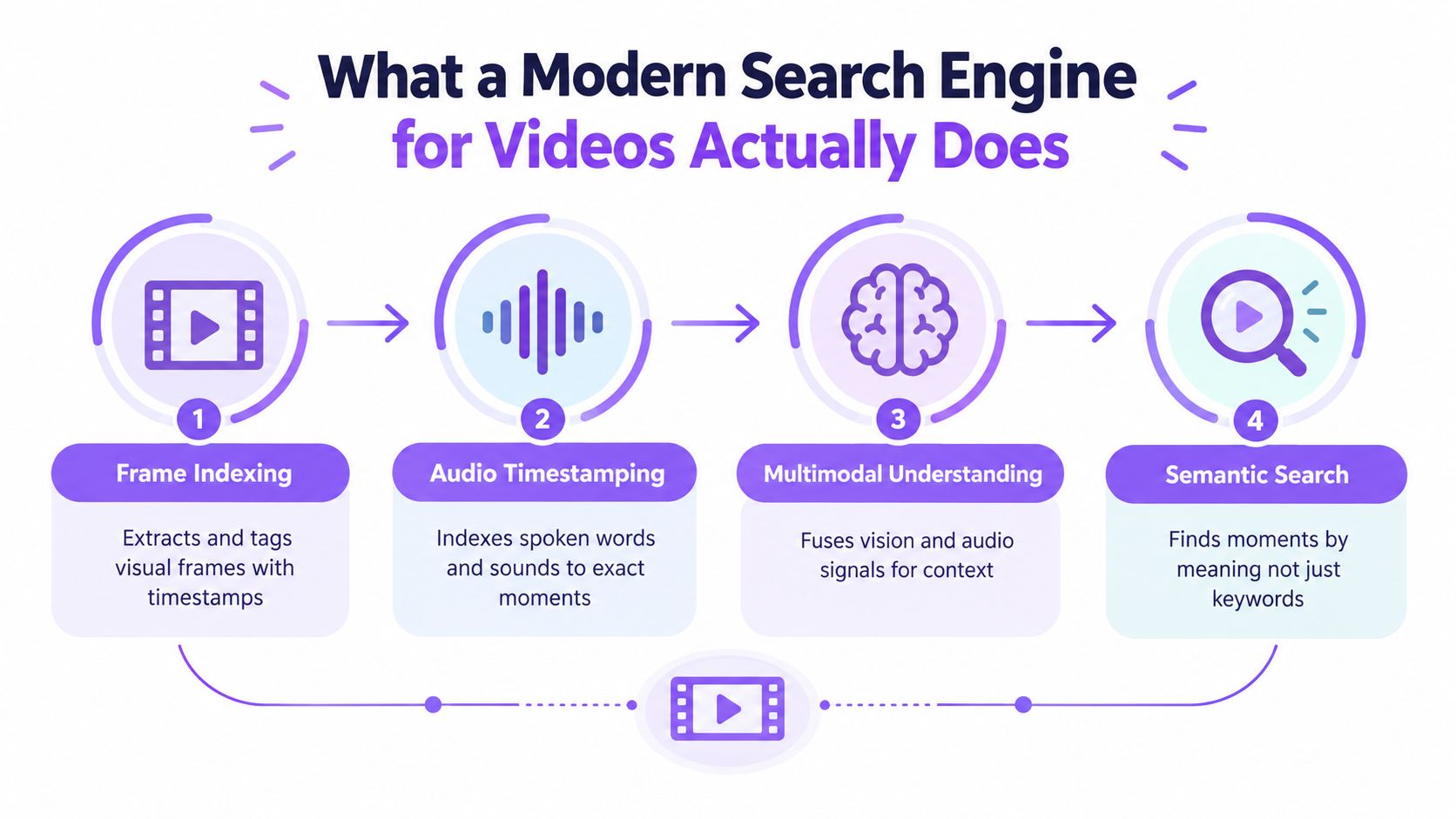
A modern video search system has a simple user-facing promise, but several responsibilities sit behind it. It must represent visual moments and audio events with time context, interpret a query beyond exact keywords, and return a useful segment rather than just a file name.
Four jobs define the search layer
Frame indexing gives the system a way to associate visual content with moments in time. It matters when the user asks for a red vehicle entering a scene, a damaged component, a hand reaching toward a control, or a particular product angle.
Audio timestamping connects speech, alarms, music, and environmental sounds to exact points in the recording. A transcript without timing is useful for reading, but much less useful for opening the player at the moment a phrase was spoken.
Multimodal understanding connects signals that are ambiguous alone. A phrase such as “the warning” might refer to spoken language, a dashboard alert, a buzzer, or a combination of these. Video and audio together provide the surrounding context.
Semantic search lets the user describe intent instead of reproducing a stored label. The useful query may be “show the moment the robot approaches an empty shelf” rather than a tag such as shelf_04.
Discovery search is not moment retrieval
YouTube illustrates the scale of video as a global search system. A 2026 marketing dataset reported more than 500 million daily search queries on YouTube, while other 2026 summaries cited roughly 2.7 billion monthly users. (Video marketing statistics and data points) A separate roundup reported that more than 25% of search results included a video snippet, and that video-rich results could earn around 58% click-through versus 41% for non-rich results. Those signals matter for audience discovery, but they don't solve the operational task of finding an exact moment inside an hour of robot footage.
Consumer platforms optimize around relevance to a viewer and continued viewing. Physical AI applications optimize around recall, timestamp precision, response time, privacy, and the ability to work with incomplete connectivity. A useful system can support text-to-video, image-to-video, voice-to-audio, and environmental-state-to-video intent without asking the operator to understand how the media representation works.
The strongest practical distinction is the retrieval unit. A file-level result answers, “Which recording might contain this?” A moment-level result answers, “Open the relevant segment now.” That difference determines whether a technician can act immediately or must become the indexing system through manual review.
"On Device Versus Cloud Indexing for Video Search"
The on-device versus cloud decision isn't about choosing the newer option. It depends on where the system must respond, how much footage it handles, and whether the device can safely transfer media. A robot operating in a warehouse with unreliable connectivity has different requirements from a post-production team searching a centralized archive.
The production trade-off
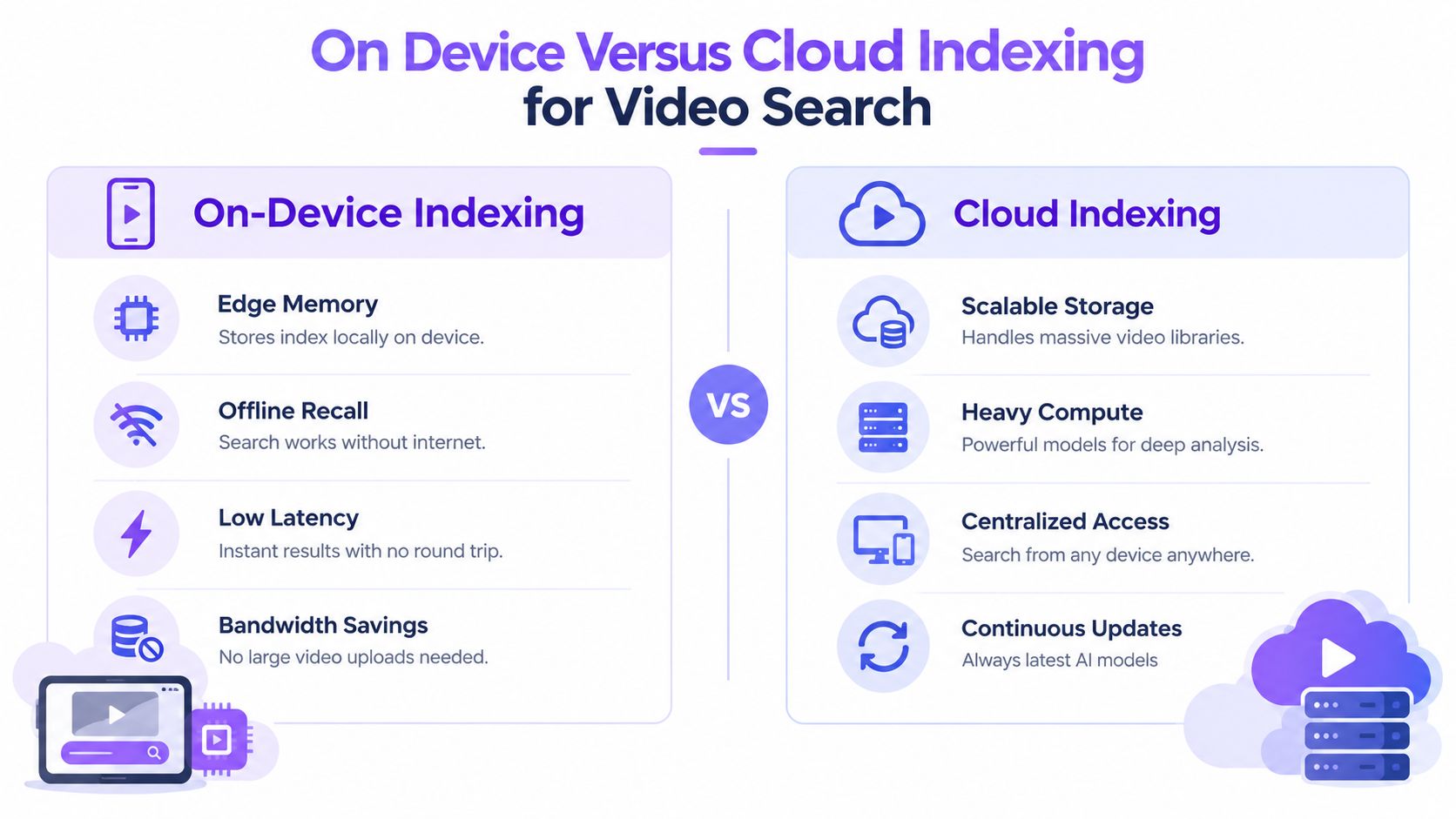
On-device indexing keeps memory close to the camera, robot, or mobile application. That supports offline recall, avoids sending every recording upstream, and removes a network round trip from time-sensitive searches. The cost is finite storage, constrained compute, thermal pressure, battery impact, and more complicated model lifecycle management.
Cloud indexing offers elastic storage and stronger centralized compute. It suits organizations that need shared access to large libraries, cross-device investigation, or centralized model updates. Its weaknesses appear when uploads compete with live streams, connectivity drops, privacy requirements restrict transfer, or a robot needs an immediate answer during a perception-action loop.
| Criterion | On Device Edge Indexing | Cloud Indexing |
|---|---|---|
| Latency | Avoids a network round trip for local recall | Depends on upload, network, and service response time |
| Bandwidth | Reduces the need to upload complete recordings | Requires transferring media or representations for remote analysis |
| Connectivity resilience | Can continue searching when disconnected | Search quality and availability depend on network access |
| Privacy | Keeps selected history on the device | Centralizes data under the organization's cloud controls |
| Compute and storage | Limited by hardware, thermals, battery, and local capacity | Easier to scale for large libraries and demanding analysis |
| Model updates | Requires coordinated device updates | Centralized updates simplify fleet-wide changes |
| Access | Best for the device or local operator | Supports shared access across authorized clients |
For robotics and smart glasses, the decisive question is whether the perception-action loop can wait for the cloud.
A hybrid architecture is often the sensible compromise. Keep a recent operational memory and urgent retrieval capability local, then synchronize selected clips or search context when connectivity returns. Use cloud indexing for deeper historical analysis and organization-wide review, not as the only path to a decision that must happen beside the physical system.
The difficult engineering work is operational rather than fashionable. Large uploads can destabilize mobile applications, live streams can create backpressure, and synchronization can produce duplicate or stale results. Signed streaming URLs and chunked uploads can help media handling, but they don't remove the need to define what the device owns, what the cloud owns, and how conflicts are resolved.
"Multimodal Fusion Versus Separate Pipelines for Video and Audio"
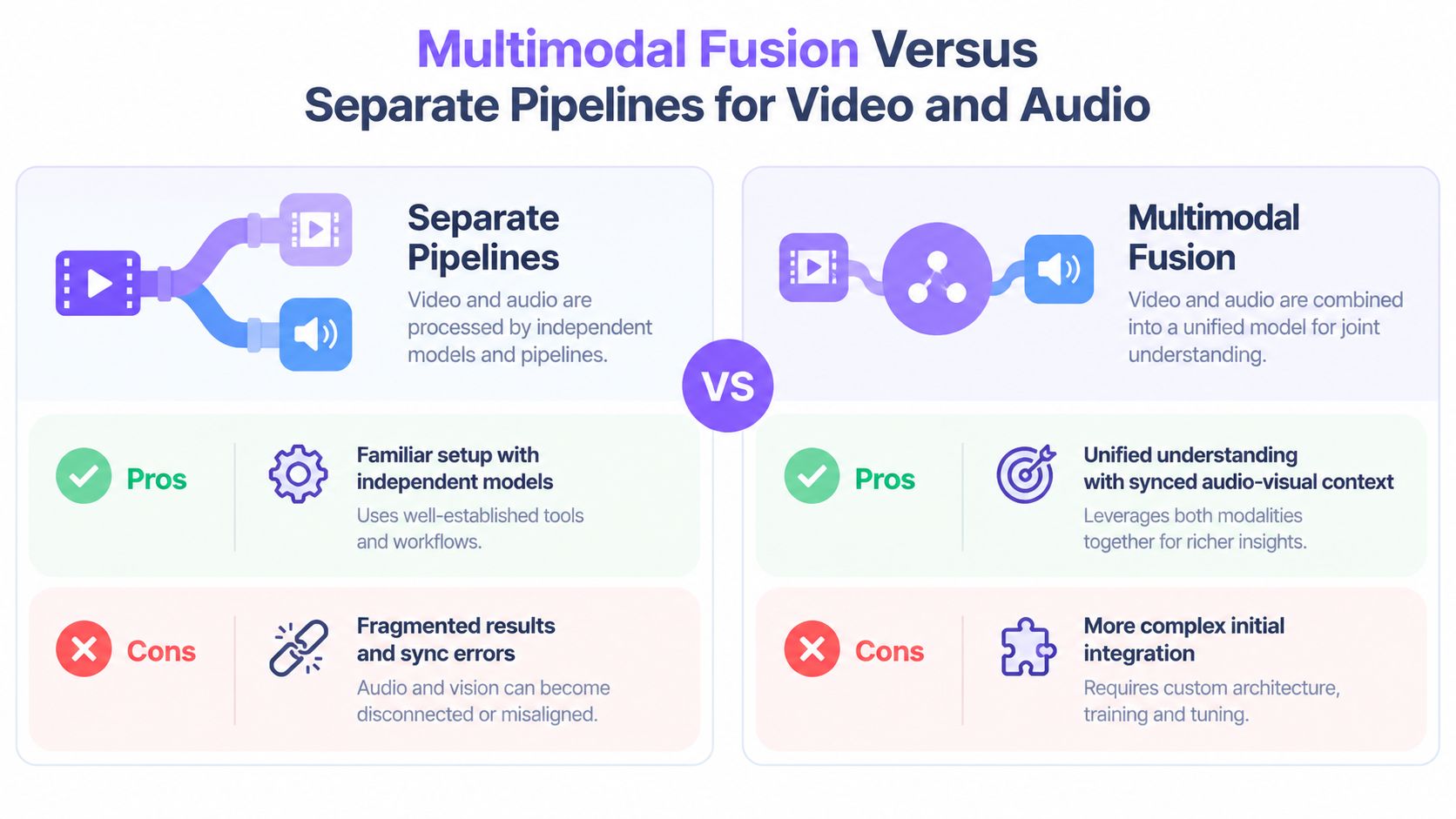
Separate audio and video pipelines are attractive because they fit existing teams and tools. One component handles transcription, another analyzes frames, and an application combines the results later. That design can work, especially when a legacy stack already has dependable speech or vision services.
The problem emerges at the moment of retrieval. A user doesn't always want “the transcript result” and “the visual result” as separate lists. They want the segment where a spoken product claim coincides with a visual transition, or where a robot hears a metallic impact while its camera sees an object fall.
Separate pipelines preserve flexibility
Independent pipelines can be easier to replace and debug. A media team might keep an established speech-to-text service while adding a visual retrieval component. Robotics teams may also prefer separate streams when audio is processed on a dedicated sensor path or when a safety subsystem must remain isolated.
They introduce coordination costs:
- Timestamp alignment: Audio and visual results can refer to different boundaries or clocks.
- Fragmented ranking: The application must decide how to combine independently scored evidence.
- Context loss: A sound may change the meaning of a visual event, but separate results don't naturally express that relationship.
- Operational overhead: More services create more monitoring, synchronization, and failure paths.
Fusion matches compound queries
A fused approach treats the query as a multimodal intent. For advertisement edition, the request might identify a spoken claim, a soundtrack cue, and a visual transition in one segment. For robotics, it might combine “a person says stop” with “the arm is moving toward the work zone.” The benefit is a result that reflects shared context rather than a manually assembled intersection.
Recent audiovisual retrieval work describes combining audio, video, text, and metadata for efficient and precise content retrieval. (Audiovisual retrieval paper abstract) That capability is particularly relevant when the desired output is a timestamped moment, not a whole clip selected by a title.
Fusion isn't free. It can complicate integration, make component-level debugging less familiar, and require careful handling when one modality is missing or degraded. A practical rollout can preserve separate outputs for observability while presenting a unified search experience to the operator. That gives teams a migration path without forcing every legacy subsystem to change at once.
The decision should follow the query, not architectural fashion. If users ask only for spoken words, a focused audio pipeline may be sufficient. If they ask for relationships between what was seen, heard, and said, separate retrieval lists usually create avoidable work at the application layer.
"Indexing and Retrieval Strategies That Shape Latency and Accuracy"
A benchmark score can look healthy while a deployed search experience feels slow. Long-video retrieval benchmarks increasingly report Recall@K alongside end-to-end latency split into with I/O and without I/O. That split matters because it distinguishes retrieval quality and ranking work from storage and network bottlenecks. (Long-video retrieval benchmark methodology)
Recall@K asks whether a relevant result appears within the returned top K candidates. It helps compare retrieval quality, but it doesn't tell you whether the user receives the result quickly enough. If I/O dominates, improving ranking alone won't fix the product.
Evaluate the whole retrieval path
Modern long-video evaluation is moving beyond short caption matching. FLARE contains 87,697 annotated clips, 274,933 user-style queries, and 399 videos totaling 225.4 hours, with evaluation across caption-based and query-based regimes for vision, audio, and unified audiovisual retrieval. (FLARE multimodal video retrieval benchmark)
Those conditions resemble the difficulty of noisy operational footage more closely than a small collection of neatly edited clips. Builders should examine whether a system can return the right moment when the query doesn't match the source wording and when relevant evidence is distributed across image, speech, and sound.
| Metric | What It Measures | Why It Matters for Builders |
|---|---|---|
| Recall@K | Whether relevant moments appear among the top K results | Shows whether search can surface useful candidates |
| Latency without I/O | Retrieval work apart from storage and network movement | Reveals model, embedding, and ranking cost |
| Latency with I/O | End-to-end response including data access | Reflects the operator's actual experience |
| Timestamp precision | How closely results identify the requested moment | Determines whether users still need manual scrubbing |
| Query regime | Whether evaluation uses captions, natural-language queries, or both | Indicates how well the system matches real user intent |
| Modality coverage | Vision, audio, or unified audiovisual retrieval | Shows whether the system handles compound evidence |
Chunking and timestamp granularity also shape usefulness. Coarse segments may reduce search overhead but force the user to scrub inside every returned result. Very fine segments can improve moment precision while increasing index management and retrieval pressure. The right balance depends on whether the application is editing media, investigating an incident, or supporting a robot during operation.
A good Recall@K score doesn't compensate for an I/O path that makes the operator wait.
Test with the actual device, storage path, network conditions, and footage types. Include empty stretches, overlapping voices, camera movement, ambient noise, and missing modalities. A search engine for videos is ready for production when its measured end-to-end behavior matches the decision time of the person or system using it.
"Industry Use Cases Where Video Search Delivers Real Value"
The value becomes obvious when the search request contains a verb and a condition, not just a topic. “Find the shot with the spoken claim,” “recall when the robot saw the blocked aisle,” and “locate the alarm before the arm stopped” all require timestamp-aware retrieval.
Advertisement video edition
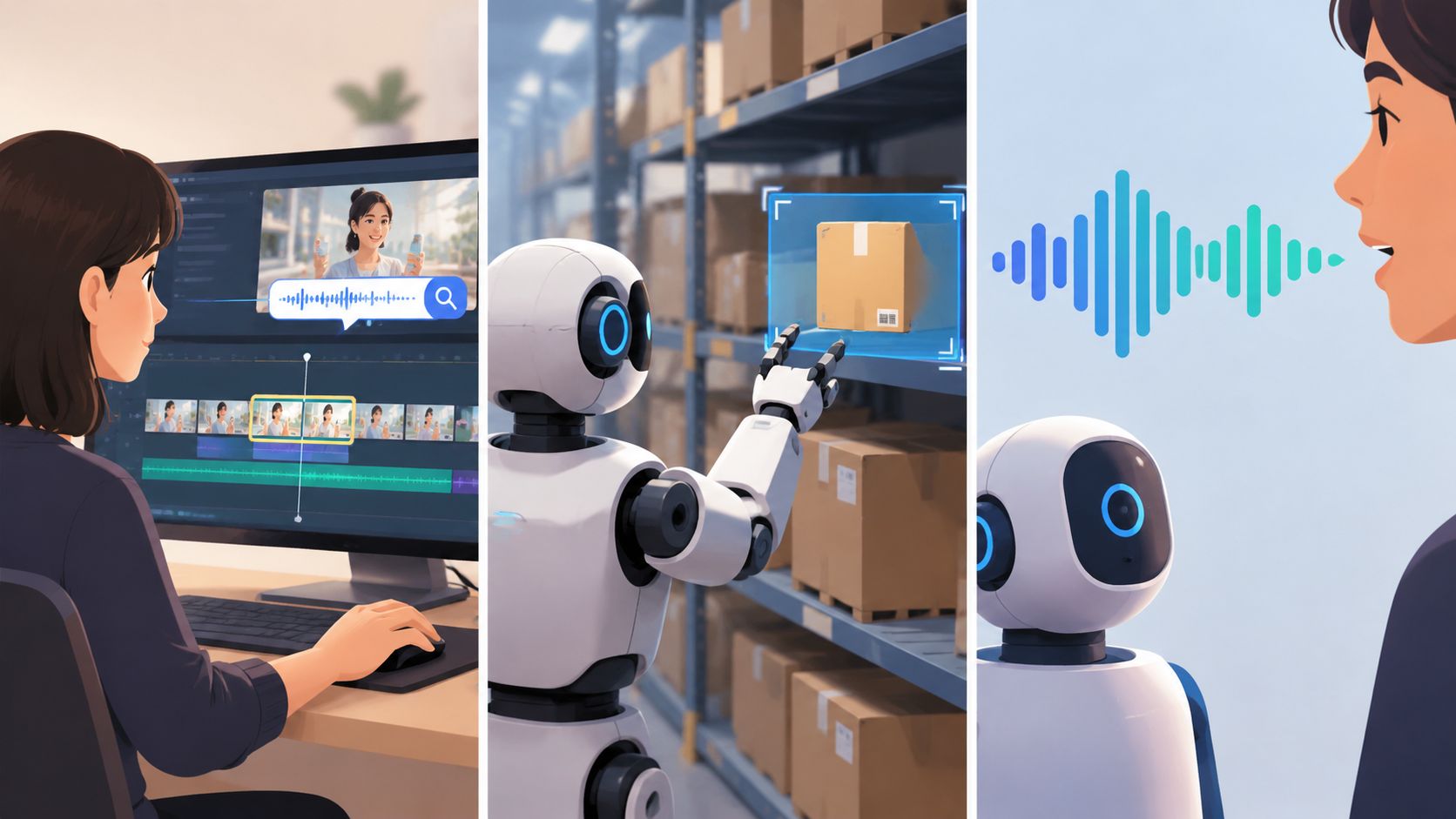
Editors often work with multiple interviews, product demonstrations, alternate cuts, and sound beds. Manual scrubbing is slow when the request combines a spoken phrase with a visual condition. A multimodal search layer can return the segment containing the claim, the product close-up, or the transition that matches the edit brief.
The practical gain isn't just speed. Editors can review candidate moments consistently, compare alternate takes, and preserve the relationship between speech, image, and sound. Separate transcript search may find the words, but it won't necessarily identify the strongest visual delivery or the right soundtrack context.
Vision for robotics
A robot's continuous visual history can support incident review, navigation analysis, and repeatable evaluation. Engineers may search for moments when an object was misplaced, a route became obstructed, or a human entered a work area. That history becomes more useful when the query returns a playable segment tied to the robot's operational context.
Physical AI guidance describes a stack that includes sensors and compute, robot data, a policy, and a repeatable real-world evaluation loop. (Robotics and Physical AI stack guide) Without a unified search layer, video history and evaluation records remain fragmented, leaving engineers to reconcile separate logs and recordings manually.
Audio for robotics
Vision misses events that sound provides first or provides more clearly. A motor whine, collision, spoken command, warning tone, or dropped object may be partly hidden from the camera. Audio retrieval lets the team ask for the event directly and inspect the corresponding visual context.
Local operation matters for robots, smart glasses, and IoT cameras. Physical AI systems are commonly described as closing the perception-action loop locally on the robot, which makes edge-capable memory relevant when bandwidth, latency, or connectivity limits cloud dependence. (Edge AI and Physical AI hardware overview)
Common pain points cut across all three workflows:
- Opaque physical data: Teams can't easily query what devices observed.
- Manual review: Operators scrub long recordings to verify one event.
- Disconnected history: Device, audio, and visual records live in separate places.
- Mobile instability: Large uploads and live streams compete with application resources.
- Missing context: A transcript or frame alone doesn't explain the complete event.
"How to Choose the Right Search Engine for Videos Approach"
There isn't one universal winner between edge and cloud, or between fusion and separate services. Choose based on the moment when search must work, the content that users query, and the consequences of failure.
Start with deployment constraints
Keep the first index local when the device must operate offline, the response belongs inside a perception-action loop, or privacy and bandwidth make continuous uploads unacceptable. Prefer cloud indexing when the organization needs a shared archive, centralized access, elastic analysis, and simpler fleet-wide model management.
A hybrid design fits teams that need both. Store recent or safety-relevant memory on the device, synchronize selected content when possible, and retain cloud search for broader historical analysis. Define synchronization behavior early, especially for duplicate recordings, delayed uploads, and searches issued before a device reconnects.
Match the pipeline to the query
Use separate pipelines when existing services already solve narrow tasks and the product can tolerate application-level result merging. Use multimodal fusion to find relationships between sight, sound, speech, and environmental state.
A practical evaluation checklist:
- Connectivity: Does search need to function without an active network?
- Latency: Is a delayed answer inconvenient, or does it interrupt a physical operation?
- Content length: Are users searching short edited clips or continuous ambient recordings?
- Modalities: Will queries combine visual, textual, auditory, and environmental signals?
- Client stack: Does the product need Android Kotlin, Flutter, or embedded Linux integration?
- Media transport: Can the system handle large uploads, resumable transfers, and controlled playback?
- Evaluation: Will you measure both Recall@K and end-to-end latency with I/O?
V-Modal AI is one option for teams evaluating this architecture. Its platform provides a multimodal search API, a robotics edge-optimized memory layer, natural-language video search, query modes spanning text-to-video, image-to-video, voice-to-audio, and environmental-state-to-video, plus Android Kotlin and Flutter SDK offerings. It also lists signed streaming URLs, chunked multipart uploads, and public repositories for prototyping across mobile, smart-glasses, robotics, edge, and IoT camera environments.
Start with your own footage rather than a polished demo. Test a spoken claim in an advertisement archive, a blocked path in robot vision history, and a warning tone in robotics audio. Record whether the result is precise enough to act on, whether offline behavior meets the product requirement, and whether the combined pipeline stays stable on the target hardware.
V-Modal AI provides a Search Layer for Physical AI through multimodal video and audio retrieval, edge-oriented memory, and mobile and robotics integration options. Visit V-Modal AI to evaluate the platform with your own advertising, robotics, smart-glasses, or IoT footage and test the trade-offs that matter in production.