Technical Challenges Ahead for Robotics / Physical AI Software Stack
A robot finishes its route. A smart-glasses wearer records an entire shift. A dashcam stores a long drive, and a CCTV system keeps collecting audio and video. Later, someone asks a simple question: “When did the warning sound start, and what did the camera see immediately afterward?” The hardware captured the evidence, but the software can't connect the moment, retrieve it quickly, or use it safely in a decision loop.
That failure is becoming more common as Physical AI systems combine cameras, microphones, spatial sensors, language models, planners, and controllers. The hard problem is no longer only recognizing an object or generating an answer. It's coordinating perception, memory, retrieval, action, safety, and certification across devices that have limited power and strict timing requirements.
The technical challenges ahead for Robotics / Physical AI software stack are therefore architectural. Teams need a stack that can remember what a machine sensed, connect Multimodal Video with Multimodal Audio, operate at the edge when the network is unreliable, and expose useful history without turning the robot into an opaque collection of dependencies. A model can be impressive in a benchmark and still fail when its output arrives too late, its memory isn't synchronized, or its behavior can't be tested.
Table of Contents
- Introduction Why the Software Stack Now Decides Physical AI Success
- Understanding the Physical AI Software Stack and Where Search Fits
- The Integration and Architecture Bottleneck Behind Most Failures
- Why adding another model often makes the system worse
- A practical architecture review
- Edge Latency, Memory Bandwidth, and Real-Time Constraints
- Where the time disappears
- How Mobile Smart Glasses DashCam GoPro and CCTV Stacks Differ From Robotics
- Industry Use Cases, Pain Points, and What Query-Based Retrieval Changes
- Advertisement Video Editing
- Vision for Robotics and Audio for Robotics
- Dashcam and CCTV Review
- Choosing and Integrating a Search Memory Layer Without Adding Complexity
Introduction Why the Software Stack Now Decides Physical AI Success
Physical AI systems act in environments that weren't designed for them. A warehouse robot must interpret changing obstacles, a vehicle must connect road context with audio alerts, and smart glasses must preserve useful visual memory without exhausting the device. These systems need more than isolated perception. They need continuous context.
The practical gap appears after deployment. A robot may detect a tool, hear a warning, and record a human instruction, yet those events can remain separated across sensor logs, transcription services, video files, and telemetry databases. A developer then spends time reconstructing what happened instead of improving the robot's behavior.
Practical rule: If engineers can't query the machine's recent experience, they'll struggle to debug, validate, and improve its decisions.
This is why a dedicated memory and search layer matters. It doesn't replace perception, planning, or control. It gives those layers a way to work with historical context, including specific visual moments, sounds, spoken instructions, and environmental states. The same capability supports a mobile companion app, a wearable camera, a dashcam review tool, and an autonomous robot, although each requires a different balance of local processing, storage, synchronization, and response time.
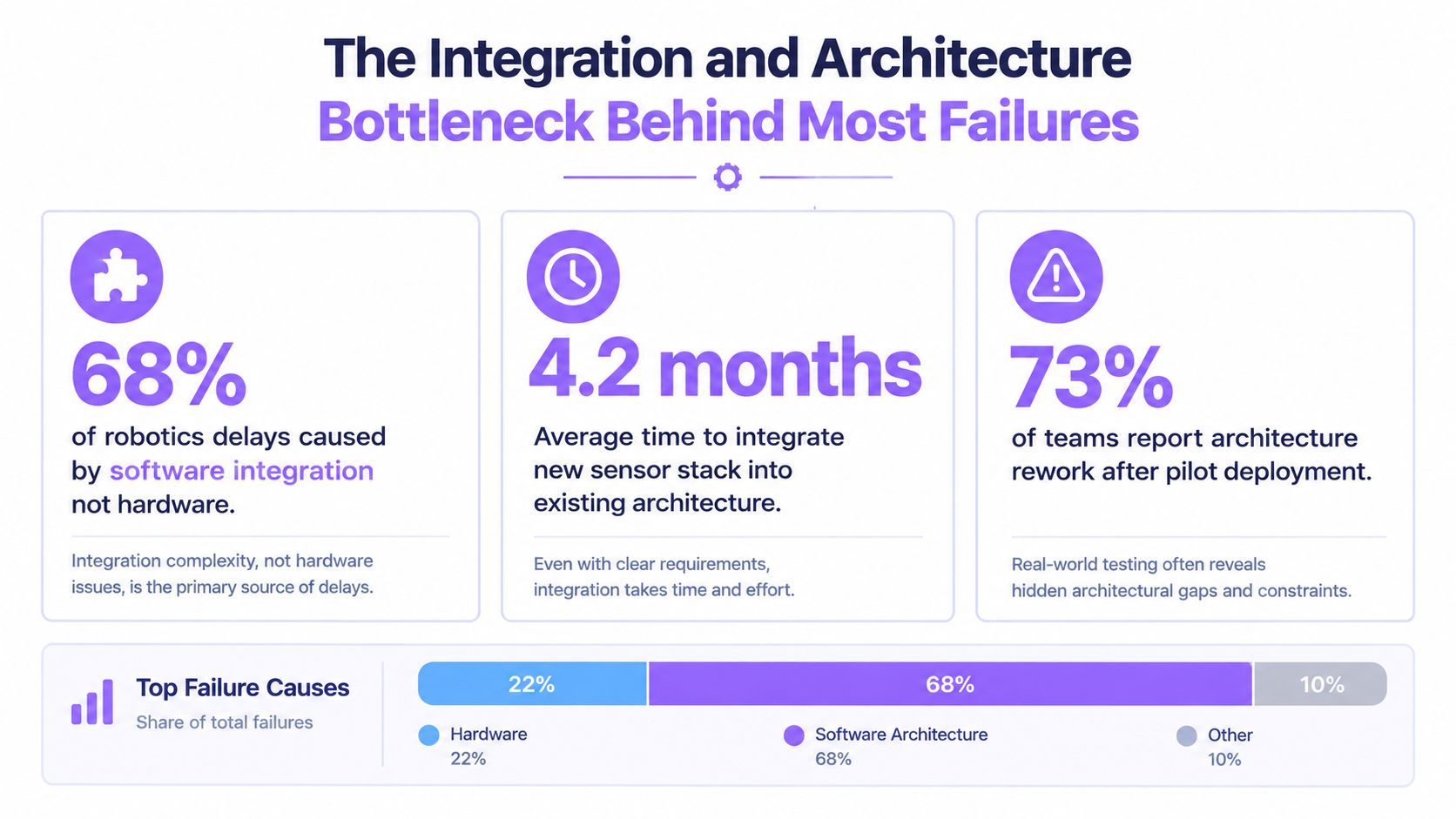
Recent industry evidence points to the same shift. A 2026 robotics benchmark summarized in the research literature found that software architecture and integration were the biggest performance bottleneck for 27% of developers, compared with 16% citing hardware constraints. The result changes the engineering question. Instead of asking only which model or sensor to buy, teams must ask whether the entire stack can coordinate perception, memory, action, safety, and compliance under real operating conditions.
Understanding the Physical AI Software Stack and Where Search Fits
Think of the stack as a memory assistant for a machine. The assistant listens, watches, organizes what happened, answers questions about the past, and passes relevant context to the system making the next decision.
A useful stack has several connected layers:
- Capture layer: Cameras, microphones, LiDAR, inertial sensors, tactile sensors, and vehicle or robot telemetry collect raw observations.
- Perception layer: Vision models identify objects, movement, people, scenes, and spatial relationships. Audio models identify speech, alarms, impacts, or other relevant sounds.
- Fusion layer: The system connects visual, auditory, temporal, and environmental signals so that an event has context rather than existing as an isolated frame.
- Memory layer: The machine keeps an operational history that can be recalled by time, content, modality, or environment.
- Query layer: A user or another software component asks for a relevant moment using text, an image, a voice request, or an environmental state.
- Action layer: A planner or controller uses the retrieved context for diagnosis, assistance, navigation, manipulation, or other decisions.
Multimodal Video and Multimodal Audio search sits between perception and action. It can return a useful segment when someone asks for a spoken instruction, a moving object, a visual condition, or a combination of sound and sight. Frame-level and audio-timestamp understanding reduces dependence on manual tags and static file descriptions.
For a mobile companion, text-to-video might retrieve the moment a user entered a room. Voice-to-audio might find a spoken reminder or an unusual sound. In robotics, an environmental-state-to-video query could help locate earlier observations associated with a particular workspace condition. The interface changes, but the core requirement remains the same: connect natural language and sensory history without forcing every application to maintain disconnected transcription and vision workflows.
That separation is important. Search shouldn't become another opaque model inside the control path. It should expose useful context through clear interfaces, preserve timing, and let safety-critical components decide whether retrieved information is trustworthy enough to influence action.
The Integration and Architecture Bottleneck Behind Most Failures
A robot can have a capable perception model, stable control, and enough compute, yet still fail in production. The failures usually occur at interfaces: timestamps drift, queues fill, sensor outages propagate, and one component assumes guarantees that another never provides. For Physical AI, architecture and memory infrastructure now constrain results as much as model quality. A system cannot use sensory history reliably if capture, indexing, retrieval, and action operate on incompatible timing and data contracts.
The 2024 robotics benchmark quantifies this boundary problem. It reports that 42% of developers name integration complexity as their biggest software-development challenge, alongside 46% reporting higher safety risks, 44% reporting system instability, and 35% reporting an expanded testing burden. These are reported effects associated with integration complexity, not comparisons against a defined control group. The pattern matters because every added model, sensor, middleware service, or cloud dependency expands the number of states engineers must observe and reproduce. industry benchmark
Why adding another model often makes the system worse
A vision-language model may improve scene interpretation while consuming memory needed by perception or control. A speech service may improve transcription while adding clock synchronization issues and network dependence. A retrieval layer can make past events easier to inspect, but only if its inputs, outputs, timestamps, and failures are recorded well enough to replay.
The benchmark also reports that 66% of developers experienced project delays from certification requirements. Cybersecurity standards were cited by 51%, and functional safety standards by 49% among the hardest requirements to manage. A component that adds capability but cannot provide bounded behavior, traceable failures, and repeatable tests can raise project risk instead of reducing it.
A practical architecture review
Before integrating a search or memory component, ask:
- Boundary clarity: Does it expose a stable interface, or require access to unrelated application internals?
- Failure behavior: What happens when indexing is incomplete, storage is full, the network disappears, or a sensor stops reporting?
- Timing visibility: Can the team measure capture, processing, retrieval, and handoff delays separately?
- Replayability: Can developers replay the same sensory history during debugging and safety validation?
- Data ownership: Can teams control retention, deletion, access, and local-storage policies?
- Safety separation: Does retrieved context inform a decision without bypassing deterministic safety checks?
A workable architecture is modular without becoming fragmented. Perception, memory, planning, and control need explicit contracts, while the safety layer must be able to reject unsafe actions regardless of what a foundation model or retrieval service suggests. That separation keeps queryable multimodal memory useful without placing an opaque search dependency inside the control path.
Edge Latency, Memory Bandwidth, and Real-Time Constraints
A robot that waits for an answer can miss a grasp, brake late, interrupt an interaction, or act on stale surroundings. The practical bottleneck is often the architecture around the model, including data movement, scheduling, and queryable memory, rather than model capability alone. Large multimodal models may reason well, yet still exceed the timing budget of a closed-loop system.
One reported edge robotics setup measured roughly 1,600 milliseconds of end-to-end latency for an on-device vision-language model, compared with about 1,685 milliseconds in cloud deployment, only a 5% reduction. The study also found that text generation consumed more than 85% of total end-to-end latency. Local inference reduced network dependence, but the workload remained unsuitable for fast reactive control.
A separate benchmark in the same study reported 47.2 milliseconds average inference latency at the edge versus 114.3 milliseconds in the cloud, a 58.7% improvement. Packet round-trip time was 22.5 milliseconds versus 105.1 milliseconds, a 78.6% reduction. Local execution can therefore remove significant communication delay, while model execution, memory traffic, and scheduling still determine whether the full pipeline meets its deadline.
Where the time disappears
The Physical AI latency review describes the conflict between tight real-time perception and control budgets and computationally heavy multimodal foundation models. A model that performs well for retrospective analysis may fail inside a motion loop that needs millisecond-scale responses.
Memory movement adds another source of delay. A recent edge inference survey reports that autoregressive vision-language-action policies are constrained primarily by memory bandwidth. It also reports that fine-grained transformer kernels can spend 30% to 60% of latency in kernel-launch overhead, with utilization falling below 20% during decoding.
Model compression alone does not resolve this. Teams need to reduce unnecessary copies, fuse operations where practical, quantize with accuracy checks, schedule workloads around sensor timing, and prevent retrieval from competing with control-critical processes. A workable split keeps lightweight local components responsible for immediate state, while heavier multimodal reasoning handles lower-frequency context and review. Queryable memory belongs on the context path unless its timing and failure behavior are bounded well enough for the control path.
Engineering trade-off: Cloud inference offers flexibility and centralized updates, while edge execution reduces connectivity dependence, improves privacy control, and makes local behavior more predictable.
Thermals and battery capacity expose the same constraints on mobile hardware. The Reka Edge product documentation describes how continuous visual processing on smart glasses can drain batteries within minutes and overheat the headset, while offline edge processing helps preserve thermals and battery life. Dashcams, GoPro-style cameras, mobile devices, and robots face different duty cycles, but the integration problem remains. A workload that runs acceptably in a server room may fail on a wearable or robot that cannot sustain its compute and memory load.
How Mobile Smart Glasses DashCam GoPro and CCTV Stacks Differ From Robotics
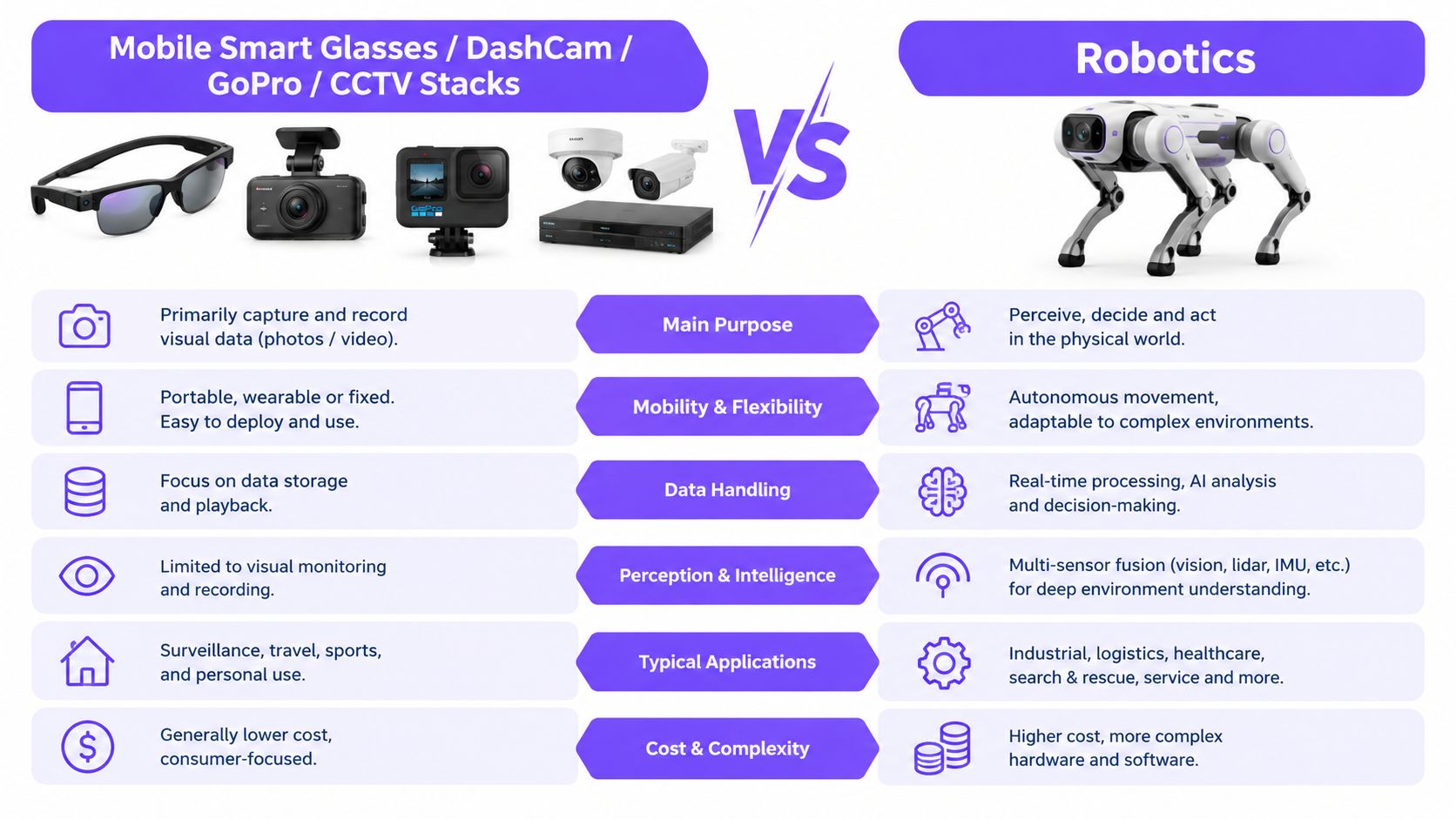
The same search capability behaves differently on every form factor. A mobile phone can defer work until a user opens an app. Smart glasses need hands-free recall while protecting battery and heat limits. A dashcam or GoPro may capture continuously but upload only when a connection becomes available. CCTV systems can use fixed infrastructure, while robots must connect memory to immediate action.
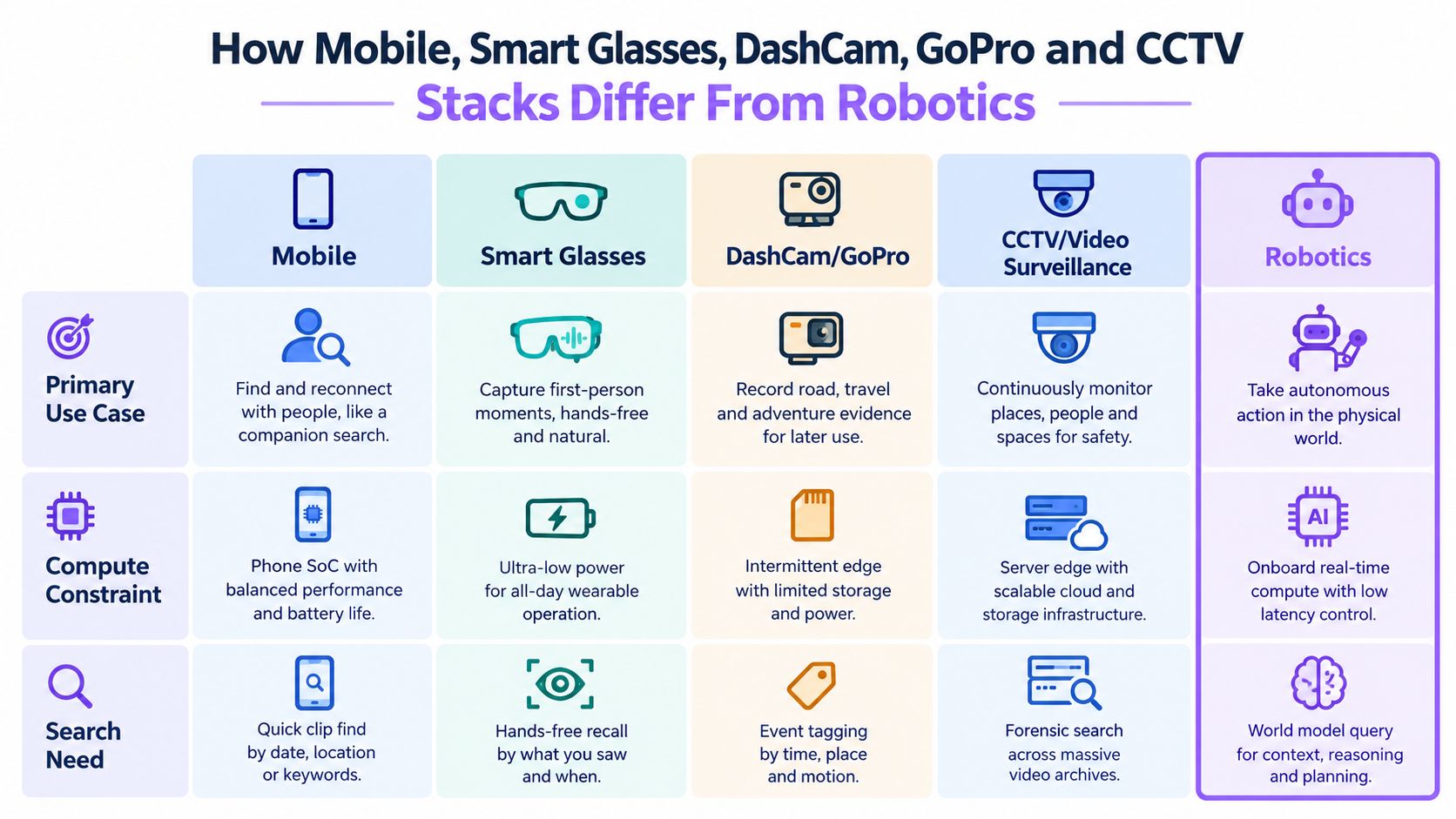
| Platform | Primary need | Practical stack priority |
|---|---|---|
| Mobile | Companion search across personal recordings | Local caching, resumable transfers, clear user-facing retrieval |
| Smart glasses | First-person visual and audio memory | Low-power processing, offline operation, hands-free queries |
| DashCam and GoPro | Road evidence, activity capture, and event review | Continuous capture, selective upload, robust timestamp handling |
| CCTV and video surveillance | Monitoring across fixed viewpoints | Multi-camera coordination, audio-video filtering, access controls |
| Robotics | Autonomous action in changing environments | Bounded latency, synchronized memory, safe handoff to planning |
The difference between CCTV and robotics is especially important. A surveillance operator can review a retrieved event after detection. A robot may need the same context while deciding whether to move, stop, inspect, or ask for help.
Research examples show how fixed and mobile sensing can work together. A distributed surveillance system paper describes a static acoustic agent, a static vision agent, and a mobile vision agent mounted on a robot. The robot's omnidirectional camera provides closer inspection and covers areas outside fixed sensor views.
A separate ambient-safety system used multiple audio and video sensors to detect relevant or dangerous events, allowing remote operators to review selected moments rather than every recording. That pattern translates well to modern video surveillance, but robotics adds a stricter requirement: retrieved evidence must arrive in a form that downstream software can use without compromising control or safety.
Industry Use Cases, Pain Points, and What Query-Based Retrieval Changes
Across industries, the bottleneck is rarely a shortage of footage. It is the time and infrastructure required to find meaning in that footage, connect it with other signals, and return usable context at the point of need.
Advertisement Video Editing
Editors may need every shot containing a product, person, spoken phrase, or particular setting. Manual scrubbing becomes slow when the same material exists across several camera angles. Natural-language video search can narrow a library to relevant time segments, while audio search can locate dialogue, music cues, or production sounds. The practical gain is a shorter review loop, not merely a larger archive.
Vision for Robotics and Audio for Robotics
A robot developer may need to find each moment when a pallet was partly obstructed, a worker gave an instruction, or an alarm preceded a navigation failure. Visual and audio history becomes useful for training and debugging when both channels can be retrieved around the same event, with timestamps that downstream tools can interpret.
The data infrastructure problem is broader than model size. A recent analysis of robotics infrastructure describes the need for context-specific images, video, LiDAR, sensor streams, and motion data rather than web text alone. It also highlights fragmentation across embodiments, sensors, control frequencies, and deployment settings. A memory layer must preserve those differences without forcing phones, cameras, edge computers, and robots through one identical pipeline.
Dashcam and CCTV Review
Dashcam users may search for a near miss, road sign, spoken exchange, or sudden sound. Security teams may search CCTV archives for a person entering an area, an object left behind, broken glass, or an alarm followed by movement. Query-based retrieval replaces broad manual review with targeted inspection, while access and retention controls still govern sensitive footage.
Commercial platforms illustrate this shift. Twelve Labs describes indexing an hour of video in a minute and searching large libraries with natural language. Its positioning also reflects a wider move toward multimodal retrieval, combining visual, audio, and language inputs instead of sending each channel into a separate review workflow.
The recurring pain points are straightforward:
- Opaque physical data: Teams capture events but cannot recall them in operational language.
- Fragmented modalities: Audio, video, and sensor records drift into separate systems.
- Manual review: Operators scrub footage instead of investigating relevant moments.
- Disconnected history: A mobile device, camera, and robot may each retain only part of one event.
- Bandwidth limits: Uploading every stream to the cloud is not always practical or desirable.
Query-based retrieval changes the architecture by making recorded experience addressable. It gives applications a way to request the relevant moment, modality, and surrounding context without treating the entire archive as a single undifferentiated stream.
Choosing and Integrating a Search Memory Layer Without Adding Complexity
A memory layer should simplify the system boundary, not become another platform that every engineer must understand. Start with the operating requirement. A mobile app may need resumable media handling and cross-platform SDK support, while a robot needs local recall, predictable resource use, and a clean separation between retrieved context and safety-critical control.
Evaluate candidates against a short checklist:
- Interface fit: Look for APIs that cover video, image, audio, and spatial sensor access without forcing unrelated services into the application.
- Edge behavior: Test offline-capable operation on the actual phone, smart glasses, edge computer, or robot hardware.
- Temporal precision: Verify that results point to useful frame-level and audio-timestamp context.
- Query coverage: Test text-to-video, image-to-video, voice-to-audio, and environmental-state-to-video workflows where they match the product.
- Operational resilience: Interrupt uploads, remove network access, fill local storage, and restart processes. The system should fail visibly and recover predictably.
- Validation cost: Measure how much replay, logging, monitoring, and safety review the new dependency requires.
A prototype should use representative data, not only clean demo clips. Include noisy audio, partial views, motion blur, changing lighting, sensor gaps, long recordings, and the exact edge hardware planned for deployment. Measure retrieval usefulness and integration effort alongside model quality. A faster search result that cannot be reproduced or trusted may create more work than it removes.
For teams building across Android and iOS, V-Modal AI provides a Visual Memory Layer for Physical AI with a multimodal search API, an edge-oriented memory layer, native Android support through Kotlin, and a Flutter wrapper. Its stated capabilities include natural-language video search, audio and visual retrieval, signed streaming URLs, chunked multipart uploads, and query modes spanning text, images, voice, and environmental intent. These capabilities should still be tested inside the target safety and deployment architecture rather than accepted as a substitute for system validation.
The right design keeps immediate control local, makes historical context queryable, and gives engineers a reliable way to replay what the machine saw and heard. That's the foundation for a Physical AI stack that can grow without turning every new sensor or model into an integration crisis.
V-Modal AI offers a Visual Memory Layer for Physical AI, including Multimodal Video and Audio Search for mobile, edge, robotics, and connected camera workflows. Visit V-Modal AI to review the public repositories and evaluate a search and memory layer against your own device, latency, offline, and integration requirements.