Nvidia Inference Stack (Blackwell / Vera Rubin) Guide
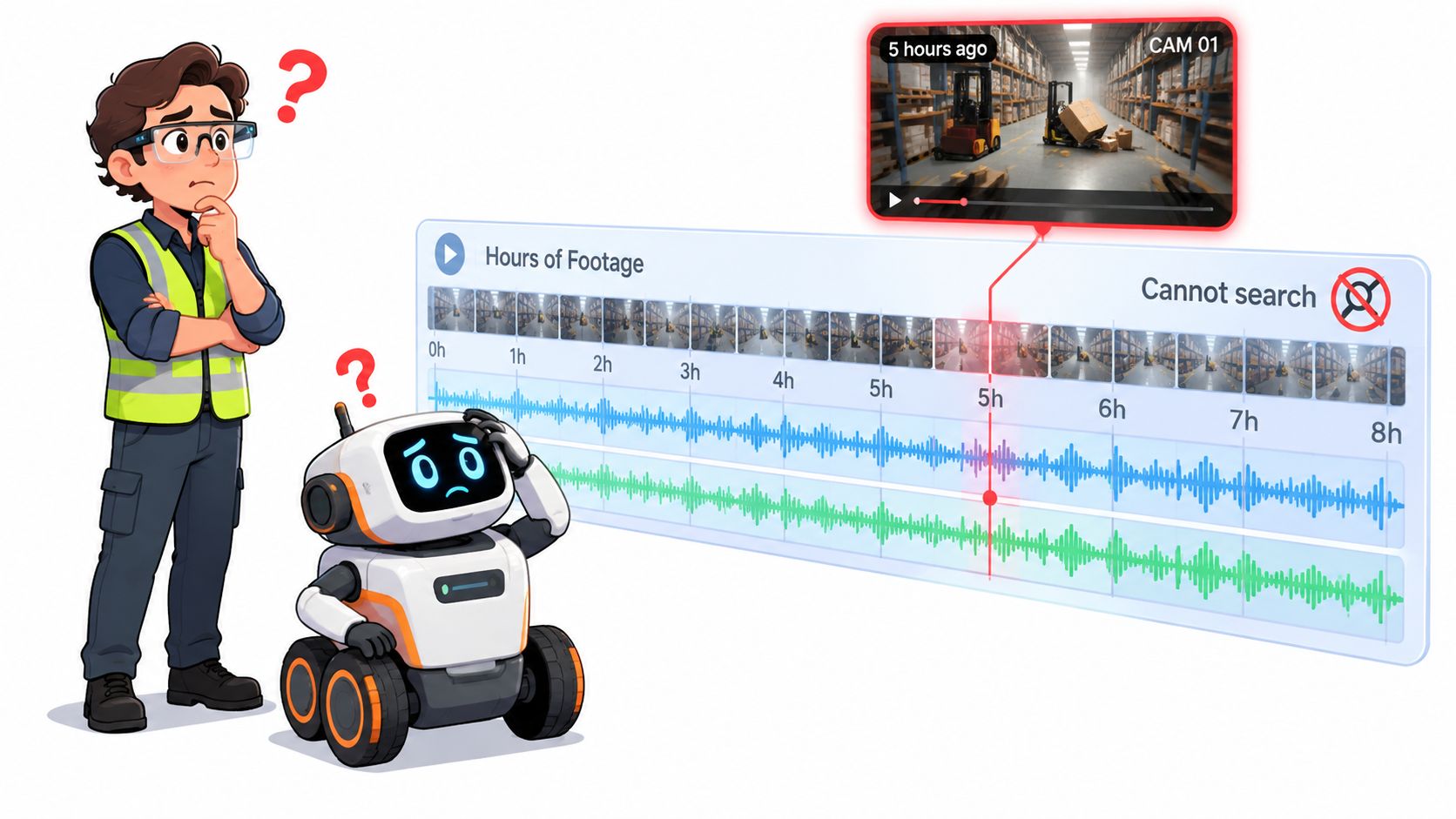
You're reviewing footage from a robot, smart-glasses app, dashcam, or CCTV camera. The recording exists, but the answer is buried inside hours of unsorted video and audio. A worker asks what happened near a loading area, an operator wants the moment a warning sound began, or a mobile user needs to find every clip showing a particular object. Traditional storage can preserve the files, but it doesn't give the system a usable memory.
That distinction matters for the Nvidia inference stack, Blackwell and Vera Rubin. The important question isn't only how many calculations a GPU can perform. It's how efficiently a complete system can move, remember, interpret, and retrieve multimodal information for continuous Physical AI. This guide connects data-center inference with the mobile and edge devices that capture the world.
Table of Contents
- Why Physical AI Needs a Memory Layer Now
- Continuous capture changes the inference problem
- From capture to recall
- What an AI Memory Layer Actually Does
- Storage is not indexing
- Why timestamps matter
- Inside the Nvidia Inference Stack From Blackwell to Vera Rubin
- Blackwell connects the model to the serving path
- Memory movement can dominate
- Vera Rubin treats the rack as the unit
- How Blackwell and Vera Rubin Change Inference Economics
- Where inference gains actually come from
- The on-device and rack-scale trade-off
- Architecture Patterns for Edge and Mobile Memory
- Three practical patterns
- Mapping the pattern to the device
- Industry Use Cases for Search for Video in Physical AI
- Advertisement video edition
- Vision for Robotics
- Audio for Robotics
- Dashcam, CCTV, and video surveillance
- Design Patterns Pain Points and Next Steps for Builders
Why Physical AI Needs a Memory Layer Now
A warehouse robot may observe shelves, workers, alarms, forklifts, and changing routes throughout a shift. A pair of smart glasses may capture what the wearer sees while recording synchronized audio through a companion phone. A dashcam or CCTV system may preserve an incident, yet still fail the simple question, “What happened shortly before the obstruction appeared?”
The problem isn't necessarily missing data. It's missing context. Conventional video storage treats footage primarily as a file to play or scrub manually. Physical AI needs a way to connect visual events, speech, environmental sounds, and time so an application can recall a moment instead of forcing a person to inspect the entire recording.
Continuous capture changes the inference problem
A short question about a physical event may depend on several signals. The relevant evidence could be a person entering a zone, a machine changing state, a spoken instruction, or a sound that occurred before the visible event. A system that analyzes only isolated images will miss relationships across those signals.
This is why always-on applications need more than a model endpoint. They need an inference path that can process streams efficiently, preserve useful history, and return results with enough temporal precision for an operator or an autonomous system to act.
Practical rule: Treat video and audio history as an active operating layer, not as an archive that becomes useful only after someone opens a file.
From capture to recall
The architecture spans several levels:
- Capture devices include phones, smart glasses, robots, dashcams, GoPro cameras, and IoT cameras.
- Edge software manages buffering, uploads, local processing, and connectivity interruptions.
- Inference infrastructure interprets visual, textual, auditory, and environmental signals.
- Memory and search make past events available to applications through natural-language, visual, or audio intent.
The Nvidia stack addresses the infrastructure side of this path. Blackwell combines hardware with production software for serving models, while Vera Rubin extends the idea toward a rack-scale AI system. Mobile developers still have to solve a different problem at the edge: how to collect and synchronize useful history without draining the device, losing data during poor connectivity, or making users manually label every moment.
The rest of the design follows one principle. A Physical AI system becomes more useful when it can remember the world it has already observed.
What an AI Memory Layer Actually Does
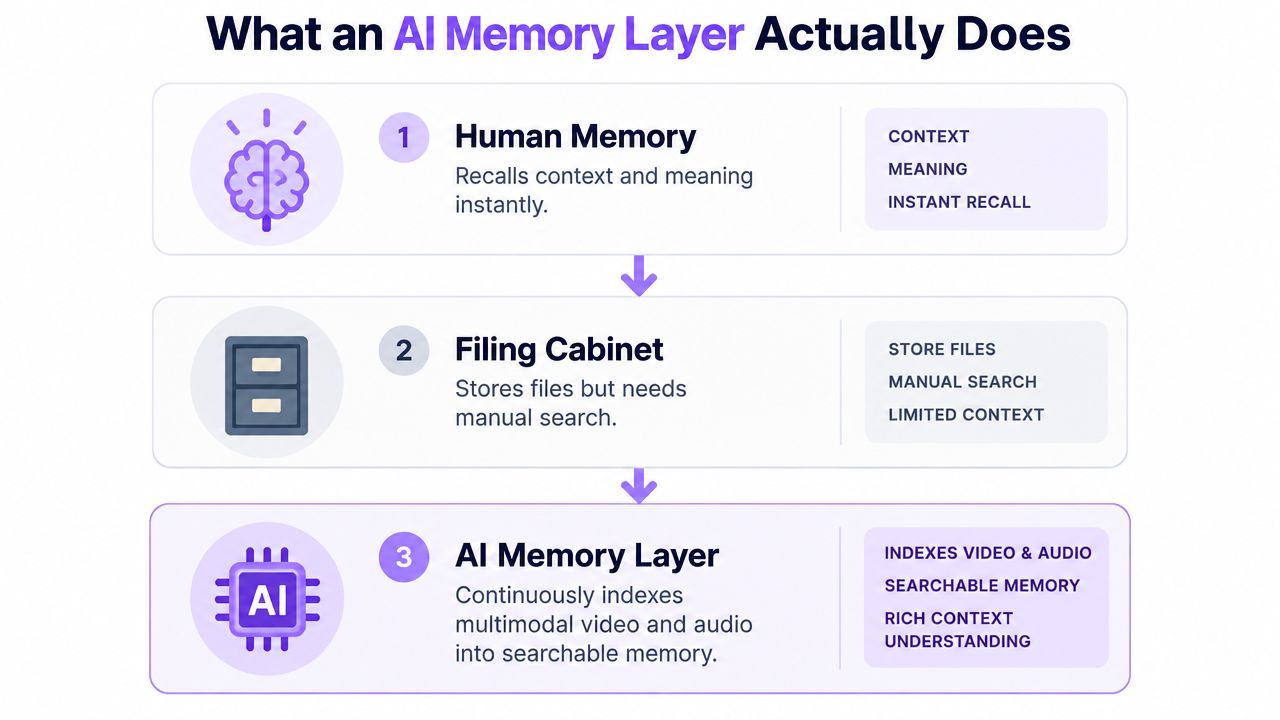
Think about the difference between human memory and a filing cabinet. A person can recall that a warning tone preceded a robot stopping, even if they don't remember the exact filename of the recording. A filing cabinet can store the evidence, but it needs a person to know which folder to open and where to look.
An AI memory layer sits between those extremes. It continuously processes multimodal streams and creates a searchable representation of what happened. The application can then ask about meaning, appearance, sound, or environmental state instead of relying on filenames and manual tags.
Storage is not indexing
A useful implementation separates three jobs:
- Storage preserves the original media. Video, audio, images, and sensor records remain available for playback or later processing.
- Indexing turns observations into searchable memory. The system identifies relevant visual and auditory context and associates it with time.
- Retrieval returns evidence to the application. A query can point to a precise segment rather than returning an entire recording.
These jobs have different constraints. Storage needs durability and manageable transfer. Indexing needs efficient inference and temporal alignment. Retrieval needs low enough latency for a person or robot to use the result during a workflow.
Why timestamps matter
Physical events unfold continuously. A worker may speak before a robot changes direction. A warning sound may begin before a camera sees the obstruction. A vehicle may pass through a frame while a driver issues a voice command. If the visual and audio streams aren't aligned, the system may return a technically related clip without the causal context that makes it useful.
Frame-level understanding helps the system distinguish a moment from a broad file description. Audio-timestamp understanding helps it associate speech, alarms, impacts, and environmental sounds with the corresponding visual scene. The application can then support query modes such as:
- Text to video, for requests describing an event or object.
- Image to video, for finding moments visually similar to a reference.
- Voice to audio, for locating spoken phrases or sound patterns.
- Environmental state to video, for connecting a physical condition with recorded evidence.
The memory layer shouldn't replace the original recording. It should make the recording usable. For a robot, that can mean recalling a prior obstacle. For a glasses application, it can mean finding when a product was seen. For a surveillance operator, it can mean narrowing a long review to relevant time segments.
Inside the Nvidia Inference Stack From Blackwell to Vera Rubin
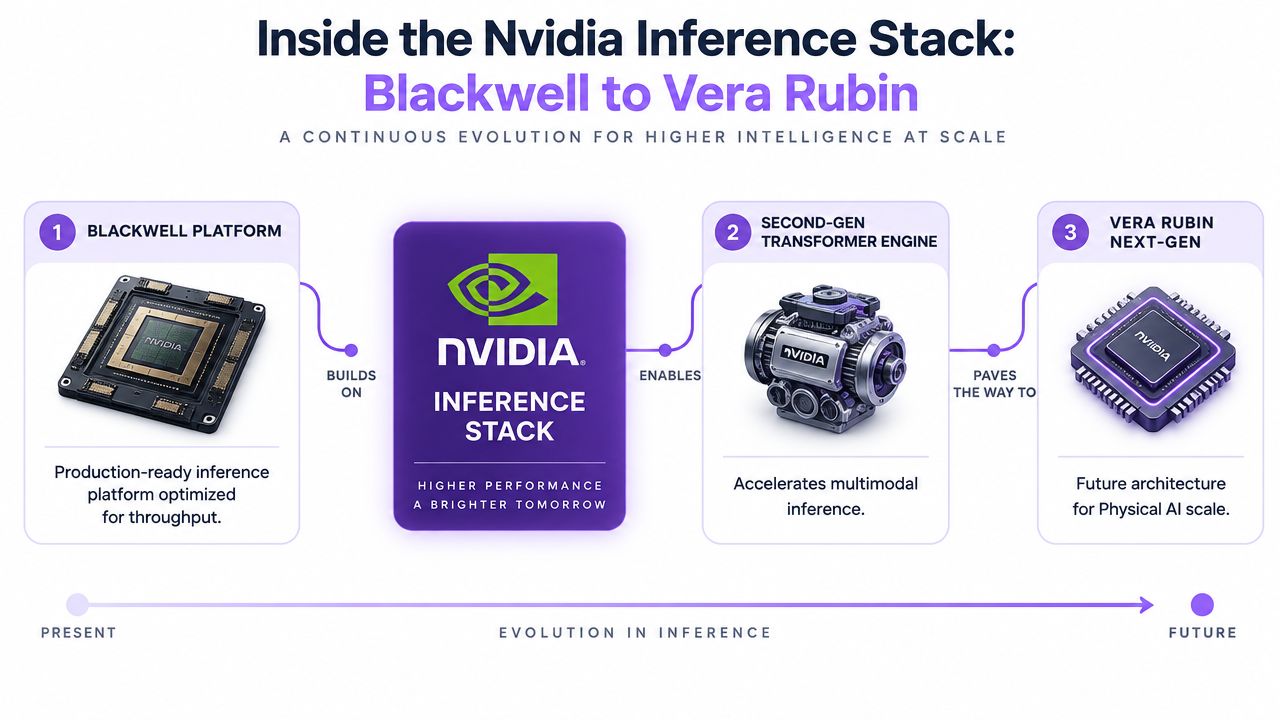
Blackwell is best understood as a production-ready inference platform, not merely a standalone accelerator. NVIDIA describes its inference stack around the second-generation Transformer Engine and a production software layer that includes TensorRT-LLM, NeMo Framework, Dynamo, and native integrations with PyTorch, vLLM, SGLang, and llm-d through its Blackwell architecture overview.
Blackwell connects the model to the serving path
For an inference application, raw GPU throughput is only one part of the result. Model graphs may need optimization. Kernels may need fusion. The serving framework must schedule requests and move data through memory without leaving the accelerator idle. Integrations with familiar frameworks reduce the distance between a developer's model and a deployable service.
That matters for large language models and Mixture-of-Experts workloads, where the system may spend substantial effort coordinating data and execution. NVIDIA's positioning of Blackwell emphasizes end-to-end serving efficiency, including model graph optimization, kernel fusion, and framework-native deployment.
A mobile developer doesn't need to manage every data-center detail, but the consequence is direct. If the backend serves multimodal queries efficiently, a smart-glasses or robotics application can request richer context without turning every interaction into a slow, expensive batch job.
Memory movement can dominate
A microbenchmark of Blackwell found 96–99% of theoretical peak across precisions, while concluding that tensor cores weren't the bottleneck. The analysis identifies memory bandwidth and kernel-launch overhead as dominant constraints in the tested workload, as documented in the Blackwell microbenchmark paper.
That finding changes how buyers should evaluate inference hardware. A higher FLOPS figure doesn't automatically translate into lower latency for decode, long-context interaction, or multimodal retrieval. The useful questions are:
- How much data must move between memory tiers?
- How often does the system launch small kernels?
- Does the serving layer schedule the workload efficiently?
- Can multiple GPUs communicate without becoming the limiting path?
Vera Rubin treats the rack as the unit
NVIDIA describes Vera Rubin as the successor platform to Blackwell for large-scale AI deployments. Its Vera Rubin platform page presents a multi-rack POD-scale system that combines five purpose-built rack-scale systems into one coherent AI supercomputer.
Independent reporting describes Rubin as spanning seven chips across five rack types, including GPU, CPU, DPU, Ethernet, and a dedicated inference accelerator. The same reporting says NVIDIA claims 10x lower token cost and one-quarter of the GPU count for MoE training versus Blackwell, while also highlighting the unresolved production question: whether the savings appear most clearly in low-latency decode, long-context agents, or overall cluster utilization. Those claims and trade-offs are discussed in Tom's Hardware's Rubin coverage.
The architectural shift is important. Blackwell packages hardware and software for efficient serving. Vera Rubin expands the scope to rack-level orchestration, networking, power, cooling, and procurement. For Physical AI, that system view matters because continuous multimodal inference creates pressure across the complete path, from captured frame to returned memory.
How Blackwell and Vera Rubin Change Inference Economics
Distributed inference often becomes limited by memory and communication rather than by arithmetic. A large model may need to be divided across GPUs, and the system must exchange activations, expert assignments, or cached context while keeping the devices productive.
Blackwell's fifth-generation NVLink addresses this layer. NVIDIA's technical brief reports 50 GB/s in each direction per NVLink link, 18 NVLink links per GPU, and 1.8 TB/s of total bandwidth per GPU. At the system level, NVLink Switch enables 130 TB/s of GPU bandwidth in a 72-GPU NVL72 domain and scales to 576 GPUs, according to the Blackwell and Blackwell Ultra technical brief.
That capability matters when a model is sharded across devices. Faster communication can reduce waiting, but it doesn't eliminate every bottleneck. Kernel-launch overhead, memory access patterns, request scheduling, and utilization still determine what an application experiences.
Where inference gains actually come from
| Factor | Impact on Inference |
|---|---|
| Tensor-core throughput | Helps dense mathematical work, but it may not be the limiting factor for every serving path. |
| Memory bandwidth | Feeds model weights, cache, and intermediate data, especially during communication-heavy or long-context workloads. |
| Kernel-launch overhead | Small or fragmented operations can leave compute resources waiting. |
| GPU interconnect | Faster links support model sharding and distributed inference with less communication pressure. |
| Serving software | Graph optimization, kernel fusion, batching, and framework integration influence token latency and utilization. |
| Rack-scale design | Coordinated networking, cooling, power, and orchestration can affect the economics of sustained operation. |
The on-device and rack-scale trade-off
On-device inference offers local responsiveness, reduced dependence on network access, and stronger control over sensitive recordings. Its limits include battery, thermal headroom, memory capacity, and the practical difficulty of indexing continuous multimodal history on a mobile or embedded device.
Cloud inference offers broader model capacity and centralized operations. It also introduces upload latency, bandwidth dependency, and the need to transfer or synchronize physical-world data before the system can use it.
Rack-scale platforms sit at the opposite end of the design space. Rubin is positioned for large-scale AI deployments where communication, utilization, and infrastructure coordination are purchased as one system rather than assembled as isolated servers. That can simplify performance planning for demanding workloads, but it also creates trade-offs in procurement, facility power, cooling, deployment scope, and software integration.
The right question isn't “Which platform has the biggest theoretical number?” It's “Which memory and serving path keeps the application responsive at the required scale?”
Architecture Patterns for Edge and Mobile Memory
Physical AI begins where the data is captured. A phone, robot, smart-glasses companion, dashcam, GoPro, or CCTV camera sees and hears the environment before a Blackwell or Rubin system processes it. The edge architecture determines whether that information arrives intact, arrives late, or disappears during a connectivity failure.
Three practical patterns
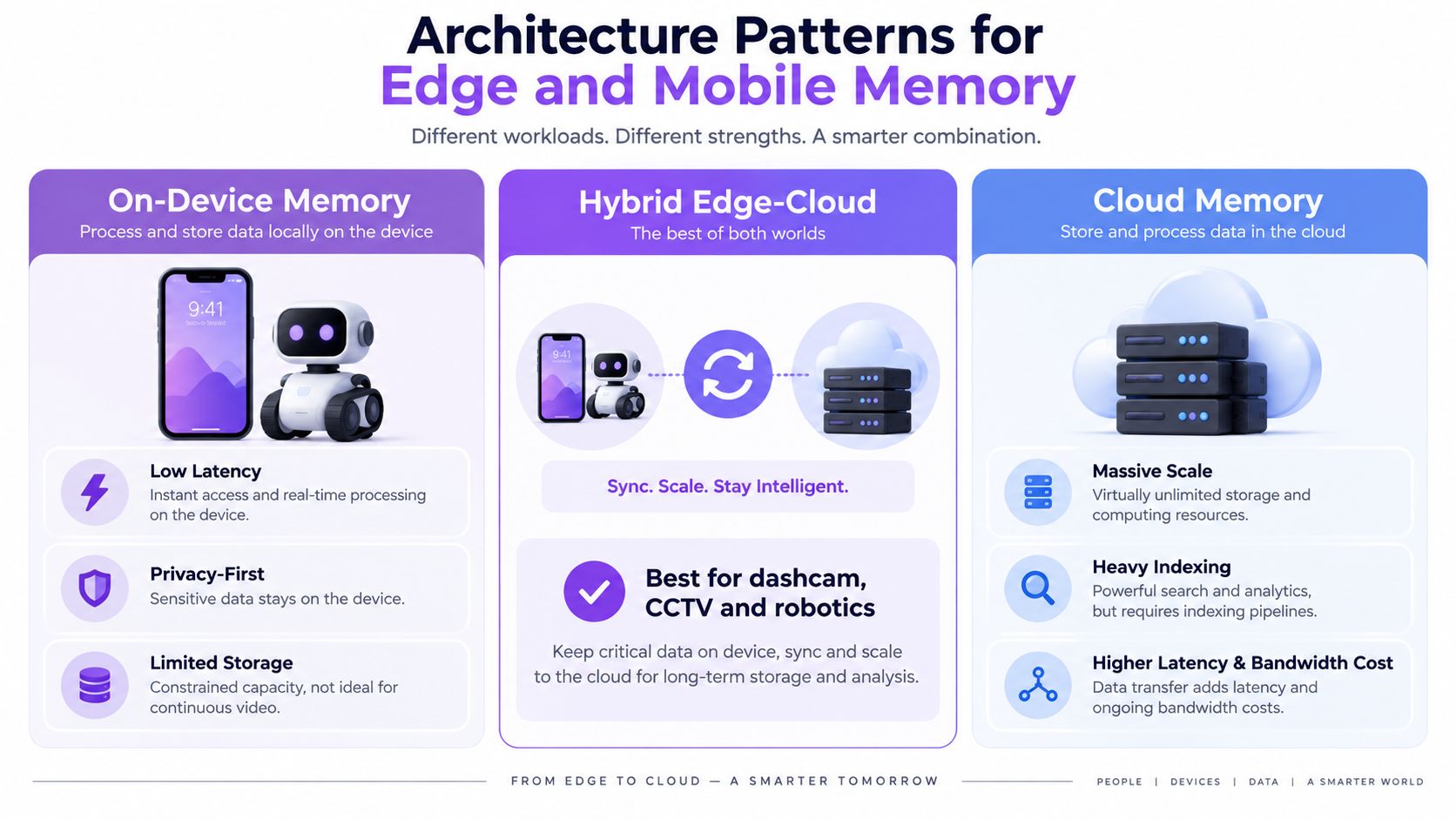
On-device memory keeps capture and recall close to the sensor. A robot can retain recent observations locally, while a mobile app can make selected history available without waiting for a round trip to the cloud. This pattern supports privacy and local responsiveness, but storage and compute remain constrained.
Hybrid edge-cloud memory lets the device capture, buffer, and perform lightweight local work while sending selected media or queries to a stronger backend. This fits dashcams, CCTV deployments, and robotics hubs where connectivity exists but isn't perfectly reliable.
Cloud-centered memory centralizes indexing and retrieval. It can support broad model capacity and shared access across teams, but the application must manage uploads, bandwidth, latency, and data governance.
Mapping the pattern to the device
A smart-glasses application may use a mobile companion app to access camera and audio functions. Meta's Wearables Device Access Toolkit gives developers access to those functions through a mobile app, while third-party examples built on Meta Ray-Ban glasses describe continuous video capture at about 1 frame per second with synchronized audio. That capture pattern is sparse compared with conventional video, but it can still create valuable ambient memory when the system preserves timing and context.
For Android, Kotlin services can manage capture state, local queues, permissions, and upload retries. Flutter can provide a shared application layer across Android and iOS, while platform-specific code handles camera, audio, and background execution constraints. Dashcam and GoPro applications need resilient chunking because connectivity may disappear while the camera continues recording. CCTV systems need stable ingestion and retention policies because multiple streams may run continuously.
Design insight: The edge shouldn't attempt to reproduce a data center. It should preserve context, maintain synchronization, and send the right material to the right inference tier.
A good mobile stack separates media handling from search requests. Signed streaming URLs can support controlled playback, while chunked multipart uploads help applications recover from interrupted transfers. Local buffering protects against temporary network loss. A hybrid memory layer can then return recent local history quickly and use cloud or rack-scale inference for broader search.
Industry Use Cases for Search for Video in Physical AI
The same multimodal search capability looks different in each industry because the user's question changes. A media editor wants a usable shot. A robot wants evidence about its surroundings. A security operator wants to narrow an investigation.
Advertisement video edition
An editor may have a large collection of product footage and remember the desired moment by meaning rather than filename. A text-to-video query such as “show the product being placed on a table near a window” can identify candidate segments. Image-to-video search can help locate visually similar framing or packaging, while audio search can find a spoken product phrase or a particular sound effect.
The value isn't only faster browsing. It helps connect visual content with dialogue, ambience, and timing. Editors can still review the original material, but they start from relevant moments instead of manually scrubbing every file.
Vision for Robotics
A warehouse robot may need to answer whether it encountered a blocked route earlier, where an object was last visible, or which scene preceded a failed action. Visual memory can provide historical context for planning, debugging, and operator review.
Robotics teams often face opaque physical data. Logs may record actions and sensor values without making the surrounding visual scene easy to inspect. Searchable video gives engineers a more direct way to relate a decision to what the robot observed.
Audio for Robotics
Sound can reveal information that vision misses. A robot may hear a warning alarm, a human instruction, a collision-like impact, or a machine operating irregularly. Voice-to-audio queries can locate the relevant sound, while synchronized video lets an engineer inspect the environment at the same moment.
This is especially useful when a physical event has a delayed visual consequence. The sound may occur first, and the robot's changed behavior may appear later.
Dashcam, CCTV, and video surveillance
A dashcam system can search for a vehicle, obstruction, spoken phrase, or unusual sound without requiring a driver or investigator to review every recording. CCTV operators can narrow footage around a visual indicator, then inspect adjacent audio and camera context. Video surveillance teams can use the same approach to reduce manual review while preserving the original evidence for verification.
Physical AI, robotics, and media content share the same foundation, but their pain points differ:
- Physical AI needs continuous environmental memory for systems that act in the world.
- Robotics needs visual and auditory context for navigation, diagnosis, and safety review.
- Media content needs precise discovery across large creative libraries.
- Surveillance needs time-based evidence retrieval across long operational recordings.
The common requirement is a search layer that understands more than a filename. It must connect text, images, audio, and physical context without forcing the user to create exhaustive manual tags.
Design Patterns Pain Points and Next Steps for Builders
Builders usually encounter the same obstacles before they reach a reliable Physical AI memory experience:
- Disconnected device history: A phone, glasses system, robot, or camera may preserve its own context without sharing it cleanly.
- Bandwidth constraints: Continuous media can overwhelm uploads or create unacceptable delays.
- Cross-platform complexity: Android, iOS, Flutter, embedded Linux, and camera firmware impose different lifecycle and storage rules.
- Manual footage review: Operators and developers lose time scrubbing recordings to find one event.
- Fragmented audio-visual analysis: Separate pipelines can produce mismatched timestamps and incomplete context.
A practical architecture starts by deciding where each responsibility belongs. Keep urgent or privacy-sensitive recall near the device. Use a hybrid path when the device needs local resilience but the application also requires broader inference. Reserve rack-scale infrastructure for workloads where large models, shared memory, distributed serving, and sustained utilization justify the operational commitment.
Use a few design checks before implementation:
- Preserve original media and searchable representations separately.
- Keep visual frames and audio timestamps aligned.
- Support text, image, voice, and environmental-state queries.
- Design uploads for interruption and recovery.
- Test retrieval during poor connectivity, not only in a stable lab.
- Measure useful response time from the user's query to returned evidence, not just model execution time.
Vera Rubin's role is to extend the system-level approach. NVIDIA describes it as a multi-rack POD-scale system combining five purpose-built rack-scale systems into one coherent AI supercomputer and as the successor to Blackwell for large-scale AI deployments, as stated on the NVIDIA Vera Rubin platform page. Blackwell provides a production inference foundation today, while Rubin represents a broader rack-scale direction for continuous, multimodal, agentic workloads.
V-Modal AI provides a Visual Memory Layer for Physical AI, with multimodal video and audio search, robotics edge memory, natural-language retrieval, and mobile integration support. To prototype a searchable memory layer across robotics, smart glasses, dashcams, CCTV, or mobile applications, visit V-Modal AI and explore its public repositories and SDK offerings.