Edge Compute Accelerator for AI Workload
A field technician puts on smart glasses and asks for the moment a robotic arm stalled during the previous shift. A home robot hears a spoken complaint and searches its own camera and microphone history for the matching event. Neither user wants to scrub hours of recordings, upload sensitive sensor data, or wait for a remote service to interpret a simple request.
That experience depends on more than a powerful model. It depends on an Edge Compute Accelerator for AI workload, the hardware that moves perception, encoding, retrieval, and action closer to the device where data is created. The important question isn't how impressive the accelerator looks in a product brief. It's whether the complete system can keep video, audio, control, and memory workloads moving together under real power, thermal, bandwidth, and privacy constraints.
Table of Contents
- Why the Edge Compute Accelerator for AI Workload Matters Now
- The shift from cloud inference to local memory
- Why raw compute isn't enough
- What an Edge Compute Accelerator Actually Does
- Different processors, different stations
- Memory movement sets the practical speed
- Physical AI Stacks and Where Accelerators Plug In
- The accelerator's position in each stack
- Hardware selection is a system decision
- Multimodal Video and Audio Search in Real Devices
- Dashcam memory needs more than object detection
- Robots search across perception logs
- Inside an On-Device Multimodal Search Architecture
- Capture creates the timing problem
- Encoding turns raw streams into usable representations
- Indexing and retrieval need different primitives
- Fusion produces the useful answer
- Pain Points When AI Workloads Meet Edge Reality
- Why the cloud isn't a universal escape hatch
- Choosing and Deploying the Right Accelerator Stack
- Seven decisions that prevent expensive rework
- The deployment sequence matters
Why the Edge Compute Accelerator for AI Workload Matters Now
AI inference used to be treated as a cloud task with a thin device client. A phone, camera, or robot captured data, sent it away, waited for a response, and displayed the result. That model still works for some workloads, but it becomes inefficient when the device must remain responsive, operate offline, protect private recordings, or understand several streams at once.
A smart-glasses application may need to process first-person video, microphone input, motion data, and a user query at the same time. A dashcam may need to recognize road events while preserving cabin audio and navigating local storage. A robot may combine vision, depth, inertial data, speech, and control signals without pausing its physical behavior.
The shift from cloud inference to local memory
Local processing doesn't eliminate the cloud. It changes which tasks need a round trip. Lightweight perception, event detection, audio filtering, embedding generation, and memory updates can happen close to the sensor, while heavier analysis or fleet-level workflows can remain remote.
That division matters because edge devices face constraints that data centers don't. Bandwidth, latency, privacy, power, and connectivity all shape the design. A device that records continuously can't assume a reliable network, and a robot that must react to a physical obstacle can't make every decision after a remote request.
The market reflects this change. One edge AI accelerator market estimate valued the industry at USD 7.7149 billion in 2024 and projected it to reach USD 38.4458 billion by 2030, representing a 30.8% CAGR from 2025 to 2030. The same source cites another estimate of USD 9.91 billion in 2025 and USD 112.14 billion by 2034, with a 30.9% CAGR from 2026 to 2034. These estimates differ in scope, but both point to the same architectural reality, dedicated acceleration is becoming central to practical edge inference.
Why raw compute isn't enough
Multimodal systems create a continuous memory problem. The hardware must receive sensor data, prepare it, stage model inputs, move tensors to the accelerator, run inference, move outputs back, and complete post-processing. Those stages often compete for memory bandwidth and CPU time.
Architectural rule: Treat the accelerator as part of the whole inference path, not as an isolated chip.
Physical AI makes this especially clear. A robot doesn't only classify an image. It interprets the environment, recalls relevant observations, chooses an action, and responds within the limits of its mechanical system. A mature NPU can help, but only if the surrounding software and memory architecture can sustain the stream.
What an Edge Compute Accelerator Actually Does
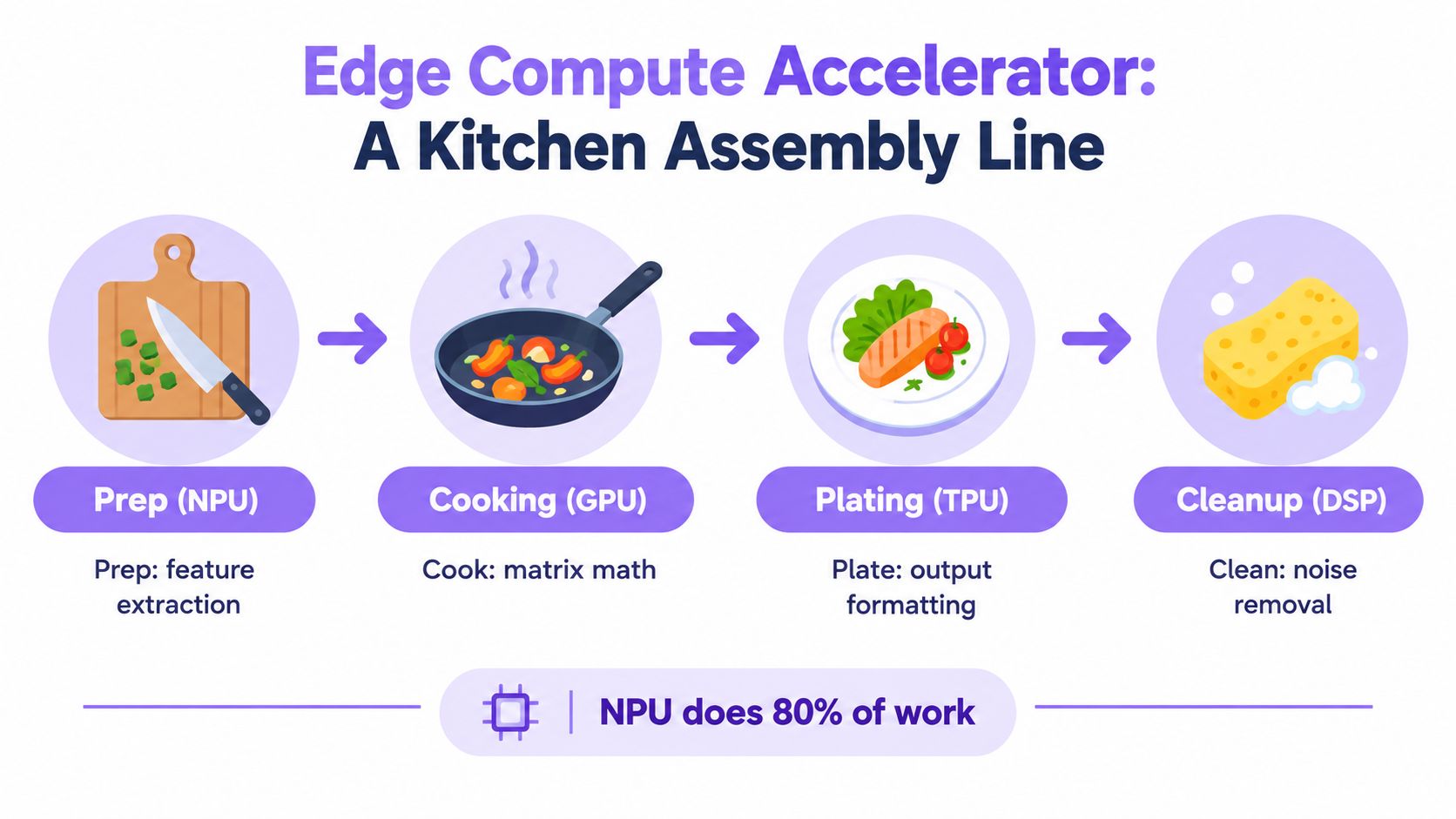
An accelerator is a specialized processing engine that handles operations common in neural-network inference more efficiently than a general-purpose CPU. The easiest way to understand the difference is to think of an edge system as a kitchen assembly line.
Different processors, different stations
The NPU is the preparation station. It performs the repeated tensor operations used by feature extraction and many transformer layers. On a smart-glasses device, it might prepare visual features from camera frames. On a mobile phone, it can run an optimized encoder without placing every operation on the CPU.
The GPU is the cooking station. Its parallel structure suits vision kernels, image transformations, and matrix operations that can be distributed across many processing units. A vision-heavy robotics workload may favor the GPU when its operators map naturally to broad parallel execution.
A TPU-style systolic array is the plating station. It specializes in regular, structured tensor movement, making it useful for batched embedding or retrieval-related workloads when the software stack supports that execution pattern. A DSP is the cleanup station. It can handle always-on audio tasks such as filtering, beamforming, and voice-activity detection, allowing the main processor to remain available for other work.
The best design often uses these processors together rather than choosing one universal winner. Independent edge benchmarking illustrates why. For matrix-vector multiplication, NPUs reduced latency by 58.54%, while GPUs delivered 22.6% lower latency and twice the throughput for matrix multiplication, according to independent edge accelerator benchmarking. The operator and workload shape determine the result.
Memory movement sets the practical speed
Peak TOPS describes how quickly an engine can perform arithmetic under favorable conditions. It doesn't describe how quickly the system can deliver data to that engine. Real latency includes sensor transfer, preprocessing, input staging, DMA transfers, inference, output movement, and post-processing.
Memory bandwidth becomes a major limit when a model repeatedly reads weights and activations. A survey on cognitive edge computing contrasts the 1,555 GB/s bandwidth reported for an NVIDIA A100 with approximately 50 to 60 GB/s for mobile SoCs. That gap helps explain why autoregressive and streaming models can become memory-bound before they exhaust compute capacity.
Quantization can reduce that pressure. INT8, INT4, and mixed-precision paths shrink tensor representation, while sparsity can reduce unnecessary operations when the hardware and compiler support it. On-chip SRAM and unified memory also matter because they reduce expensive movement between processor domains. In a multimodal retrieval system, a smaller model that stays close to its data may feel faster than a larger model with higher theoretical throughput.
Physical AI Stacks and Where Accelerators Plug In
Physical AI connects perception to decisions and action. A mobile app can tolerate a delayed recommendation. A robot, dashcam, or smart-glasses interface often can't. Developers therefore select an accelerator stack according to the device's sensor load, response requirements, power source, thermal design, and software ecosystem.
The comparison below uses qualitative targets because actual latency depends on the model, sensor rate, operating conditions, and pipeline implementation.
| Stack | Typical Latency Target | Power Budget | Accelerator Mix | Multimodal Fit |
|---|---|---|---|---|
| Robotics | Real-time, predictable response | Constrained by battery and thermal enclosure | Full-stack SoC with NPU and DSP | Strong fit for vision, audio, depth, IMU, and control |
| Smart glasses | Immediate interaction with minimal delay | Extremely constrained by battery and heat | Ultra-low-power NPU with DSP support | Strong fit for first-person video and voice |
| Dashcam | Continuous event processing | Vehicle-powered, but thermally constrained | Always-on DSP plus mid-tier NPU | Good fit for road video, cabin audio, and event memory |
| CCTV | Sustained multi-stream processing | Depends on camera enclosure and local hub | Multi-stream NPU with edge TPU co-processor | Strong fit for video surveillance and audio events |
| Mobile phone | Interactive response across varied apps | Battery and skin-temperature limits | Heterogeneous CPU, GPU, NPU, and DSP | Broad fit for video, audio, language, and sensor fusion |
The accelerator's position in each stack
In robotics, the accelerator sits between the capture front end and the perception and fusion layers. The host processor still manages connectivity, operating-system responsibilities, security, and control logic. A dedicated engine can process camera and depth data while the CPU handles the rest of the system.
Smart glasses need a different balance. The device may capture a continuous first-person view, but it can't afford to run every model at maximum capacity. Lightweight local indexing, audio activity detection, and selective visual processing help preserve battery life while maintaining an interactive experience.
Dashcams and CCTV systems prioritize sustained operation. A dashcam benefits from a DSP that listens and filters continuously, paired with an NPU that processes meaningful visual events. CCTV platforms may need to manage several streams, so memory scheduling and multi-stream fairness matter as much as the accelerator's peak capability.
Mobile phones offer the broadest heterogeneous stack. Developers can assign camera preprocessing to one engine, audio cleanup to another, and neural inference to an NPU or GPU. The trade-off is software complexity. SDK maturity, model portability, compiler behavior, secure boot, and support for continuous embedding all influence the product outcome.
Hardware selection is a system decision
A chip that wins a single benchmark may lose in a wearable or robot after thermal limits, memory contention, and sensor transfers are included. Developers should evaluate the capture front end, on-device indexing, retrieval cache, and fusion layer as one pipeline.
That approach also clarifies the difference between conventional media content and Physical AI. Advertisement video editing can process selected clips in a workstation. A robot's memory layer must keep operating while the machine sees, hears, moves, and makes decisions.
Multimodal Video and Audio Search in Real Devices
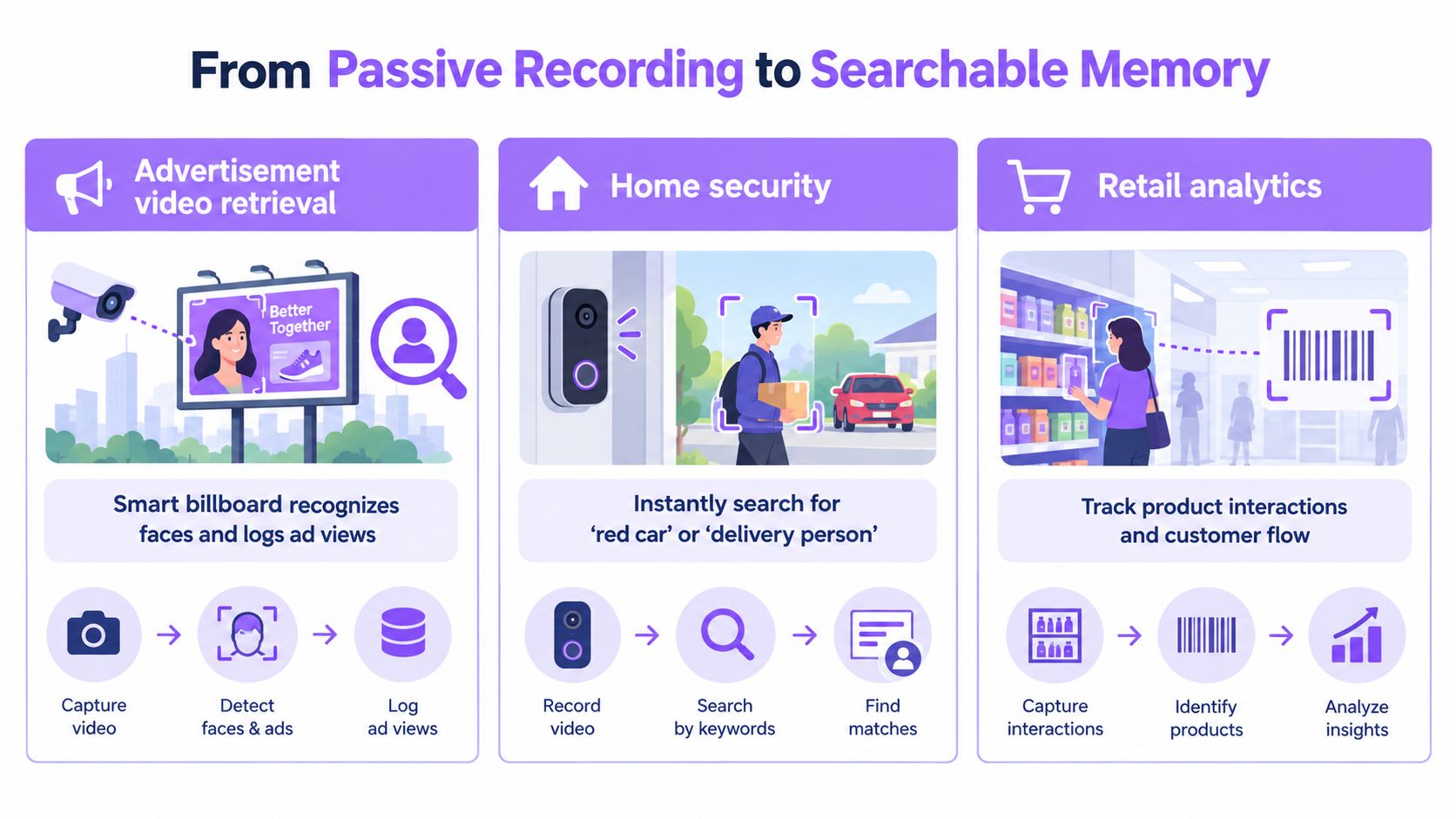
A recording becomes useful memory only when a device can locate the relevant moment without forcing a person to scrub through it. An edge compute accelerator makes that possible by processing selected video, audio, and sensor workloads near the source.
Advertisement video editing is a practical example. An editor may want every appearance of a product, logo, spoken phrase, or campaign sound across a collection of footage. A local device can identify useful moments during capture or ingest, so later review starts with searchable events rather than a blank timeline.
Dashcam memory needs more than object detection
A driver may ask for the car that cut them off near an exit. That request combines visual appearance, road context, approximate time, and possibly cabin speech. The accelerator must support frame analysis, audio processing, and temporal association without turning the dashcam into a cloud-dependent recorder.
The useful result isn't merely “a car was detected.” It's a short, relevant segment that preserves the surrounding context. Local processing can also keep sensitive cabin audio and road footage on the device when connectivity is unavailable or privacy requirements discourage upload.
Robots search across perception logs
A quadruped robot may record patrol footage alongside depth and inertial streams. An engineer could later look for stops preceded by unusual vibration, a visual obstruction accompanied by a sound, or a repeated interaction near a specific object.
Audio deserves first-class treatment in this workflow. NVIDIA describes Cosmos 3 as a family of omnimodal world models for Physical AI that processes language, image, video, audio, and action sequences across robotics, autonomous vehicles, and smart spaces. Its audio and video generation interface treats audio as part of the same multimodal world-model interaction, which is directly relevant when visual and acoustic context must remain synchronized.
A separate multisensory simulation study reported a 23.3% average reduction in NMAE when audio was added to simulation training compared with vision-only baselines. The lesson for robotics is practical, not cosmetic. Sound can add information that video alone doesn't capture.
The accelerator's batching strategy, quantization support, and local memory determine whether these searches feel responsive. A model that processes one stream efficiently may struggle when video, audio, and sensor features arrive concurrently.
Inside an On-Device Multimodal Search Architecture
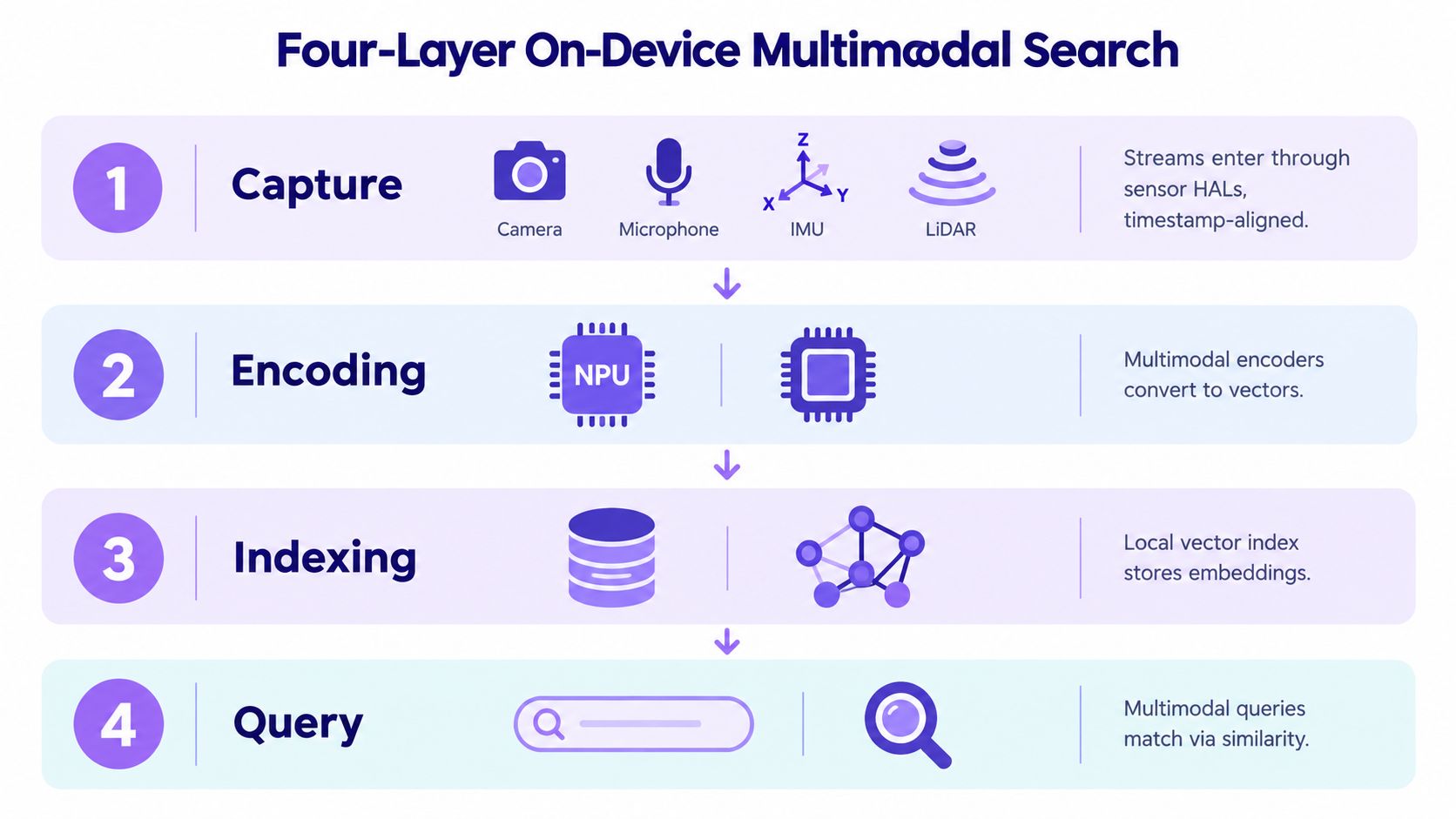
A practical on-device search system has four cooperating layers. The names are simple, but the hardware dependencies are tightly connected.
Capture creates the timing problem
Cameras, microphones, IMUs, and LiDAR produce different streams. Sensor hardware abstraction layers bring those streams into the software stack, while a shared clock and timestamp alignment preserve the relationship between what the device saw, heard, and felt.
This layer needs reliable transfer paths more than neural arithmetic. DMA, buffering, interrupt behavior, and memory layout determine whether downstream models receive complete and correctly ordered inputs.
Encoding turns raw streams into usable representations
Lightweight encoders transform images, audio, and video segments into compact representations. A CLIP-style image encoder can describe visual content, a small speech model can process audio, and a temporal model can represent changes across a video segment.
The accelerator helps with quantized and batched embedding generation. INT8 GEMM, supported convolutional operations, and efficient tensor staging can reduce the work assigned to the CPU. For continuous memory, sustained throughput matters more than a short burst because the device must keep updating its local history.
Indexing and retrieval need different primitives
The indexing layer stores representations so a later query can find related moments. Approximate nearest-neighbor structures, compressed vectors, sparse lookups, and local storage each place different demands on the system. The accelerator may support parts of the vector operation, while the CPU or storage engine manages organization and persistence.
Exact words from speech can follow a lexical path, while visual and acoustic similarity can follow a vector path. The system doesn't need one processor to own every operation. It needs predictable movement between them.
Fusion produces the useful answer
The fusion layer combines signals from different modalities and ranks candidate moments. A query about a delivery person may rely on visual evidence, speech context, and time relationships. A robotics query about vibration may combine inertial data with video and audio.
Google DeepMind's Gemini Robotics ER 2 integration pattern shows how developers can stream multimodal video, audio, or text into a model while exposing low-level control interfaces as tools. That pattern connects perception and action, but the local system still needs careful scheduling so retrieval doesn't interfere with control.
The architecture works when capture, encoding, indexing, and fusion share a hardware-aware design. Treating them as independent services often creates transfers, queues, and synchronization gaps that erase the advantage of local inference.
Pain Points When AI Workloads Meet Edge Reality
A prototype can look excellent when one short clip runs through one model. Production devices face a harsher workload. They process continuous streams, share memory with operating-system tasks, and operate inside thermal and battery limits that a development workstation doesn't reproduce.
The most common problems appear at the boundaries between components:
| Pain Point | Typical Symptom | Accelerator-Aware Fix |
|---|---|---|
| Thermal pressure | Sustained inference loses responsiveness | Measure performance across the full thermal envelope and schedule workloads by priority |
| Memory contention | Concurrent encoders queue behind one another | Keep frequently used tensors close to the accelerator and reduce unnecessary transfers |
| Model portability | Operators fall back to the CPU | Validate supported operators, compilers, and precision paths before committing to a model |
| Index growth | Local memory becomes difficult to manage | Compress representations, control retention, and design storage around actual queries |
| Quantization trade-offs | Lower precision affects result quality or creates fallback work | Test precision by modality and workload instead of applying one setting everywhere |
| Sensor drift | Audio, video, and IMU evidence no longer aligns | Use a shared clock, explicit timestamps, and integration tests with real sensors |
| Cloud fallback | Offline operation and privacy guarantees weaken | Keep time-sensitive perception and memory updates local, using the cloud selectively |
Why the cloud isn't a universal escape hatch
Sending every query to the cloud can simplify an early prototype, but it introduces network dependence and transfers sensitive content away from the device. It also separates the act of recording from the act of remembering. A robot that can't reach the network may lose access to its own recent context, while a surveillance operator may face restrictions on moving footage outside the site.
The deeper issue is co-design. Models, index structures, memory layouts, scheduling policies, and accelerator backends must be evaluated together. Optimizing only the neural model can leave the system waiting on preprocessing or data movement.
Production test: Benchmark the complete path from sensor arrival to returned result. A model benchmark alone can't expose queueing, synchronization, or memory-transfer costs.
Developers should also separate interactive queries from background ingestion. A dashcam can process an event asynchronously, but a user asking about the last incident needs a responsive query path. Robotics systems must prioritize control and safety workloads over optional historical indexing.
Choosing and Deploying the Right Accelerator Stack
Choosing an accelerator starts with the workload, not the product category. A smart-glasses application, a CCTV recorder, and a mobile robot may all use video and language, but their thermal, mechanical, and response constraints differ.
Seven decisions that prevent expensive rework
-
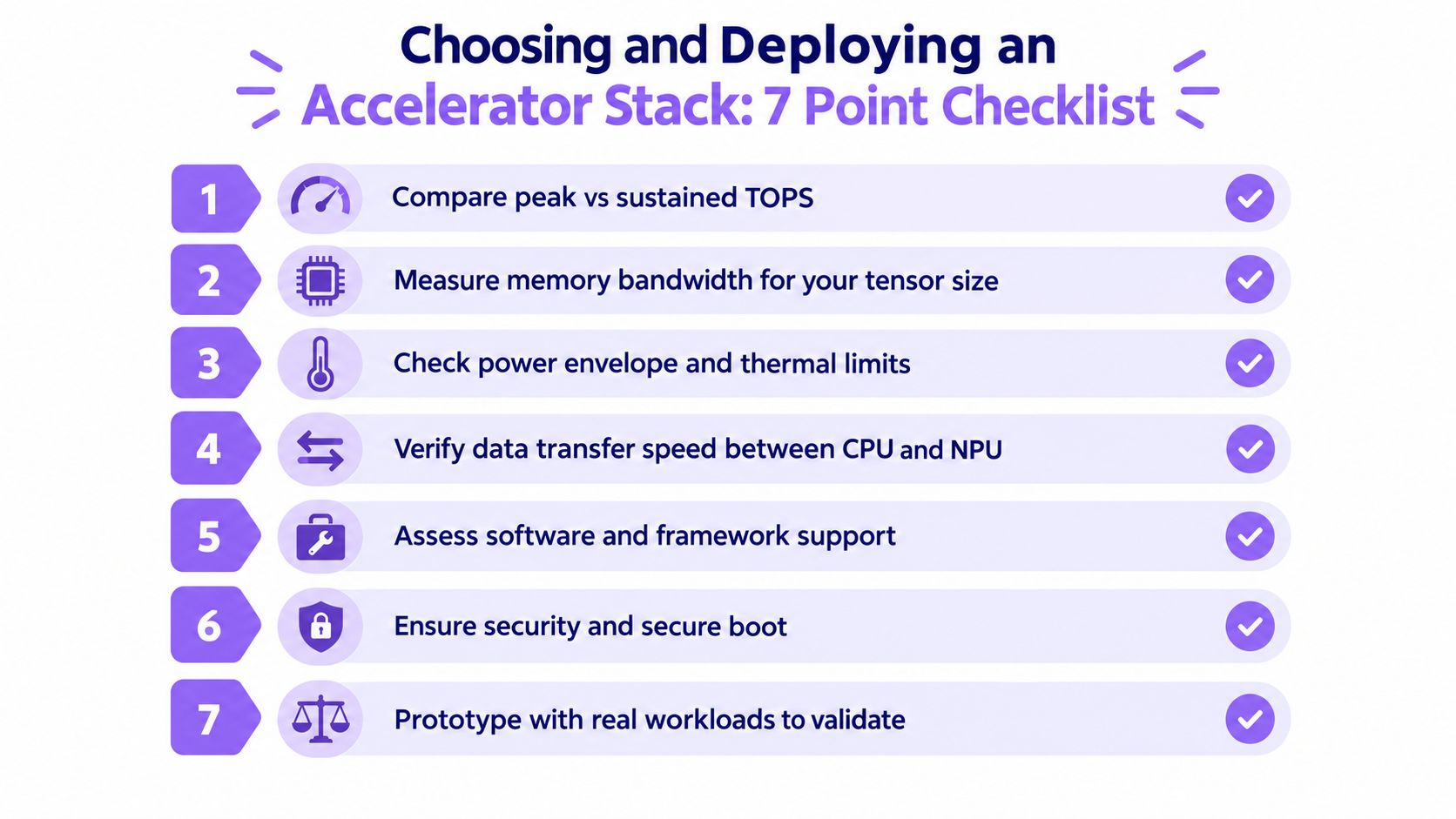
Compare peak and sustained throughput. Measure the accelerator while the workload runs continuously, not only during a short burst.
-
Match memory bandwidth to tensor movement. Identify the largest embedding, activation, and model-weight transfers, then test whether the memory system can feed them without starving other tasks.
-
Check thermal and power limits. A wearable needs a different operating point from a vehicle-powered CCTV hub. Battery life, enclosure temperature, and fan behavior belong in the benchmark plan.
-
Verify processor interconnects. CPU-to-NPU and sensor-to-memory transfers can dominate latency when the accelerator sits on a separate bus.
-
Assess software support. Confirm that the SDK, compiler, runtime, and model format support the operators and precision modes your multimodal models require.
-
Protect the deployment. Secure boot, hardware root of trust, protected model assets, and controlled updates matter when devices capture private environments or control physical systems.
-
Prototype with real streams. Use actual cameras, microphones, IMUs, storage, queries, and background services. Synthetic single-input tests hide the failures users will notice.
Mobile NPUs suit phones and smart glasses when low power and heterogeneous scheduling matter most. Embedded GPUs paired with DSPs can fit robotics systems that combine vision, audio, and control. Dashcams and CCTV platforms often benefit from always-on audio and vision acceleration, while the exact balance depends on stream count and enclosure design.
The deployment sequence matters
Start by measuring the CPU baseline from capture through retrieval. Port the heaviest encoder to the accelerator, then fuse preprocessing kernels where the runtime permits it. Finally, benchmark end-to-end multimodal search, including indexing, storage access, query handling, and result formatting.
This approach turns the Edge Compute Accelerator for AI workload into a foundation for a Physical AI memory layer. Robots and wearables can maintain local histories, recall relevant observations, and act on context without treating the cloud as their only memory.
V-Modal AI provides a dedicated Search Layer for Physical AI with multimodal video and audio search, continuous memory, and edge-oriented tools for mobile devices, smart glasses, robotics, and IoT cameras. Explore the platform and SDK options by visiting V-Modal AI and evaluate how local searchable memory can fit your next edge accelerator workload.