Edge AI Inference: Hardware Stack for Mobile and Robotics
Your robot is moving through a warehouse when its camera catches a person entering the aisle. The perception model detects the event, but the response arrives late because frames are being copied through memory, the accelerator is waiting on data, and the system still depends on a cloud connection. A dashcam can record the same failure in a different form: video continues locally, audio timestamps drift, uploads stall, and a search for a spoken warning becomes a manual review exercise.
This is why Edge AI Inference: Hardware stack decisions can't be reduced to TOPS. Physical AI systems process continuous video, audio, and sensor streams under thermal, battery, bandwidth, and reliability constraints. The useful question is whether the complete path, from sensor to memory to accelerator to runtime, can preserve context and respond locally.
Table of Contents
- Why Edge Inference Fails Without the Right Hardware Stack
- The bottleneck is often data movement
- Physical AI needs graceful degradation
- Comparing Hardware Tiers for Physical AI and Multimodal Workloads
- Optimizing Models for On Device Inference
- Start with matched benchmarks
- Quantize with evidence
- Compile for the actual runtime
- Streaming Batching and Memory Management on Mobile and Edge
- Choose latency before throughput
- Treat memory as a product resource
- Preserve alignment across modalities
- Deploying Offline Ready Search With Android Flutter and V-Modal Memory
- Keep the device useful offline
- Plan the fleet before the pilot
- Pain Points Checklist and Next Steps for Reliable Edge Deployment
Why Edge Inference Fails Without the Right Hardware Stack
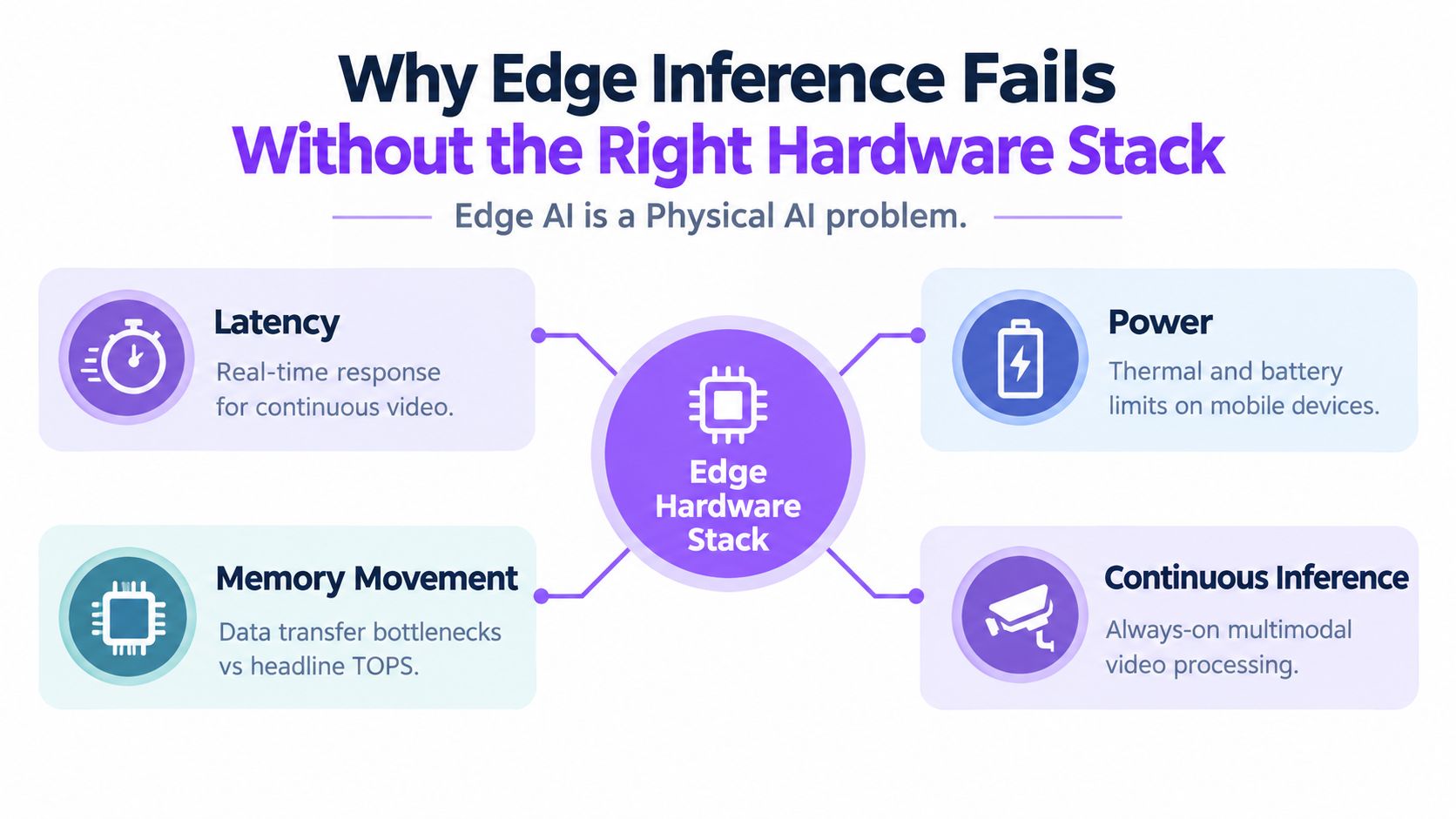
A robot may detect a person entering an aisle, yet respond too late because frames keep crossing between sensor buffers, system memory, and the accelerator. Smart glasses can lose battery faster than expected when every frame follows an inefficient path. A CCTV system may continue recording while cloud access fails, but lose the local context needed to search and classify events. These failures come from the stack, not from TOPS alone.
Market forecasts show growing demand for hardware that runs inference near the source. One estimate places the global edge AI chips market at $7.05 billion in 2025 and $8.33 billion in 2026, with an 18.2% CAGR across that forecast window, according to The Business Research Company's edge AI chips market report. The hardware is becoming easier to buy. Selecting a stack that maintains latency, power limits, and local context in production remains difficult.
The bottleneck is often data movement
A faster accelerator cannot reduce real latency if frames spend most of their time moving between the sensor, image preprocessor, system memory, cache, and NPU. Frequent memory access, limited SRAM, and constrained DRAM budgets can increase both latency and energy use, as discussed in this review of memory movement in edge AI systems.
Measure the path before choosing more compute. Check unified-memory behavior, on-chip SRAM, cache locality, bandwidth, and whether audio and video features can remain close to the accelerator. Continuous multimodal inference also needs memory for context, embeddings, timestamps, and sensor alignment. A benchmark that measures one isolated call will miss those costs.
Practical rule: Measure the time and energy spent moving data before assuming more compute will solve the problem.
Physical AI needs graceful degradation
A robot still needs obstacle avoidance when connectivity disappears. Smart glasses should retain basic perception without uploading every frame. A dashcam should preserve synchronized audio and video during a long drive, while CCTV should continue recording and classifying events through intermittent network access.
Offline-first behavior must be designed across the full stack. That includes sensor interfaces, preprocessing, memory management, inference runtime, operating system, local buffers, security controls, and update mechanisms. Fleet deployment adds another requirement: logs, model versions, thermal behavior, and recovery paths must remain manageable after devices leave the lab.
If a safety-critical response requires a cloud round trip, the deployment carries a reliability dependency that the accelerator cannot remove. The better stack keeps immediate decisions and useful multimodal memory on device, then synchronizes selected data when the connection returns.
Comparing Hardware Tiers for Physical AI and Multimodal Workloads
A smart-glasses detector, a robot with several cameras, and a dashcam listening for alarms do not stress hardware in the same way. Selection should start with the workload graph: sensor rates, preprocessing, model operators, context retention, and how often features move between CPU, GPU, NPU, and memory.
Market segmentation places ASICs and NPUs at 43.41% share in 2025, with device-edge deployment at 54.64%, according to The Business Research Company's market segmentation. Those categories reflect the shift toward local inference, but TOPS alone does not identify the right platform. Memory bandwidth, shared-memory contention, precision support, thermals, operator coverage, and runtime maturity determine whether a multimodal graph remains usable after sustained operation.
| Hardware Tier | Compute and Memory | Best Fit Use Case |
|---|---|---|
| Mobile SoC with integrated NPU | Shared mobile CPU, GPU, and NPU resources | Android apps, smart glasses, dashcams, action-camera capture, local audio, and lightweight video |
| Lightweight embedded accelerator | Google Coral Edge TPU, Hailo, Kneron, Syntiant, or similar specialized inference hardware | Low-power cameras, audio event detection, and compact IoT devices |
| NVIDIA Jetson Orin Nano | About 67 TOPS and 8 GB, based on public physical-AI hardware guidance | Lightweight robotic perception, compact vision systems, and Physical AI prototypes |
| Qualcomm RB3 Gen 2 | Up to 12 dense TOPS | Robotics, AI vision, smart security, and embedded mobile-style deployments |
| NVIDIA Jetson AGX Orin | About 275 TOPS and up to 64 GB | Production robots, multi-camera perception, and richer audio-video fusion |
| Camera and edge-box processor | Texas Instruments AM69A provides 32 TOPS for one to 12 cameras, according to Texas Instruments | Smart cameras, traffic monitoring, autonomous mobile robots, CCTV, and surveillance |
| Large Physical AI platform | Jetson AGX Thor is cited at about 2,070 FP4 TFLOPS and 128 GB for 2026 humanoid and large-model workloads | Humanoid robotics, large multimodal models, demanding local perception, and planning |
Treat the table as a sizing reference, not a ranking. Coral and compact Hailo-class devices suit fixed camera graphs with limited operators. They become restrictive when models change often, unsupported operations force CPU fallback, or continuous multimodal memory competes with inference buffers. Jetson platforms provide a broader robotics software ecosystem. Mobile SoCs usually win on size, power draw, camera integration, and Android deployment.
Memory movement often decides the practical tier. Keep audio features, video features, timestamps, embeddings, and recent context in the memory domain closest to the accelerator when possible. A platform with fewer advertised TOPS can deliver steadier latency if it avoids repeated copies and thermal throttling.
For Vision for Robotics, check camera count, image preprocessing, memory capacity, and sustained thermal behavior. Audio for Robotics may need a separate low-power path for wake words, alarms, speech cues, or machine sounds. Video editing favors a mobile GPU and media engine for responsive playback. CCTV and video surveillance need local buffering, predictable throughput, and recovery after long offline periods.
Choose the smallest platform that runs the complete graph, preserves useful multimodal context, supports required operators, and remains manageable across the fleet lifecycle.
Optimizing Models for On Device Inference
A model that performs well in a notebook can behave badly on a phone, robot, or camera. The deployment path changes memory layout, operator support, precision, preprocessing cost, and synchronization between streams. Optimization should therefore follow a measurement loop that uses the target hardware and representative inputs.
Start with matched benchmarks
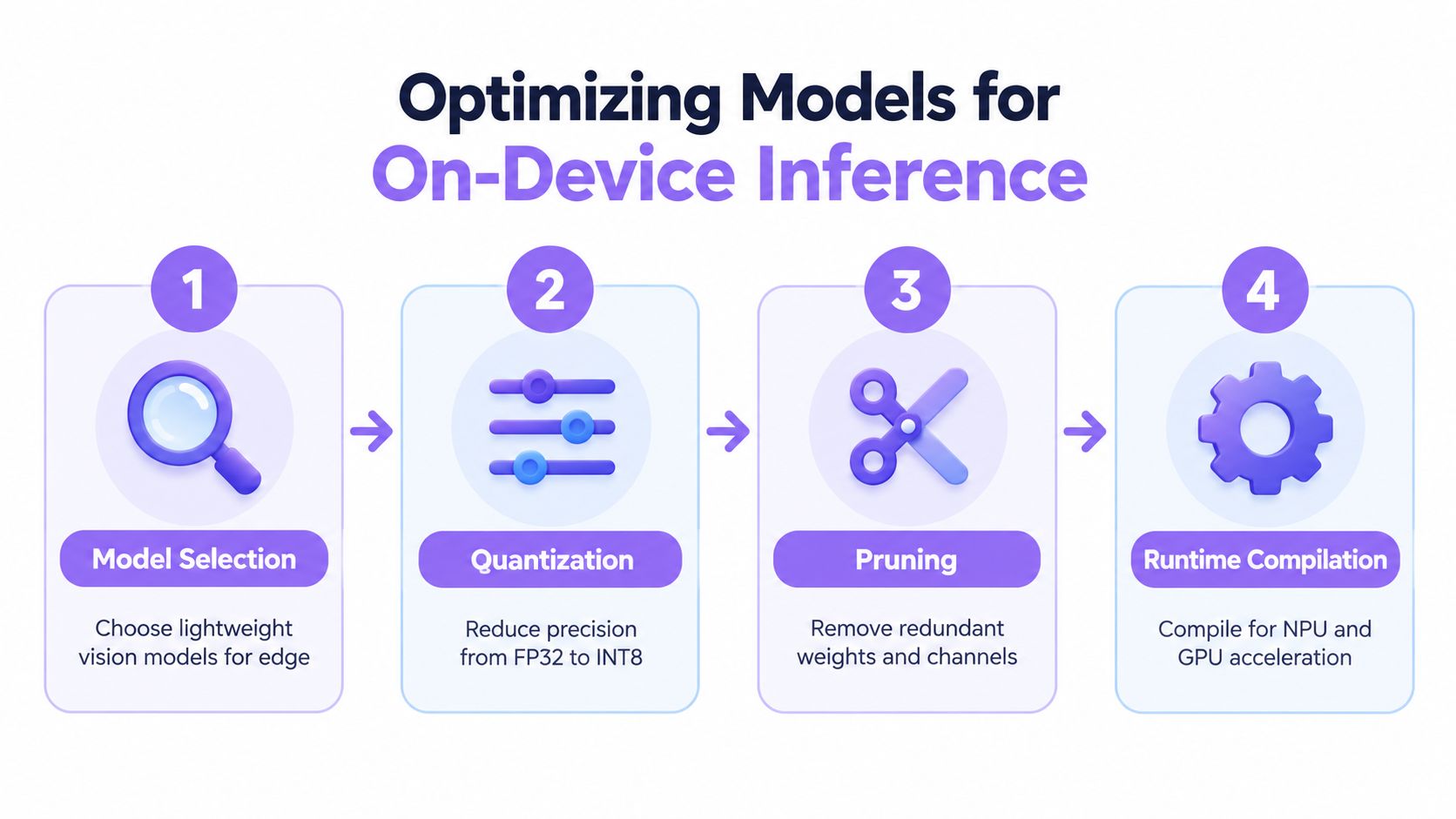
Run the same workload on CPU, GPU, and NPU at INT8 precision, using representative models such as YOLO and ResNet-style classifiers. Record single-sample latency, throughput, power, and power efficiency, then include preprocessing and postprocessing in the end-to-end result.
An independent benchmark found that NPU inference was 58.6% faster for matrix-vector multiplication and up to 3.2× faster for video classification and large language model workloads. GPU inference was 22.6% faster for matrix multiplication and 2.7× faster for LSTM workloads, while CPU could still win on less-parallel operations such as dot products, as reported in the benchmark study. The conclusion isn't that NPUs always win. Operator shape decides.
Quantize with evidence
Use representative calibration data, convert to INT8, and compare accuracy against the original model. Recent deployment analysis reports that incremental quantization can reduce memory by 3.5× to 6.4× across image classification, speech recognition, and biomedical segmentation models. The same analysis reports post-training INT8 latency reductions of 67% on Jetson Xavier NX and 55% on Orin Nano, with model size reduced by more than 70%, as detailed in the quantization analysis.
Those results don't justify blind compression. Low-bit settings can create accuracy drift, unsupported operators, or dequantization overhead that adds latency. Validate the entire graph, including audio feature extraction, image resizing, normalization, fusion, and output decoding.
Compile for the actual runtime
Use the runtime that matches the accelerator and deployment environment. Common options include TensorFlow Lite or LiteRT, ONNX Runtime, Intel OpenVINO, and PyTorch ExecuTorch, while mobile stacks include Apple Core ML, Qualcomm AI Hub, and MediaTek NeuroPilot, as catalogued by the Edge AI Directory.
Pruning can reduce redundant weights and channels, but it only helps when the target compiler and hardware exploit the resulting structure. A smaller model isn't automatically faster if it creates irregular memory access or falls back to CPU execution.
Deployment rule: Keep an accuracy gate, a latency gate, and a power gate. A conversion succeeds only when all three pass on the target device.
Streaming Batching and Memory Management on Mobile and Edge
Continuous video and audio expose weaknesses that short inference tests hide. A smart-glasses app may process camera frames while rendering an overlay. A dashcam may encode video, classify road events, capture cabin audio, and write local history at the same time. A CCTV node can run continuously for long periods, with no convenient restart when memory fragmentation appears.
Choose latency before throughput
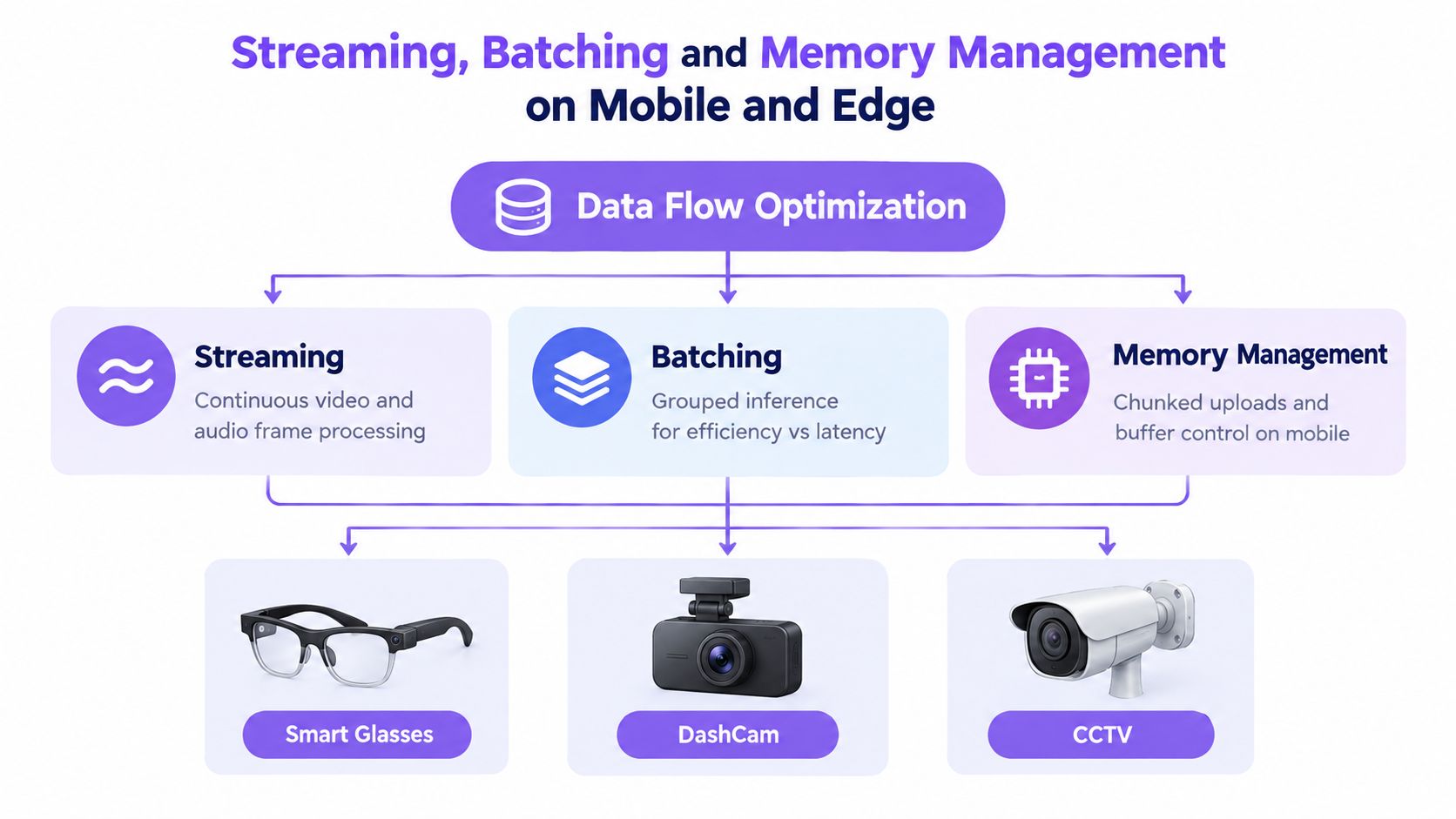
Batching improves accelerator utilization when delayed results are acceptable. Advertisement video edition can often batch candidate frames during an editing operation, while robot obstacle avoidance, smart-glass overlays, and dashcam warnings usually need bounded single-frame latency.
Streaming keeps the pipeline moving, but it requires disciplined buffer ownership. Avoid copying the same frame between camera APIs, preprocessors, inference runtimes, and encoders. Reuse buffers where the platform permits it, keep tensor layouts consistent, and release references promptly when a frame no longer contributes to a result.
Treat memory as a product resource
A local multimodal memory layer needs more than model weights. It also needs encoded media, timestamps, sensor context, temporary tensors, upload queues, and enough headroom for the operating system. On mobile devices, large uploads and local playback can compete with inference for memory and trigger crashes or severe slowdowns.
A workable design separates hot and cold data. Keep the short operational window readily available for immediate retrieval, compress or persist older material locally, and upload in chunks when connectivity and power conditions allow. Signed streaming URLs and chunked multipart uploads are useful for controlled transfer, but the device should remain functional when the network is unavailable.
Preserve alignment across modalities
Video frames, audio segments, and spatial sensor readings need a shared time reference. Store frame-level and audio-timestamp associations as the pipeline runs, rather than trying to reconstruct them after a long recording. This matters for surveillance review, dashcam incident analysis, and robotics tasks where an audible alarm, visual obstacle, and robot state may describe one event.
Memory-first test: Profile bytes moved per inference, buffer residency, and sustained power. Peak TOPS can't reveal whether the pipeline is spending its time waiting on memory.
Deploying Offline Ready Search With Android Flutter and V-Modal Memory
A mobile or robotics product becomes more useful when its local history remains available without a constant network path. Android applications can integrate a native Kotlin SDK directly, while Flutter applications can use a cross-platform wrapper for Android and iOS implementations. The integration decision should follow the device boundary: native code for direct lifecycle and hardware control, Flutter where shared application behavior matters.
The platform layer can expose a multimodal search API for video, image, audio, and spatial sensor indexing, querying, and retrieval. Query modes can include text-to-video, image-to-video, voice-to-audio, and environmental-state-to-video intents. That supports practical workflows such as locating a spoken warning in dashcam footage, finding a visual event in CCTV history, or retrieving a robot episode associated with a particular environmental state.

Keep the device useful offline
An offline-ready design doesn't mean every heavy operation must run locally. It means the device can capture, retain, index, and retrieve the operational history needed for the product's core behavior, then synchronize richer results when a connection returns.
For a dashcam, that can mean retaining synchronized audio-video segments and making recent incident retrieval available locally. For CCTV, it can mean narrowing surveillance review to relevant visual or auditory indicators without sending every stream to a remote service. For smart glasses, it can mean maintaining a local context window while protecting battery and connectivity budgets.
The Robotics Edge-optimized memory layer described by V-Modal AI is designed to capture, store, and recall continuous historical inputs directly on hardware. Its role is different from the NPU. The NPU executes inference. The memory layer preserves usable context and exposes retrieval across modalities.
Plan the fleet before the pilot
A device that works in a lab can still fail during rollout because the fleet contains different Android releases, camera drivers, SoCs, runtimes, and thermal profiles. Production packaging should cover the runtime and OS, model versioning, signed updates, rollback behavior, observability, secure boot where available, and local buffering during disconnection.
The same control plane should distinguish model failures from sensor failures and memory pressure. Without those signals, teams often replace hardware to solve what is really a packaging, driver, or buffer-management problem. Cross-platform support matters too, especially when one product spans Android phones, smart glasses, embedded Linux robots, and IoT cameras.
Pain Points Checklist and Next Steps for Reliable Edge Deployment
In pilot deployment reviews, failures most often occur at the boundaries between sensor drivers, memory management, and inference runtimes. An accurate model can still produce an unreliable product when device history is fragmented, audio timestamps drift, or an unsupported operator sends a robot's workload back to the CPU. Mobile applications expose the same weakness when short clips work but large uploads or live streams exhaust memory.
Use this checklist before committing to production hardware:
- Opaque physical data: Define what the device must retain locally, including video, audio, and spatial context.
- Fragmented audio-video analysis: Keep one shared timeline so related audible and visual events form a retrievable episode.
- Manual review: Test natural-language and visual retrieval against long dashcam, CCTV, and robotics recordings.
- Disconnected history: Verify capture, local indexing, and recent retrieval without network access.
- Bandwidth pressure: Buffer locally and transfer in chunks. Connectivity should affect synchronization, not core capture.
- Memory movement: Measure transfers among sensors, preprocessors, system memory, accelerators, and encoders.
- Mixed operator graphs: Benchmark CPU, GPU, and NPU paths with matched precision and production-shaped models.
- Thermal limits: Run sustained workloads in the actual enclosure with the intended battery and camera configuration.
- Fleet variation: Ship runtimes, models, drivers, signed updates, rollback, and telemetry through one release process.
- Cross-platform integration: Validate Kotlin, Flutter, embedded Linux, robotics middleware, and IoT camera boundaries early.
A useful proof of concept follows the final sensor path, rather than copying desktop recordings into a test folder. Run representative multimodal streams, measure single-sample latency and sustained power, disconnect the network, restart the process, rotate local history, and test update rollback. Public repositories and example code can shorten early evaluation, but production confidence requires the exact hardware, runtime, model graph, and memory policy to operate together.
Choose the architecture that minimizes memory movement while preserving continuous context and manageable fleet operations. TOPS still matters, alongside memory bandwidth, model residency, operator coverage, thermals, offline behavior, and software lifecycle support.
V-Modal AI provides a Visual Memory Layer for Physical AI, with multimodal video and audio search, continuous memory, Android Kotlin and Flutter SDK options, and an edge-optimized memory layer for robotics and mobile hardware. Connect a dashcam, CCTV, smart-glasses, or robotics prototype to the V-Modal AI repositories and test retrieval against the offline workloads planned for production.