Technology Stack for CCTV Analysis: A Practical Guide
Determining a technology stack for CCTV analysis often starts from a common situation. Cameras, an NVR, too much footage, and a simple question from operations or security that should be easy to answer. Find the red sedan near the loading dock. Pull the moment when a pallet went missing. Check whether the alarm matched what happened on camera.
What slows them down isn't recording. It's retrieval.
Legacy CCTV systems were built to store video. Modern sites need systems that can search video, audio, and event context across fixed cameras, mobile devices, and physical machines. Once you treat CCTV as part of a broader Physical AI stack, the architecture changes. The useful system isn't the one with the biggest archive. It's the one that can return the right moment quickly, even when bandwidth is limited, sites are distributed, and operators need answers before a manual review burns an hour.
Table of Contents
- Why CCTV Analysis Is Now a Physical AI Retrieval Problem
- Retrieval beats scrubbing
- CCTV now sits inside Physical AI
- Core Layers of a Modern CCTV Technology Stack
- The layers that actually matter
- What works and what usually fails
- Edge Search Versus Cloud Search for CCTV Footage
- Codecs, Storage, and Bandwidth Trade-offs
- What to optimize for
- The right storage pattern
- Multimodal Video and Audio Indexing in Practice
- Reducing False Alarms With Multimodal Verification
- Two-stage verification works better
- Common pain points teams run into
- Dashcam, Smart Glasses, and Robotics on the Same Stack
- Assembling Your CCTV Analysis Stack
- Start with infrastructure reality
- Then build in this order
- What to prioritize first
Why CCTV Analysis Is Now a Physical AI Retrieval Problem
A control room operator gets a call at 14:20. A red sedan was seen near a loading dock, and someone wants the clip now. In a DVR workflow, that usually means opening several camera views, scrubbing timelines by hand, and hoping timestamps are aligned well enough to narrow the search.
That model breaks down once footage volume grows. The global video surveillance systems market is projected to grow from USD 64.79 billion in 2025 to USD 71.65 billion in 2026, then to USD 118.83 billion by 2031, with a 10.65% CAGR from 2026 to 2031, according to Mordor Intelligence's video surveillance systems market outlook. At that scale, CCTV isn't a sidecar security tool anymore. It's enterprise data infrastructure.
Retrieval beats scrubbing
In a Physical AI retrieval model, the useful unit isn't "the recording." It's the searchable event.
A camera feed gets turned into artifacts an operator can query later:
- Visual observations like vehicles, people, colors, and motion regions
- Audio context such as speech, alarms, impacts, or sirens
- Time windows tied to exact timestamps
- Location tags tied to cameras, zones, and site layouts
The difference is operational. Instead of "watch footage until you find something," the workflow becomes "ask for moments that match the event."
Practical rule: if an operator still has to scrub first and search second, the system is still a recorder, not a retrieval stack.
CCTV now sits inside Physical AI
This matters beyond fixed surveillance. The same retrieval problem shows up in dashcam review, smart glasses capture, robotics vision, and media content search. An editor looking for a product shot in advertisement video edition, a warehouse robot trying to recall where it last saw a pallet, and a security operator reviewing a gate event all need the same thing. They need fast retrieval across multimodal evidence.
NVIDIA describes Physical AI systems as needing to perceive, predict, and act across text, video, audio, and action data, and frames omni-modal embedding models as useful for "needle-in-a-haystack" retrieval across text, image, audio, and video in NVIDIA's overview of omni models. That's the right mental model for modern CCTV analysis. Not passive monitoring. Searchable memory for the physical world.
Core Layers of a Modern CCTV Technology Stack
The modern stack starts with one foundational shift. CCTV moved from analog closed-circuit recording to networked IP video. That migration is what made frame extraction, timestamp indexing, remote search, and software analytics practical.
Industry data summarized by WiFiTalents' CCTV security industry statistics notes that the IP camera segment held more than 70% of global revenue in 2023, one estimate placed IP-based technology at 62.7% of CCTV camera revenue in 2025, and by 2026 more than 1.2 billion surveillance cameras were estimated to be active worldwide, with roughly 140 million new cameras shipped annually. That's why the stack now revolves around codecs, transport, metadata, storage, and search instead of tape-like recording.
The layers that actually matter
A practical technology stack for CCTV analysis usually has these layers:
- Capture layer. IP cameras, microphones, dashcams, body-worn devices, smart glasses, and mobile apps generate streams. In real deployments, you inherit mixed hardware, mixed firmware, and inconsistent timestamps. That matters more than vendor slide decks admit.
- Edge processing layer. Local NVRs, site gateways, Jetson-class devices, or embedded GPU boxes run detection, tracking, clip extraction, and basic audio processing close to the camera.
- Transport layer. The best systems move metadata first, not just video. Whether teams use RTSP for streams and MQTT, Kafka, or gRPC for event movement, the goal is the same. Push searchable context upstream without flooding the network.
- Storage layer. Hot storage keeps active indexes and recent evidence. Warm tiers hold searchable clips. Long-term archives keep compressed footage for compliance and investigations.
- Query layer. Dashboards and APIs expose natural-language search, example-image lookup, time filters, and camera-zone filters.
What works and what usually fails
The layer people underrate is the index. Without it, all the other components just produce expensive footage.
A good index ties camera ID, timestamp, object attributes, event labels, and audio context into one retrievable unit. That same pattern works across CCTV, dashcam fleets, GoPro footage, smart-glasses sessions, and mobile video capture. The device changes. The retrieval requirement doesn't.
Teams often overbuy models and underbuild indexing. In production, weak indexing hurts more than imperfect detection.
Some teams evaluate dedicated search layers. For example, V-Modal AI offers a multimodal search API and edge-oriented memory layer for video and audio retrieval across cameras, robotics hardware, and mobile devices. That's useful when the requirement is less about building a detector from scratch and more about making footage searchable across device types.
Edge Search Versus Cloud Search for CCTV Footage
A store manager asks for "the clip where a delivery driver argued with staff near the back door just before closing." If that request has to wait on a congested uplink and a cloud round trip, the system behaves like a remote archive. If the site can search local video, audio, and event metadata in place, it behaves like retrieval infrastructure for a physical environment.
That distinction matters. Modern CCTV is no longer only about recording evidence. It is about finding the right moment fast enough to affect operations, safety, and incident response.
The practical split is simple. Edge search answers local questions under local constraints. Cloud search answers fleet questions across time and sites.
On real deployments, edge usually carries the operational load. Cameras, NVRs, or site gateways can index recent footage, motion tracks, object attributes, and short audio snippets without shipping every frame upstream. That changes the failure mode of the system. A weak WAN link becomes an inconvenience instead of a full outage for search.
Industry coverage on hybrid surveillance AI architecture makes the same point from an infrastructure angle. Detection and tracking often run on cameras or gateways, while cloud systems handle centralized governance and broader coordination. It also calls out the need to queue clips locally and sync metadata after outages in Security SA's discussion of edge and cloud surveillance AI architecture.
Here is the deployment logic I have seen hold up in production:
- Use edge search for active incidents, guard desk workflows, privacy-sensitive sites, and any location with unstable backhaul.
- Use cloud search for cross-site investigations, corporate retention policy, model updates, and historical search across a larger corpus.
- Use both when the footage has immediate operational value on site but still needs to roll up into a shared memory layer later.
A pure cloud design looks attractive early because it centralizes everything. The bill shows up later in bandwidth, upload lag, and operator frustration. If raw footage has to move before anyone can query it, the search experience degrades at the exact moment people need it most.
A pure edge design has limits too. It keeps local retrieval fast and private, but it fragments the system if every site becomes its own island. Multi-site investigations, policy enforcement, and long-horizon analytics get harder unless metadata, selected clips, or compact embeddings replicate upward on a schedule.
That is why the right question is not "edge or cloud?" The useful question is "what must remain searchable if the network is slow, expensive, or down?"
| Dimension | Edge Search | Cloud Search |
|---|---|---|
| First response time | Better for on-site review and live incidents | Better only when the network is healthy and the footage is already uploaded |
| Network load | Sends metadata and selected evidence | Pulls or stores more centralized video and clip data |
| Privacy control | Raw media can stay on premises | Central policy is easier, but footage leaves the site |
| Failure mode | Local search still works during WAN problems | Search quality drops with upload delay or outage |
| Scope | Strong for recent footage and local context | Strong for cross-site and long-term retrieval |
| Physical AI fit | Good for fast retrieval from live camera, audio, and sensor context | Good for building shared memory across many locations |
The strongest CCTV stacks are edge-first for retrieval, cloud-assisted for coordination. That is the pattern that turns surveillance footage into searchable physical-world memory instead of another DVR backlog.
Codecs, Storage, and Bandwidth Trade-offs
Most CCTV stacks fail on cost and usability for one reason. The team treats codec choice as a camera setting instead of an architecture decision.
Storage guidance from PROMISE surveillance storage documentation shows why compression matters. Example figures put D1 systems around 1.5 Mbps for MPEG-4 and about 512 Kbps for H.264/AVC, while megapixel systems vary with scene complexity and compression settings. The important takeaway isn't a universal bitrate target. It's that ingest decisions shape retention, replication, and search responsiveness.
What to optimize for
For most new deployments, H.265 is the practical default if the camera estate, decoders, and playback stack can support it cleanly. H.264 remains the compatibility baseline. Newer options can be attractive, but only when decode cost, player support, and archive workflows are already under control.
The wrong pattern is easy to spot. Teams keep everything at high bitrate, long retention, and full-frame continuous upload. Search gets slower, replication gets expensive, and operators still don't find incidents quickly.
The right storage pattern
A better architecture uses tiers:
- Recent operational footage on faster storage
- Searchable event windows indexed aggressively
- Compressed archive for long retention
- Selective high-fidelity retention only for evidentiary or high-risk zones
| Codec | Typical Bitrate Reduction vs H.264 | Search Granularity | Edge Decode Cost | Best Fit |
|---|---|---|---|---|
| H.264 | Baseline | Good when GOP settings are reasonable | Lower | Broad compatibility across CCTV, dashcam, and mobile playback |
| H.265 | Lower bandwidth than H.264 in practice | Good, but depends on GOP and I-frame cadence | Higher than H.264 | New CCTV deployments where storage and uplink matter |
| AV1 | Qualitatively attractive for compression efficiency | Can work well for archive and retrieval workflows if tooling supports it | Often heavier | Selected software-defined pipelines |
| H.266 | Promising for future high-efficiency pipelines | Depends on ecosystem maturity | Higher | Narrow deployments that can control end-to-end tooling |
Field note: search quality doesn't just depend on models. It depends on whether your video is encoded in a way that lets the system jump to the right second without painful decode overhead.
For uplink-constrained sites, dual streams, adaptive bitrate, and event-driven clip movement usually work better than trying to centralize everything.
Multimodal Video and Audio Indexing in Practice
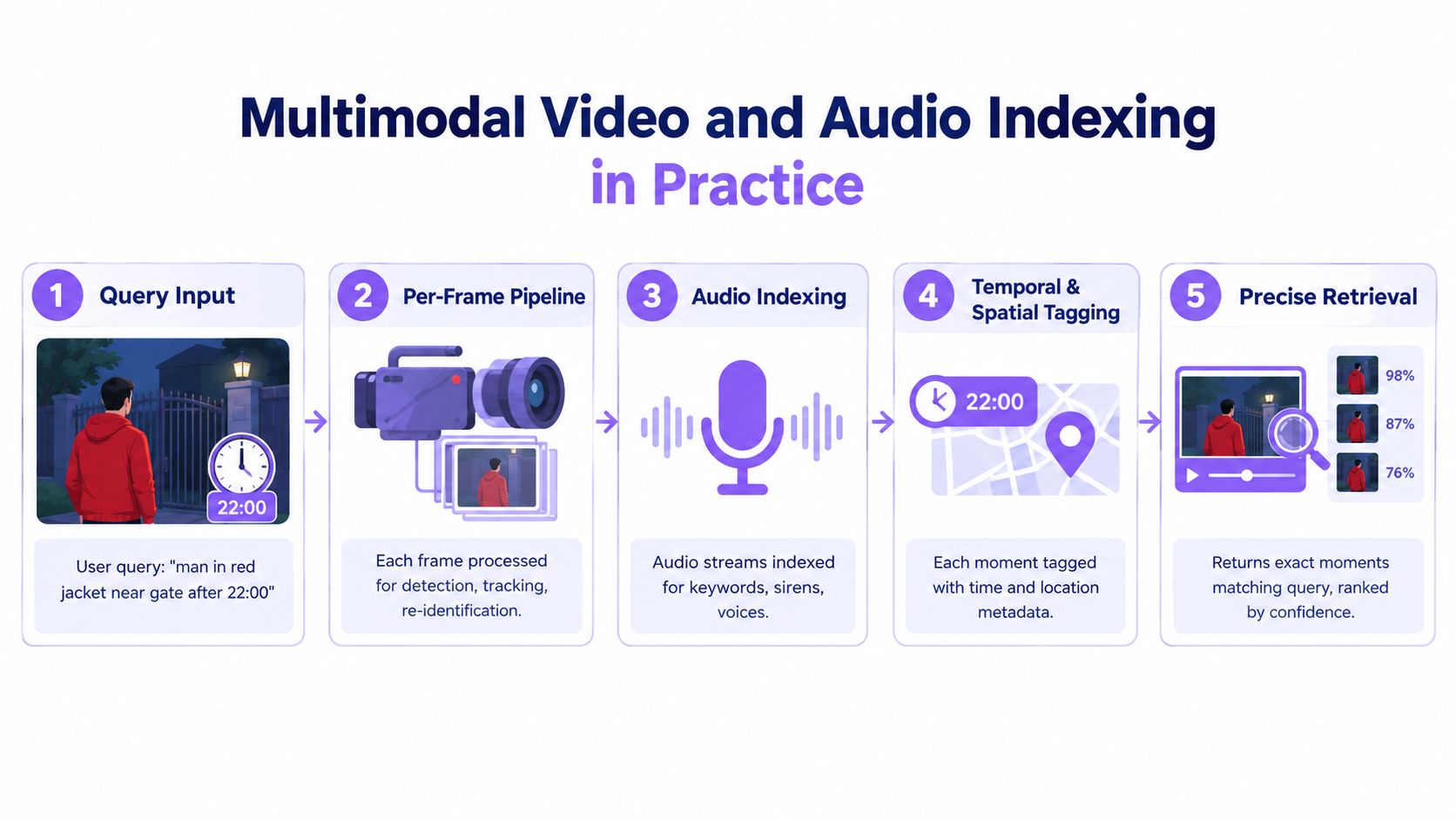
An operator gets a radio call at 22:14. Someone in a red jacket was near Gate 3, there may have been shouting, and a vehicle left seconds later. A legacy DVR workflow turns that into scrubbing timelines across several cameras. A retrieval stack turns it into a query across time, place, appearance, and sound.
That shift matters. CCTV analysis now behaves more like physical-world search than file playback.
NVIDIA describes a recent multimodal retrieval flow in five stages: audio ingestion, video ingestion, blending audio and video information, setting up the retriever, and generating answers in NVIDIA's introduction to multimodal retrieval-augmented generation for video and audio. CCTV is harder than edited media because the stream never politely cuts into scenes for you, but the design principle still holds. Split continuous footage into retrievable windows first. Run question answering on top of that index, not on raw video.
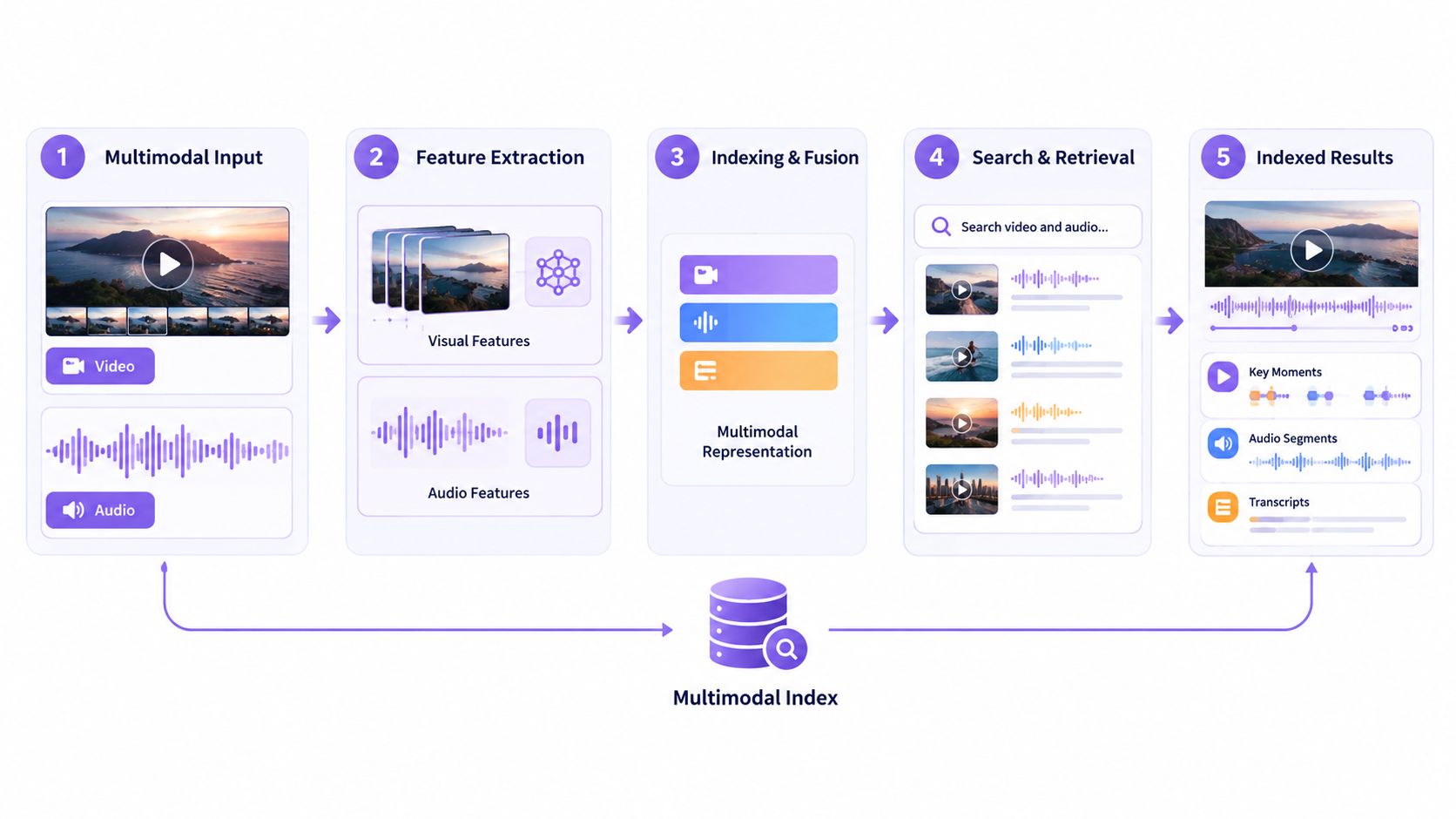
What gets indexed in a working system is narrower than many teams expect. The useful units are usually short time windows with enough metadata to filter fast and enough learned features to rerank accurately: detected people and vehicles, tracks, clothing or object attributes, camera zone labels, ASR output when microphones are present, and event markers such as alarms, impacts, or sirens. If "gate" is not mapped to a real zone on a real camera, the query quality drops fast.
A practical query path often looks like this:
- Filter by camera, zone, and time window
- Pull candidate clips with lightweight metadata and detector output
- Rerank with multimodal similarity across text, image, and audio cues
- Return exact moments with thumbnails, transcript snippets, and jump-to-playback offsets
The engineering trade-off is speed versus richness. Full cross-modal search over every second of footage is expensive, especially on edge boxes that are already decoding multiple streams. Coarse-to-fine retrieval keeps the hot path cheap. Richer models only touch a short candidate set.
Another pattern shows up in nearly every production system I trust. Video and audio usually should not share one catch-all model path. NVIDIA's 2025 blueprint for real-time multimodal XR makes that split explicit: video files are processed by a vision-language model, while audio is separated into .wav files and transcribed by an ASR service, as described in NVIDIA's AI blueprint for video search and summarization. The same division works well in CCTV. Vision models are good at appearance, motion, and scene context. Audio pipelines are better handled as their own stream with transcription, sound event detection, and timestamps that can be fused later.
This is also where weak deployments fail. They store detections but not tracks. They keep transcripts but lose precise timing. They index clips at one cadence and audio at another, then wonder why a search for "argument near loading bay before van departure" returns loosely related moments. Multimodal retrieval depends on alignment discipline. The system has to know that the voice spike, the person track, and the vehicle exit all happened in the same few seconds.
Done right, indexing changes CCTV from passive retention into physical AI memory. Operators stop hunting through footage and start retrieving evidence.
Reducing False Alarms With Multimodal Verification
False alarms usually come from a structural mistake. The pipeline promotes a weak signal too early.
A motion detector sees shadows and raises an alert. A single visual classifier catches a reflection and flags intrusion. An audio spike looks like a dangerous event when it was just metal dropped in a loading bay. Teams often respond by tuning thresholds forever, but threshold tuning alone doesn't fix poor evidence design.
Two-stage verification works better
A more reliable pattern is to treat alerting as candidate generation plus confirmation.
The first stage stays cheap and sensitive. It can be motion, a tripwire, a person detector, a vehicle detector, or a simple sound trigger. The second stage verifies the event with other evidence before it reaches an operator.
Examples that work well:
- Visual plus audio corroboration. A glass-break sound and visible intrusion in the same time window deserve escalation. Either one alone may not.
- Temporal consistency checks. If the alert claims loitering, the track should persist long enough to support that label.
- Zone-aware confirmation. A forklift in a warehouse aisle may be normal. The same forklift in a restricted pedestrian path isn't.
Recent surveillance coverage and research summarized by Technolynx on AI in video surveillance argues that false positives are an architectural problem, not just a detector problem, and notes one paper that reported a 37% reduction in false alarms with an XAI-enhanced surveillance system. The practical lesson is bigger than the number. Operators trust alerts more when the system shows why the alert fired.
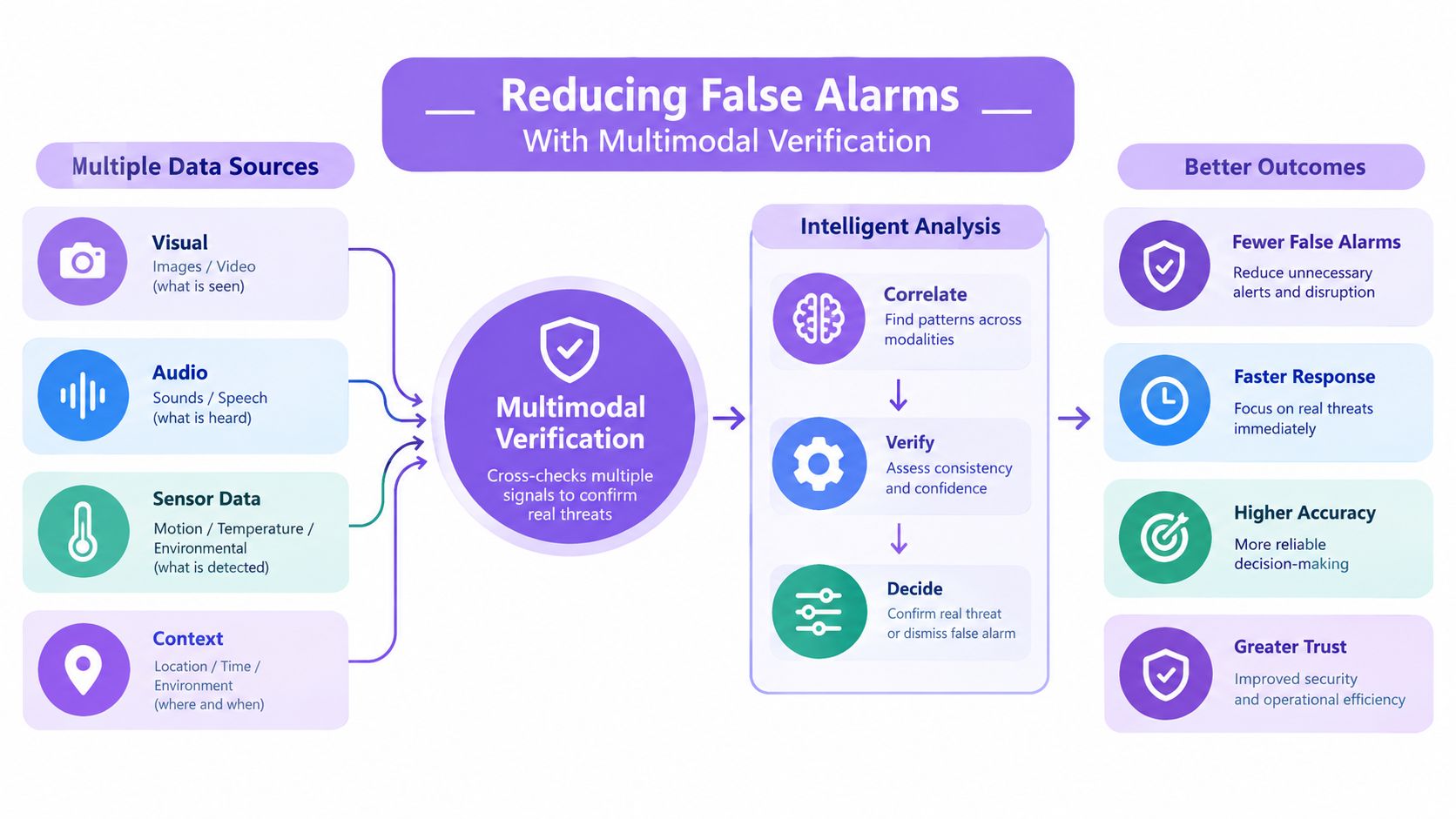
A useful alert should carry evidence, not just urgency.
Common pain points teams run into
- Alert fatigue because every trigger looks equally important
- Poor time alignment between audio and video events
- Opaque decisions that give operators no reason to trust the result
- Weak reviewability when compliance or investigations require an audit trail
- Single-sensor brittleness in noisy outdoor or industrial environments
The fix isn't endless threshold tuning. It's designing the stack so multiple signals can confirm, explain, and preserve the event.
Dashcam, Smart Glasses, and Robotics on the Same Stack
A safety manager pulls dashcam footage after a near miss. A field technician wants to find the exact moment a valve label came into view on smart glasses. A warehouse robot needs to check what was sitting in aisle 14 on its last pass before it reroutes. Those look like different products, but the retrieval problem is the same. The system has to answer: what happened, where, when, and with what supporting context from video, audio, and device state.
That shift matters because legacy CCTV design treats video as evidence you store first and review later. Physical AI systems treat it as memory you need to search while operations are still in motion. Once the stack is built around retrieval, fixed cameras become one device class among several.
The shared base is smaller than teams expect. Every one of these systems needs encoded video, reliable timestamps, enough metadata to place the clip in space and time, and an index that can join visual events with audio and sensor context. The playback layer changes by use case. The ingest and retrieval logic usually does not.
What changes is the operating envelope.
A robot often cannot wait for a cloud round trip. It needs local embeddings, short-horizon memory, and deterministic latency because retrieval may feed motion planning or task recovery. Smart glasses have the opposite pressure profile. Battery, thermals, intermittent uplink, and user comfort matter more than perfect clip quality, so aggressive edge filtering and selective upload usually win. Dashcams sit closer to CCTV on retention and chain-of-custody requirements, but they add motion, unstable connectivity, and a higher premium on tamper-resistant upload after an incident.
That is why I usually avoid building separate stacks unless there is a hard regulatory reason. The expensive part is not decoding another video format. It is maintaining different indexing, storage, and query paths for devices that ultimately answer the same operator question.
A practical design usually looks like this:
- Dashcams prioritize rolling local retention, signed event upload, GPS, and cabin or road audio alignment
- Smart glasses prioritize clip selection, speech capture, low-power encoding, and fast recall of first-person views
- Robots prioritize on-device search, recent-scene memory, pose or map context, and tight coupling between retrieval and action
- Fixed CCTV prioritizes long retention, multi-camera correlation, and review tools for operators and investigators
The media side follows the same pattern. Advertisement video edition teams search footage for product appearances, spoken lines, and scene types before anyone starts a manual cut. Robotics teams search recent observations to compare current state with the last known state. Security teams search across cameras and time windows. Different workflows, same core idea. Build once around multimodal retrieval, then adapt the capture and serving layers to each device class.
Independent evidence-workflow guidance from Vector Methods' public sector and security workflows describes this clearly in operational terms: teams need search across approved evidence sets for actions, people, objects, locations, audio context, visual references, and event windows. CCTV review, facility incident triage, and safety review are all examples of the same underlying problem.
If the CCTV stack already supports multimodal search at the edge, adding dashcams, mobile capture, smart glasses, or robotics is usually an extension project, not a restart.
Assembling Your CCTV Analysis Stack
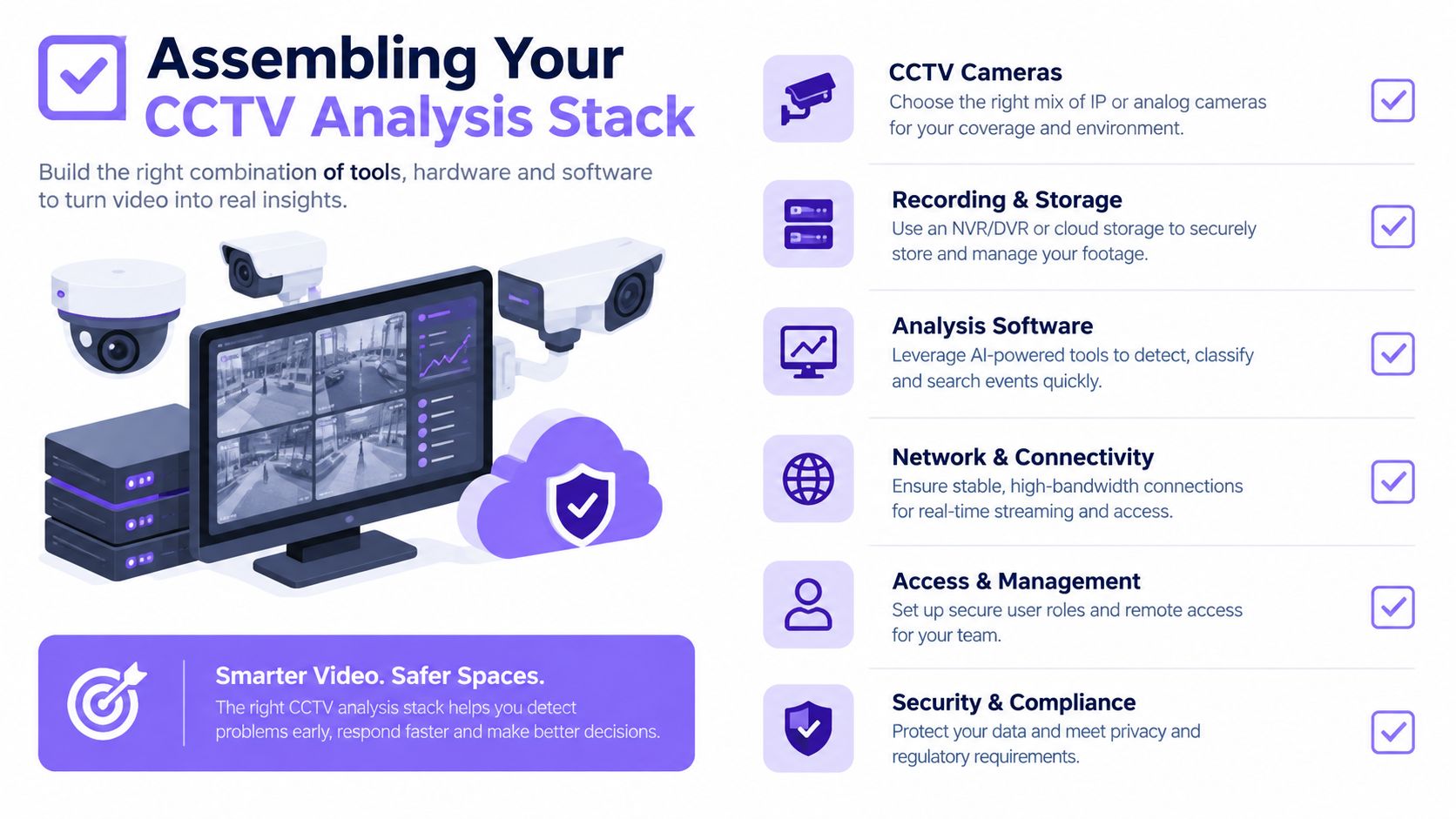
The best build order is boring on purpose. Start with the constraints that are expensive to change later, then add the layers that make footage searchable.
Start with infrastructure reality
Before anyone talks about models, check the parts that break projects first:
- Camera estate. Mixed vendors, mixed firmware, and uneven time sync create messy ingest.
- Network headroom. Switch capacity, uplink limits, and site reliability determine whether edge-first is optional or mandatory.
- Retention obligations. Compliance footage, investigation windows, and business policy change storage design immediately.
- Operator workflow. A beautiful pipeline is useless if review still happens in three disconnected tools.
Then build in this order
- Capture and encoding. Lock camera profiles, audio availability, and codec settings early.
- Edge or site processing. Decide what must happen locally for privacy, latency, or resiliency reasons.
- Storage tiers. Keep active indexes hot, recent evidence accessible, and archive compressed.
- Indexing pipeline. Generate searchable video, audio, and metadata artifacts at ingest.
- Query surface. Give operators one place to filter by time, device, location, and event description.
- Alert verification. Add multimodal confirmation before paging humans.
What to prioritize first
If bandwidth is unreliable or privacy constraints are strict, prioritize edge indexing and offline-capable retrieval first. If you run many sites and need centralized investigations, prioritize cross-site search and governance after the local pipeline is stable.
The technology stack for CCTV analysis works when teams stop asking "where do we store the video?" and start asking "how do operators retrieve the right moment with evidence they can trust?" That's the decision that separates a surveillance archive from a Physical AI memory system.
V-Modal AI offers a practical search layer for this exact problem: multimodal video and audio retrieval across CCTV, dashcam, mobile, smart glasses, and robotics workflows, with support for edge-oriented memory and natural-language search. If you're building a Physical AI retrieval stack rather than another footage archive, it's worth exploring V-Modal AI to see how its SDKs and APIs fit into your pipeline.