DashCam Videos : Ecosystem Guide to Multimodal Search
You open the dashcam app because someone cut across your lane three days ago. You know the clip exists. You know roughly where it happened. You still end up dragging a timeline back and forth, checking thumbnails, replaying the same stretch of road, and wondering why “recorded” doesn't mean “usable.”
That frustration is the center of the DashCam Videos Ecosystem. The hard part isn't only capturing footage anymore. It's finding one moment inside hours of video, matching it with sound and context, and getting it back fast enough to help with a claim, a fleet review, a robotics replay, or a safety audit.
The market tells the same story. Dashcams have moved well beyond hobby gear into a large global category, with 2025 estimates for the worldwide dashboard-camera market ranging from about USD 4.3 billion to USD 5.8 billion, with projections reaching about USD 8.3 billion by 2030, USD 9.8 billion by 2031, and as high as USD 17.6 billion by 2035, depending on the model used in Fortune Business Insights dashboard camera market coverage. That spread matters because it shows analysts now treat dashcams as a mainstream evidence and safety system, not a niche gadget.
Table of Contents
- Why DashCam Footage Is Hard to Use Without Search
- Recording is easy, retrieval is painful
- The ecosystem is now larger than the camera
- Where readers usually get stuck
- What Multimodal Search Means for Video Audio and Sensors
- One event, several streams
- Why unified indexing beats fragmented pipelines
- Recent examples make this easier to picture
- How Fusion Architectures Compare for Physical AI
- Three patterns you'll actually encounter
- Choosing by product shape
- Why this matters to Physical AI
- Inside the DashCam Ecosystem From Mobile Stacks to Edge Memory
- The stack is broader than dashcams
- Why edge memory exists
- Codec choice changes retention windows
- Common pain points developers inherit
- Where Multimodal Video Search Delivers Real Value
- Advertisement video edition
- Vision for robotics and audio for robotics
- Dashcam and fleet review
- CCTV and video surveillance
- Integrating Search With SDKs and Edge Memory Layers
- A prototype path that fits mobile reality
- Where mobile developers usually get bitten
- One practical option in this category
- Building a Searchable Future for Every Mile Recorded
Why DashCam Footage Is Hard to Use Without Search
A dashcam solves one problem very well. It keeps recording when people forget details.
It creates a second problem just as reliably. Continuous recording floods you with footage that has weak memory and poor recall.
Recording is easy, retrieval is painful
Consumer buyers usually discover this after a minor crash or road-rage incident. Fleet teams discover it during review. Robotics developers discover it when a vehicle or mobile device captures lots of useful data but nobody can quickly retrieve “the moment with the horn, sudden brake, and lane drift.”
The old mental model says a dashcam is a camera with storage. The better model is that a dashcam is a rolling evidence system. Once you see it that way, the bottleneck shifts from image quality to retrieval.
A few common pain points keep showing up:
- Manual scrubbing wastes time: A person has to search through long recordings to find one short event.
- Audio and video drift apart in practice: Teams can hear something important, like a siren or shouted warning, but they still can't jump to the right visual moment.
- Device history gets fragmented: One trip lives on the dashcam card, another clip sits in a phone app, another file gets exported to cloud storage.
- Uploads fail at the wrong time: Large mobile transfers, weak networks, and app background limits interrupt review workflows.
- Publishing creates new risk: A clip that feels useful for proof can also expose faces, plates, location, and retention issues.
Practical rule: If users can record an incident but can't retrieve it quickly, the recording system is incomplete.
The ecosystem is now larger than the camera
Adoption has crossed an important line. A 2026 usage summary says about 30% of U.S. drivers, or roughly 69 million people, use a dash cam, with use around 53% among gig and delivery drivers, according to DashLine Cameras dash cam statistics. Once usage reaches that scale, the ecosystem stops being just hardware. It starts depending on searchable pipelines, app workflows, retention choices, and evidence recall.
That shift is especially relevant for Physical AI. A robot, smart-glasses app, CCTV system, or vehicle stack doesn't get value from raw footage alone. It gets value from remembered moments. Search turns passive capture into a memory layer.
Where readers usually get stuck
People often ask the wrong first question: “How many hours can it store?”
A better question is: How do I find one meaningful moment across video, audio, and context without scrubbing everything by hand?
That's where multimodal search starts to matter.
What Multimodal Search Means for Video Audio and Sensors
Human memory doesn't store road events as isolated file types. You remember the red truck, the siren, the sudden stop, and roughly where it happened as one scene. Useful machine recall needs the same shape.
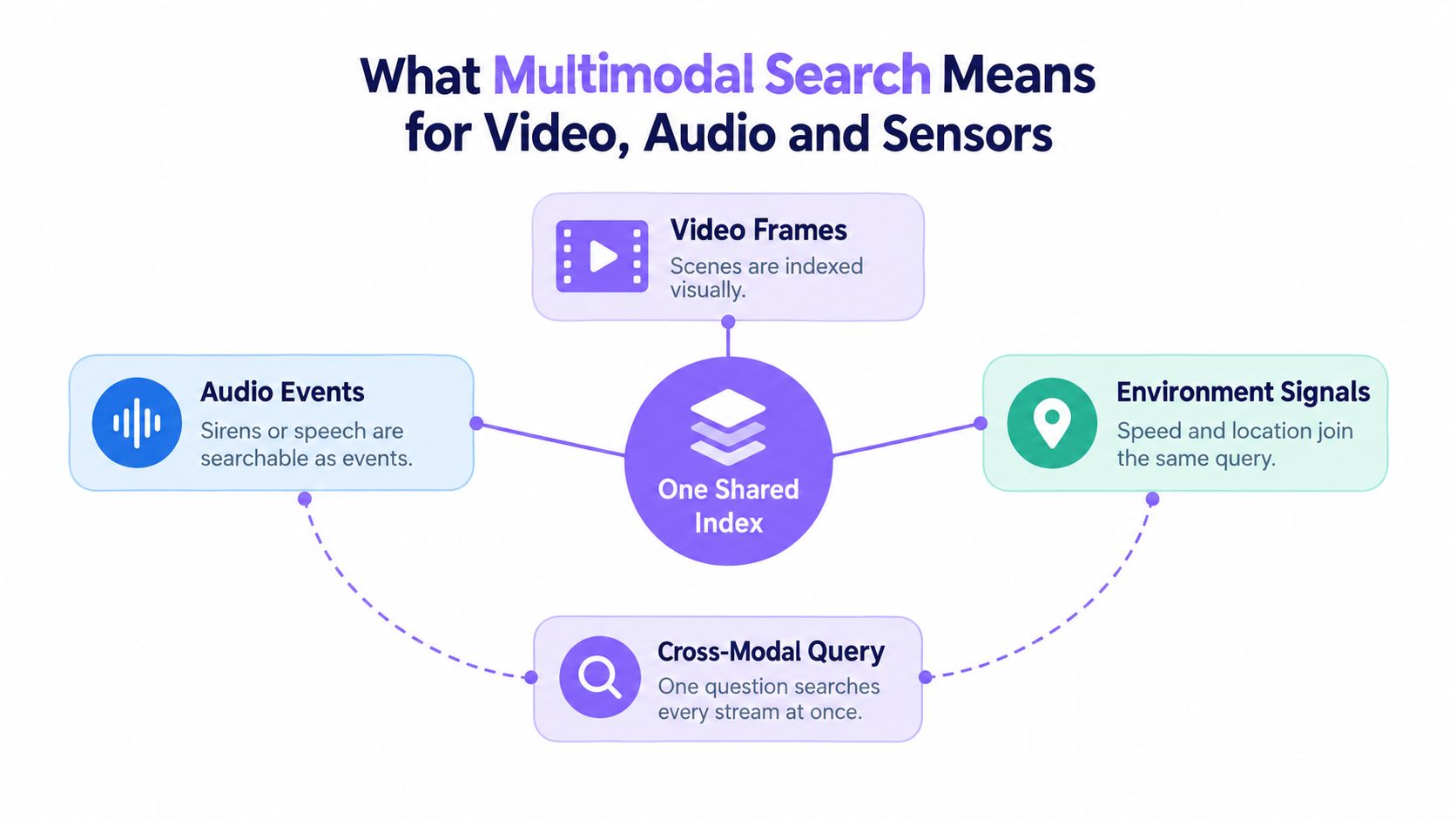
That's the simplest way to understand multimodal search. It treats video, audio, and environmental signals as parts of the same event instead of separate assets.
One event, several streams
A typical dashcam or mobile capture stack may include:
- Video frames: the road, brake lights, lane position, pedestrians, signage
- Audio events: horns, speech, sirens, impact sounds, wind noise
- Environment signals: location, speed, motion state, device time, sensor changes
If each stream lives in its own tool, the user has to think like a file manager. They search one system for speech, another for images, and maybe a third for telemetry. That's clumsy for media teams and even worse for Physical AI.
A shared search layer works more like scene memory. A query can ask for meaning, not just filenames.
Examples look like this:
- “Find the moment when a cyclist passed on the left and someone honked.”
- “Show the clip where the vehicle stopped hard near the intersection.”
- “Find speech near the loading area after dark.”
- “Locate the sequence where the robot heard a bounce and saw the ball leave frame.”
Why unified indexing beats fragmented pipelines
A fragmented stack usually forces developers to stitch together separate outputs from visual analysis and audio analysis. That can work, but it often creates timing mismatches and awkward app logic.
A unified multimodal approach is more natural for users because the question is already mixed. People don't ask, “Search the audio subsystem, then the image subsystem.” They ask for a situation.
Search quality improves when the system treats “what happened” as a single event, not as unrelated outputs from separate tools.
That idea also lines up with work in robotics. Peer-reviewed robotics literature describes systems that combine visual and audio inputs in shared physical context, as summarized in Sensors multimodal robot perception research. For robotics teams, that matters because vision for robotics and audio for robotics often describe the same real-world event from different angles.
Recent examples make this easier to picture
In media systems, multimodal models are moving toward unified handling of images, video, and audio. One recent example is Black Forest Labs FLUX 3, which is described as a unified architecture that jointly learns from images, videos, and audio and supports workflows such as text-to-video, image-to-video, video-to-video, and keyframe-to-video. That's a media-generation example, not a dashcam product, but it shows the same directional shift away from isolated modality stacks.
For developers, the practical lesson is simple. In the DashCam Videos : Ecosystem, search becomes far more useful when one query can reach every stream at once.
How Fusion Architectures Compare for Physical AI
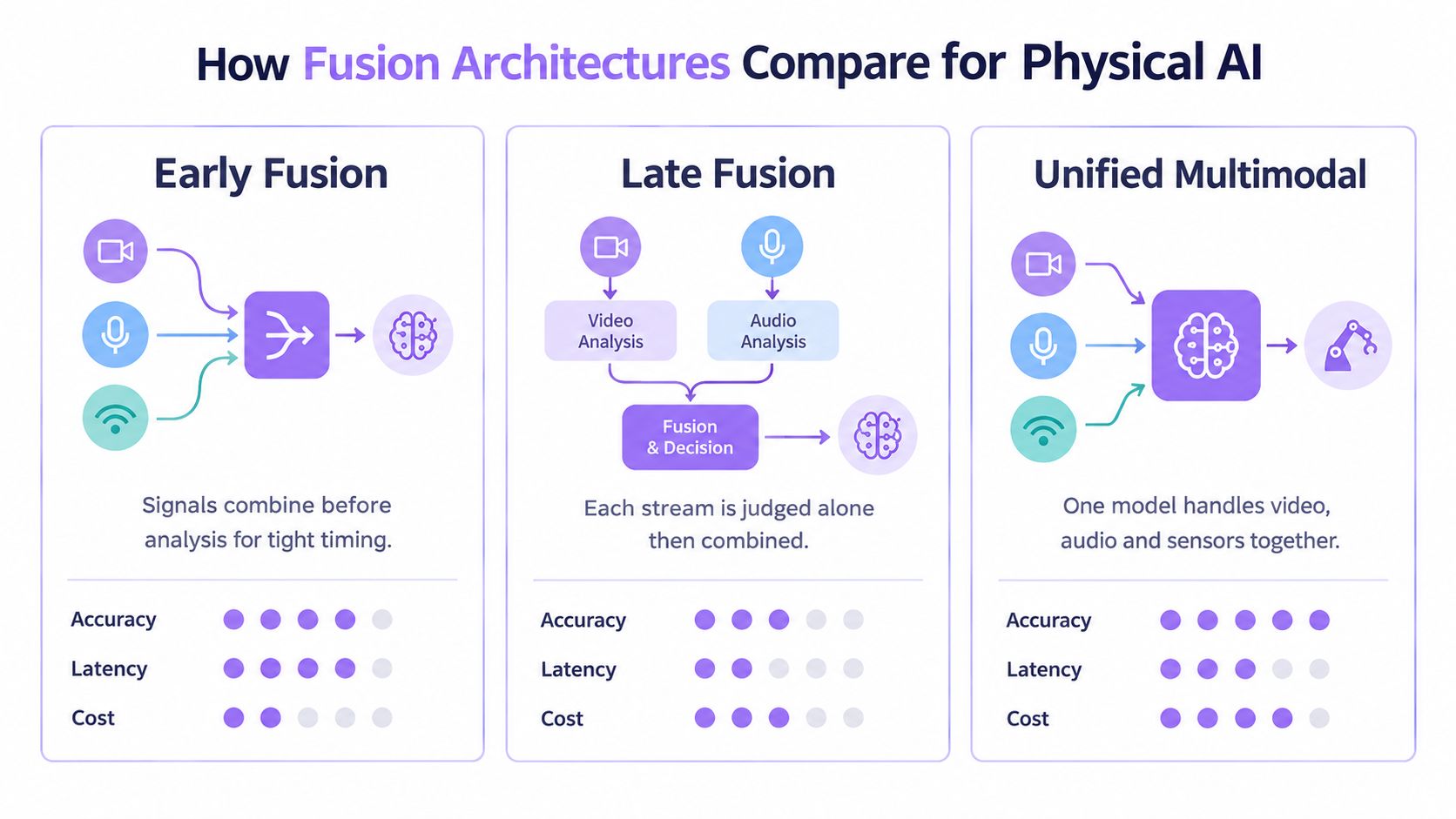
Developers usually meet three broad architecture patterns when they build search around physical-world media. The names sound academic, but the decision is practical. You're choosing how tightly to connect what the camera saw, what the microphone heard, and what the device sensed.
Three patterns you'll actually encounter
Early fusion combines signals near the front of the pipeline. That's useful when timing between streams matters a lot, such as robotics perception or smart glasses that need immediate context.
Late fusion lets each stream get analyzed separately before outputs are combined. This is common when teams already own separate speech, vision, or telemetry components and want to join results later.
Unified multimodal architecture uses a shared core for video, audio, and context together. This is the most natural fit when retrieval, recall, and scene understanding matter more than maintaining isolated modality tools.
Here's the trade-off view developers usually need:
| Pattern | How It Works | Best Fit | Trade Off |
|---|---|---|---|
| Early Fusion | Combines multiple signals before deeper analysis | Tight timing problems in robotics and responsive edge systems | Can be harder to adapt when devices change or one stream is missing |
| Late Fusion | Processes video, audio, and sensor outputs separately, then merges decisions | Legacy stacks, teams with separate model ownership, staged migration | Sync issues and extra app logic can make retrieval feel fragmented |
| Unified Multimodal | Treats mixed inputs as one shared understanding layer | Physical AI memory, DashCam search, CCTV review, mobile-first retrieval | Requires a deliberate platform choice and careful edge-resource planning |
Choosing by product shape
For smart glasses, early fusion can help when immediate interpretation of wearer context matters.
For GoPro or media editing workflows, late fusion may survive longer because teams often already have separate transcription and visual tagging systems.
For dashcams, mobile companions, CCTV, and robotics memory, unified search has a cleaner product outcome. The user asks one question and expects one answer.
Decision shortcut: If your users review incidents, not files, a unified search layer usually matches their mental model better.
Why this matters to Physical AI
Physical AI systems live in the world. They don't just classify media. They need to remember events that happened in space and time.
That's why the comparison with robotics is useful. Foxglove's August 2026 release introduced Semantic Search for robotics data, supporting plain-language prompts over image and video recordings, according to Robotics 247 coverage of Foxglove's physical-AI search release. The important signal isn't the vendor alone. It's that robotics platforms are increasingly treating recorded data as searchable operational memory.
The same architecture lesson carries into DashCam Videos : Ecosystem design. Once retrieval becomes the product, fragmented stacks start feeling expensive, even before you count infrastructure.
Inside the DashCam Ecosystem From Mobile Stacks to Edge Memory
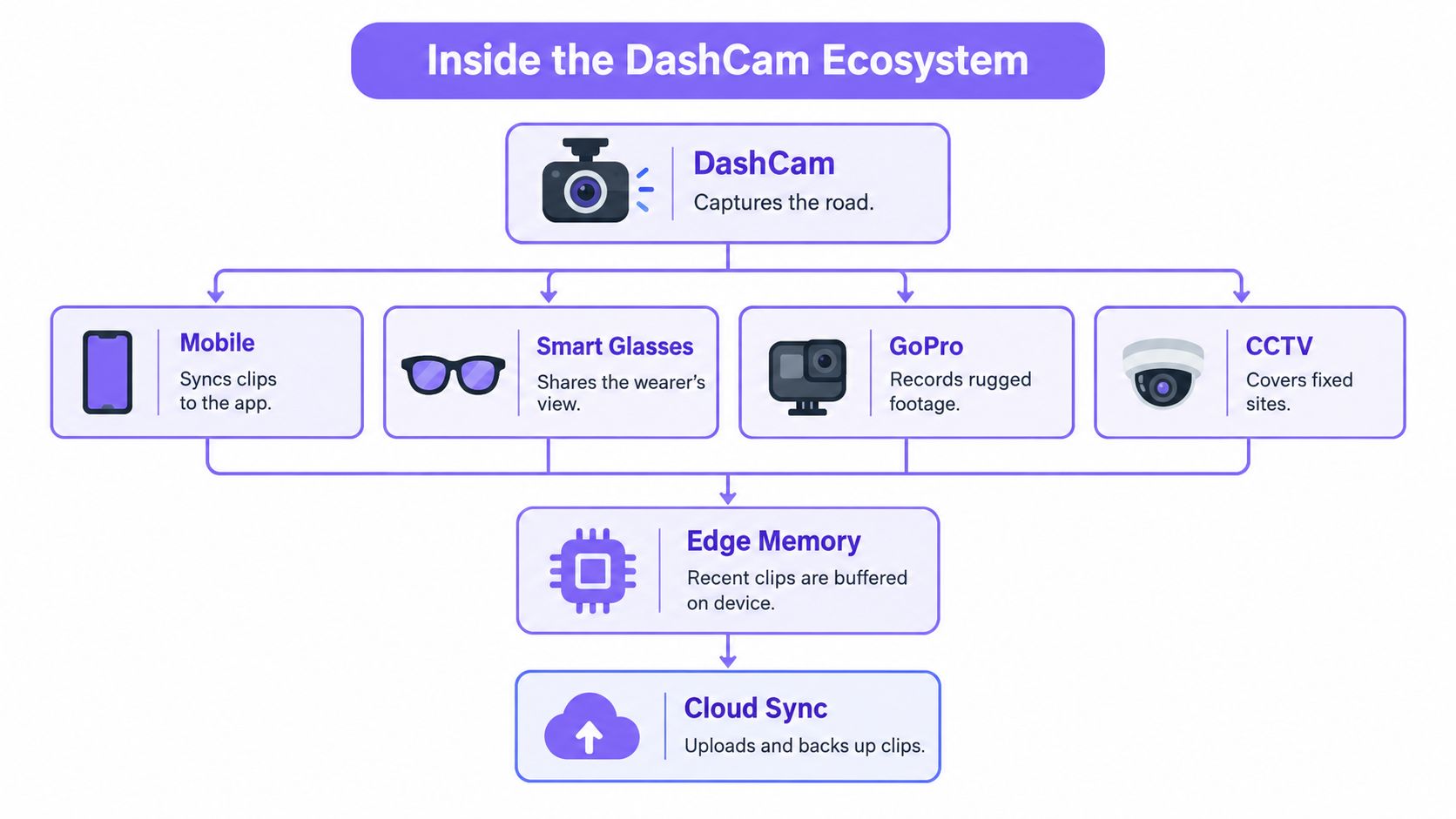
The ecosystem isn't one camera on a windshield. It's a chain of capture devices, mobile apps, codecs, storage policies, and sync decisions.
That's why developers who start with “we'll just upload the videos” usually run into trouble early.
The stack is broader than dashcams
In practice, the same retrieval problem shows up across:
- Mobile: companion apps, field capture, claim submission, trip review
- Smart glasses: first-person operational logging
- GoPro: rugged capture for delivery, inspection, or motorsports review
- CCTV: fixed-position evidence with long retention windows
- Dashcam: rolling road memory tied to motion and incidents
Each device class records differently, but users ask similar questions afterward. “Find the near miss.” “Find the shouted instruction.” “Find the clip where the vehicle stopped at the gate.”
Why edge memory exists
Continuous video creates more data than most networks can move in real time. Guidance from Jimi IoT on dash camera H.265 usage describes uncompressed HD video as tens of megabytes per second, while encoded output is typically only a few hundred kilobytes per second depending on quality and resolution. That difference explains the common pattern: local rolling storage first, selective upload second.
Dashcam systems usually rely on:
- Rolling local buffers: the device overwrites old footage until something important happens
- Event locking: collision or trigger events protect key clips from overwrite
- Dual streams: one higher-quality stream for evidence, one lighter stream for transmission
- Short overwrite loops: practical for limited local storage and continuous operation
This design isn't a compromise. It's the core operating model.
Codec choice changes retention windows
H.265 matters because it can deliver similar visual quality at about half the bitrate of H.264, though real-world gains are often smaller with motion-heavy or noisy road footage, according to Navixy's H.264 versus H.265 fleet telematics guidance. That same guidance gives practical examples such as roughly 6 Mbps for H.264 versus 3 Mbps for H.265 for similar quality, and a field case where a 128 GB card stored about 5 hours in H.264 and about 6 hours in H.265 for 4K footage.
Those numbers matter less as abstract compression wins and more as evidence windows. An extra hour on-card can be the difference between “we have the incident” and “it was already overwritten.”
Common pain points developers inherit
The ecosystem creates recurring headaches:
- Large-file instability: mobile apps crash or stall during long exports and uploads
- History fragmentation: footage lives across SD cards, local caches, phones, and cloud buckets
- Weak offline behavior: retrieval stops when the network does
- Review fatigue: operators scrub manually because no shared search exists
- Policy gaps: users record first, then wonder later how long they should retain or share clips
A mature design treats edge memory as part of product behavior, not just storage plumbing.
Where Multimodal Video Search Delivers Real Value
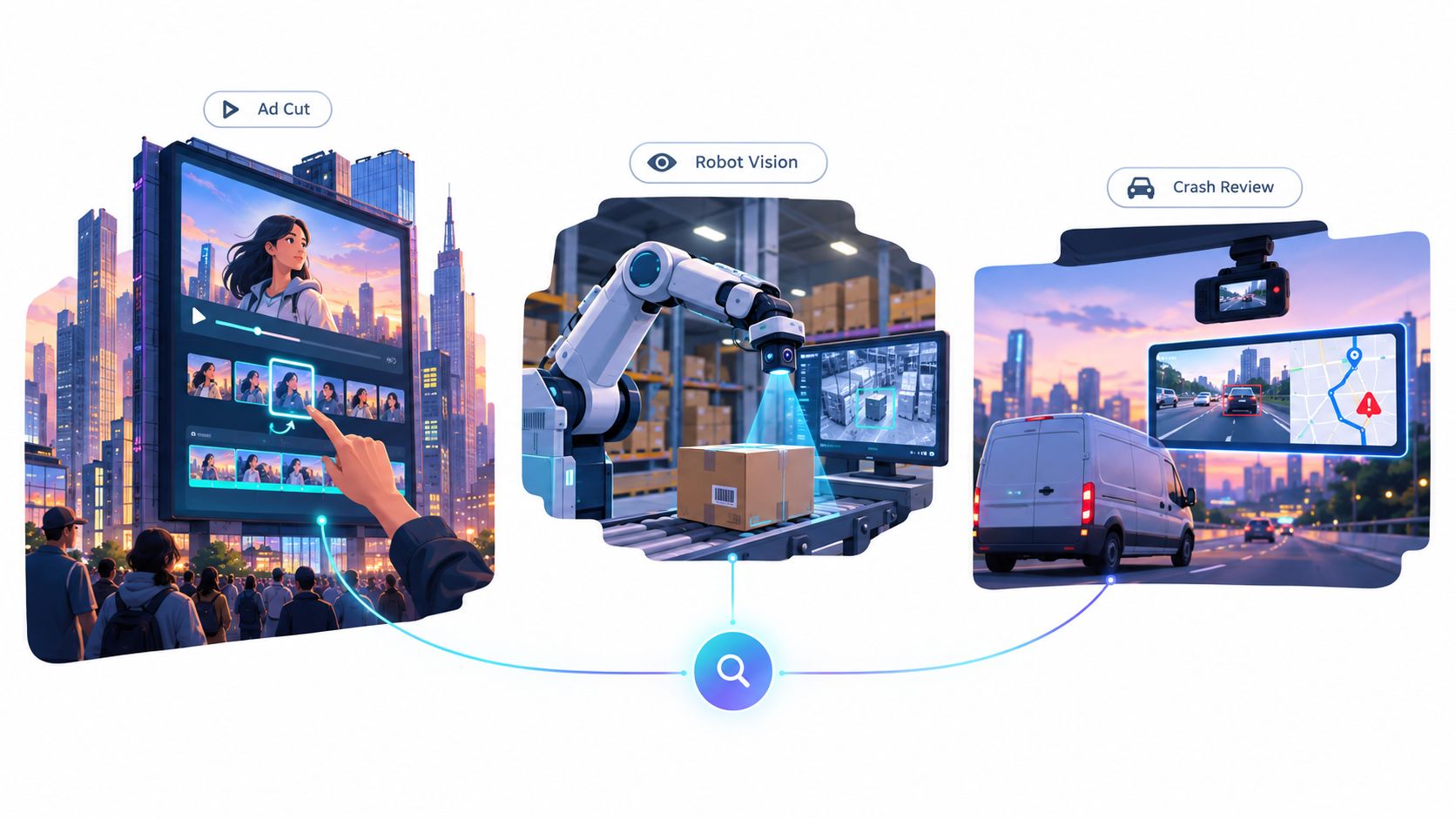
The value of search shows up when it removes manual review from a real job. Different industries phrase the problem differently, but the workflow pain is the same. Too much footage. Too little time. One event that matters.
Advertisement video edition
Media teams already work with text-to-video and image-to-video thinking. What they often need during editing is retrieval by meaning.
A producer might ask for: - the clip where a runner turns toward camera - the reaction shot with cheering audio - the storefront scene at dusk with traffic noise in the background
In older media stacks, an editor hunts through bins, transcripts, and shot tags. In a multimodal setup, one search can narrow the sequence faster because it uses sound and visuals together.
Vision for robotics and audio for robotics
Robotics teams don't search for “nice clips.” They search for operational moments.
A mobile robot team might want: - the sequence where a person entered the aisle while the alarm sounded - the basketball segment where speech and motion changed together - the moment the robot heard an impact and lost visual track
That matters because robotics perception increasingly combines sight and sound in the same physical context, as noted earlier in the robotics literature. Search becomes part of debugging and memory, not just annotation.
Dashcam and fleet review
Most readers feel the payoff immediately.
Claims, safety teams, and drivers want to retrieve: - the lane-change near miss with the horn - the stop where the other driver approached the window - the clip with sudden braking near a location the user remembers only vaguely
For North America, the broader commercial opportunity is large enough that retrieval can't stay an afterthought. One forecast puts the regional dashboard camera market at about USD 1.16 billion in 2025, rising to USD 2.18 billion by 2031, in Mordor Intelligence's North America dashboard camera market outlook. When that many systems are producing footage, the search bottleneck becomes operational, not theoretical.
The more cameras you deploy, the less “recording” is your problem. Review becomes the problem.
CCTV and video surveillance
CCTV operators live with long-duration footage and repetitive scenes. Their retrieval intents are often concise: - find the person who entered after the gate alarm - show the vehicle that stopped near the loading dock - locate the period with raised voices near the entrance
Unified search helps here because fixed surveillance often needs both visual and auditory context, even when the final evidence clip is short.
Integrating Search With SDKs and Edge Memory Layers
The safest way to integrate search is to think like a mobile engineer first. Assume unstable networks, battery constraints, background limits, and users who won't wait through giant uploads.
A practical stack starts with capture, adds selective ingestion, then gives the app a natural query layer. You don't need to expose proprietary search internals to design this well.
A prototype path that fits mobile reality
Start simple:
- Ingest clips progressively. Don't force one giant transfer when the user returns to the app. Use chunked multipart uploads for edge and mobile conditions.
- Preserve origin context. Keep recording timestamps and device context so the app can present meaningful playback windows.
- Query by intent. Let users search with natural language, visual prompts, or audio-oriented requests instead of only filenames.
- Return precise segments. The useful unit is rarely “the whole file.” It's the relevant window inside the file.
- Cache recent memory on device. Search should still feel usable when connectivity drops.
For Android teams, this usually means a native path in Kotlin. For cross-platform apps, a Flutter wrapper reduces duplicate integration work across Android and iOS.
Where mobile developers usually get bitten
A lot of failures happen outside the model layer:
- Playback friction: returned clips load too slowly for in-the-moment review
- Background interruptions: uploads pause when the app loses foreground time
- Poor segmentation: search returns a file but not the right moment inside it
- Weak retention policy: users don't know what stays local, what syncs, and what expires
- Sharing mistakes: public export happens before redaction or governance review
Recent legal commentary also highlights a blind spot: the key issue often isn't only whether recording is legal, but what happens after sharing, publishing, or using the footage for work purposes. Identifiable faces and license plates can trigger privacy and data-protection obligations, including for work vehicles, as discussed in IJIRL commentary on dashcam legality and post-recording use.
Governance check: Retrieval features should be paired with redaction, retention, and sharing rules from the first prototype, not added after rollout.
One practical option in this category
Teams evaluating a dedicated search layer can use V-Modal AI for multimodal video, audio, and sensor retrieval on mobile and edge devices, with a Kotlin Android SDK, a Flutter SDK, natural-language video search, signed streaming URLs, and chunked multipart uploads. That makes it relevant for dashcams, CCTV, smart glasses, and other Physical AI capture systems where continuous memory and retrieval need to fit mobile constraints.
Building a Searchable Future for Every Mile Recorded
The important shift in the DashCam Videos : Ecosystem is simple. Recording is no longer the differentiator. Searchable memory is.
That idea connects dashcams to a wider Physical AI stack. Mobile devices, smart glasses, GoPro workflows, CCTV systems, and robotics platforms all generate streams that are only valuable when someone can recall the right event at the right time. Unified multimodal search fits that reality better than fragmented audio and visual tooling because the world event was always mixed to begin with.
A strong evaluation checklist is short:
- Can users search by meaning, not just by file name?
- Can the system retrieve moments from video, audio, and context together?
- Does recent memory stay usable on edge hardware when the network is weak?
- Can the app return precise segments instead of whole recordings?
- Are redaction, retention, and sharing rules built into the workflow?
The teams that get this right won't treat dashcams as passive cameras. They'll treat them as memory systems for motion, sound, and evidence. That's the practical future of dashcam footage in 2026 and beyond.
If you're building around this shift, V-Modal AI offers a Visual Memory Layer for Physical AI that helps mobile, edge, and robotics teams search multimodal video and audio as continuous memory instead of static files. If you want to test natural-language retrieval, mobile SDK workflows, and edge-friendly recall on your own footage, visit V-Modal AI.