Nvidia Edge Inference Stack: Jetson Guide for Physical AI
A lot of teams are in the same spot right now. They have a robot, a smart-glasses prototype, a dashcam pipeline, or a CCTV product that can already detect objects, classify scenes, and maybe even answer a few prompts. Then the product question arrives: can the device remember what it saw and heard, and can a user search that history without sending everything to the cloud?
That's where the Nvidia edge inference stack Jetson becomes more than a small AI computer. It becomes the local runtime for Physical AI. Not just perception, but perception plus memory, retrieval, and action under real constraints: weak connectivity, privacy requirements, limited battery, thermal ceilings, and multiple sensors competing for the same device resources.
The hard part usually isn't getting one model to run. The hard part is keeping the whole system responsive when video, audio, control loops, and search all run together.
Table of Contents
- Why Edge Inference Matters Right Now
- Why Jetson keeps showing up in these conversations
- Where Physical AI projects usually get stuck
- Understanding the Nvidia Edge Inference Stack Jetson at a Glance
- Start with the module
- Then add JetPack and the runtime layer
- The broader Physical AI stack
- Why newer generations changed the design conversation
- Core Capabilities That Make Multimodal Search Possible
- Multimodal video without manual scrubbing
- Multimodal audio as context, not an afterthought
- Why unified search matters on-device
- The hidden requirement is throughput under load
- How Jetson Compares Across Generations and Alternatives
- What changed across generations
- Jetson Generation and Approach Comparison
- Edge versus cloud in practice
- Real World Use Cases From Mobile to Surveillance
- Mobile apps and smart glasses
- Dashcam and CCTV
- Robotics vision and audio
- Advertisement video edition and media workflows
- Pain points teams keep running into
- Choosing and Integrating Your AI Search Layer Without the Pain
- What to evaluate before you commit
- The bottleneck usually sits outside the model
- A practical integration checklist
- Putting It All Together With the Visual Memory Layer
Why Edge Inference Matters Right Now
A robot in a warehouse can keep driving when Wi-Fi drops. A pair of smart glasses still has to answer, “When did that leak start?” A dashcam still has to find the moment before a hard brake. In each case, the product fails if understanding lives somewhere else.
Edge inference matters because physical systems do not operate one request at a time. They are more like a small team sharing one cramped workbench. Video capture wants steady bandwidth. Audio wants continuous processing. Search wants memory access. Control logic wants predictable timing. If one part hogs the table, the rest start slipping.
Latency is the obvious reason to run locally. A robot or wearable device cannot wait on a round trip every time it needs to interpret a scene or retrieve recent context.
Privacy follows close behind. Factory floors, homes, vehicles, and camera systems often collect footage that teams cannot ship upstream by default.
Offline operation is the practical reason that turns edge AI from “nice to have” into product architecture. Elevators, tunnels, parking structures, job sites, and large industrial buildings break connectivity all the time. Users still expect the device to keep working.
Why Jetson keeps showing up in these conversations
Jetson became a common reference point because NVIDIA treated embedded AI as a full device problem early on. Even the first widely adopted Jetson modules combined GPU acceleration, ARM CPU resources, and shared memory in a form factor small enough for machines that had to sense and react on-device.
That history matters for one reason. The current challenge is no longer “can this board run a vision model?” Mobile and robotics developers are now asking a harder question: can one device watch multiple streams, keep a searchable memory of what happened, process language queries, and still leave enough headroom for control, encoding, and I/O?
That is a systems question.
Where Physical AI projects usually get stuck
A single-model demo often looks great. The trouble starts when the product adds real concurrency:
- More than one live sensor feed
- Background audio or speech processing
- Search over recent video and event history
- A mobile or operator interface
- Control loops, alerting, or robot behaviors running at the same time
At that point, peak TOPS stops being the full story. CPU scheduling starts to matter. Memory bandwidth starts to matter. Buffering, pre-processing, and data movement start to matter. The difference between a good demo and a dependable product often comes from orchestration, not from one headline accelerator number.
Practical rule: If the device has to keep understanding its environment during network loss, and has to search or act on that understanding in near real time, edge inference is part of the core product design.
That is why edge inference matters right now. Jetson gives developers a practical on-device foundation, but real-world multimodal search performance comes from how well the whole system shares compute, memory, and timing under load.
Understanding the Nvidia Edge Inference Stack Jetson at a Glance
A robot rolling through a warehouse, or a mobile device watching the road, does not experience AI as one model running in isolation. It experiences a stack. Camera frames arrive continuously. Buffers fill. Preprocessing runs on one part of the system while inference runs on another. The CPU still has to schedule work, move data, manage I/O, and keep the application responsive.
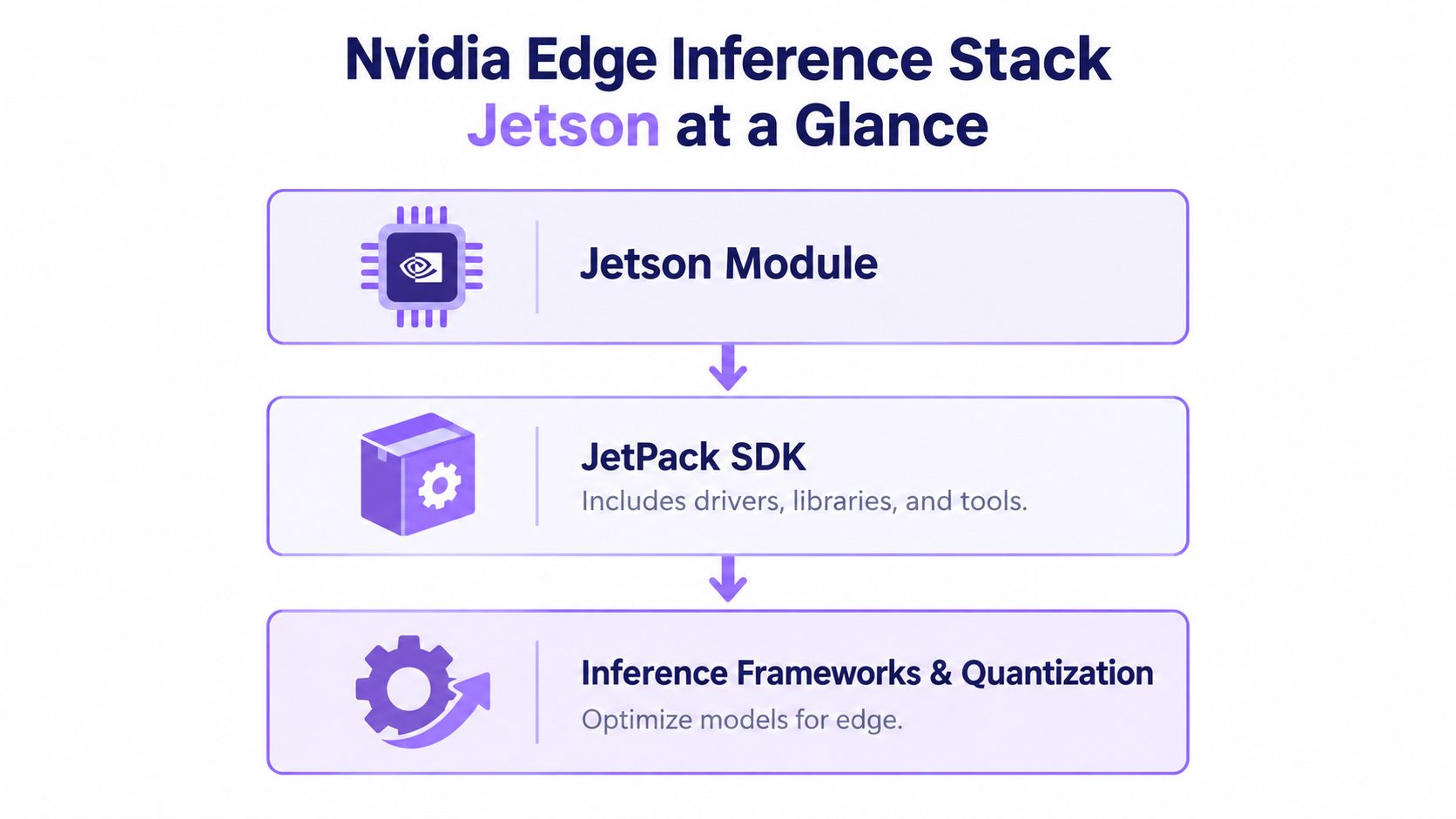
Jetson works like a compact on-device compute stack built for that kind of mixed workload. The module matters, but the story is the combination of compute, memory, software, and runtime coordination.
Start with the module
At the bottom is the Jetson module. This is the embedded compute unit that ends up inside a robot, smart camera, vehicle system, or edge appliance. Over several generations, NVIDIA moved Jetson from lighter embedded vision tasks toward heavier robotics and industrial deployments.
A quick way to read that progression is to look at how much local AI work later modules were designed to carry. NVIDIA lists Jetson Xavier NX at 21 TOPS and Jetson AGX Xavier at 32 TOPS, while Xavier-family configurations scaled to 64 GB LPDDR4x in the lineup (NVIDIA Jetson Xavier family page).
Those numbers are useful, but they do not tell you how a product will behave once multiple pipelines run at once. For multimodal search, memory capacity, memory bandwidth, and CPU headroom often decide whether the device keeps up when video decode, embedding generation, indexing, and control logic overlap.
Then add JetPack and the runtime layer
Above the module sits JetPack. JetPack provides the system software, drivers, CUDA-based tooling, accelerated libraries, and deployment environment that make Jetson usable as a development platform instead of a box of parts.
That distinction matters for edge teams. Running one model from a notebook is easy enough. Shipping a device that boots reliably, talks to sensors, handles codecs, uses hardware acceleration correctly, and survives updates is a software integration problem. JetPack reduces that work by packaging the lower layers into something developers can build on.
NVIDIA's recent guidance also places JetPack in the path for newer inference workflows, including quantized models and TensorRT Edge-LLM on newer Jetson platforms (NVIDIA JetPack 7.1 and Jetson T4000 guidance).
The broader Physical AI stack
Jetson also fits into a larger NVIDIA toolchain. NVIDIA describes its physical AI stack across Jetson, Omniverse, Isaac, Cosmos, Metropolis, and Alpamayo, with open-source agent tools aimed at perception, simulation, navigation training, mobility data generation, and edge deployment (NVIDIA open-source physical AI tools announcement).
For product teams, that usually means Jetson is the runtime endpoint, not the whole development story.
A robotics group might train and test in simulation, build perception and autonomy workflows in the NVIDIA ecosystem, then deploy the final inference graph on Jetson because that is the machine sitting next to the cameras, microphones, motors, and radios. That is where trade-offs become real. Every watt, thread, and memory copy now shares the same box.
Why newer generations changed the design conversation
Jetson Orin pushed that boundary further. NVIDIA lists the Jetson AGX Orin family at up to 275 TOPS, and its Jetson Orin family overview also frames Orin Nano as a major step up for entry-level edge AI and robotics (Jetson Orin family overview).
NVIDIA later introduced Jetson Thor modules with much larger memory configurations for heavier edge AI workloads. The public messaging around Thor points in the same direction as the hardware trend itself. More of the pipeline can stay on the device, including larger vision-language and multimodal workloads, if the rest of the system is engineered to feed them efficiently.
That is the practical way to view Jetson. It is not only an accelerator choice. It is a systems-integration choice for products that need concurrent perception, retrieval, and action under real resource limits.
Core Capabilities That Make Multimodal Search Possible
Search for Physical AI isn't the same thing as search in a media archive. A robot, dashcam, or smart-glasses device isn't just storing files. It's building a time-based memory of the world from camera frames, audio, and context.
Multimodal video without manual scrubbing
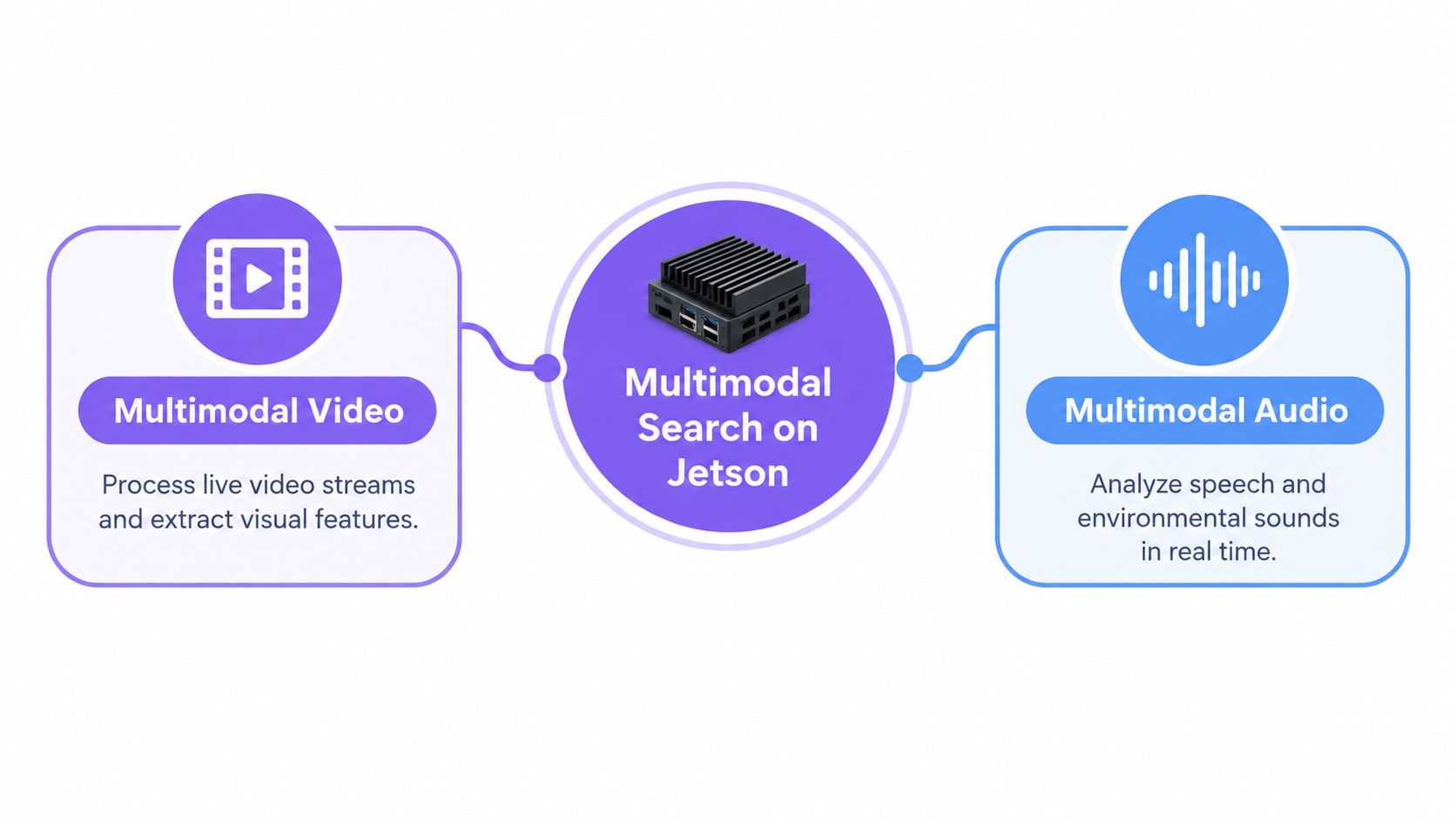
For multimodal video, the practical goal is simple. A user should be able to ask for a moment, object, scene, or event and get back the relevant segment instead of manually reviewing hours of footage.
That applies to several common workflows:
- Advertisement video edition where an editor wants the moments containing a product, logo, person, or action
- Vision for robotics where an operator needs to find the exact scene before a navigation or manipulation error
- Dashcam and CCTV review where teams search for incidents across long, continuous recordings
- Media content review where clips need to be recalled by meaning, not only by filename
At the product layer, this usually shows up as text-to-video and image-to-video queries. The user enters a phrase or supplies a visual reference, and the system returns matching moments.
Multimodal audio as context, not an afterthought
Audio is where many edge products become much more useful. A robotics team may want to find “the point where the motor started squealing” or “the moment the operator said stop.” A surveillance team may need the segment containing glass break, shouting, or a spoken exchange. A smart-glasses app may need voice-driven recall.
The useful pattern is voice-to-audio or voice-guided retrieval across video plus sound. That's different from treating audio as a separate file or relying only on text transcription. In real products, environmental sound matters alongside speech.
Why unified search matters on-device
V-Modal AI describes its platform as a Visual Memory Layer for Physical AI with multimodal video and audio search, query modes such as text-to-video, image-to-video, voice-to-audio, and environmental-state-to-video, plus Android Kotlin and Flutter SDKs for mobile integration. The practical appeal is that it presents a unified search layer instead of forcing teams to stitch together disconnected audio and visual retrieval paths.
That unified approach matters because fragmented pipelines tend to create sync problems. Video says one thing, audio says another, timestamps drift, and the user gets inconsistent retrieval behavior.
A usable edge memory system doesn't feel like three tools taped together. It feels like one timeline that understands what the device saw, heard, and was doing.
The hidden requirement is throughput under load
Multimodal search gets difficult when the workload is continuous. The device isn't only answering a query. It's also ingesting live streams, preparing data, managing memory, and preserving responsiveness for the rest of the application.
Jetson Orin NX is a good example of how NVIDIA targets this class of workload. NVIDIA positions it as a compact edge-inference module with up to 100 TOPS INT8, 1024 CUDA cores, 32 Tensor Cores, 102.4 GB/s LPDDR5 bandwidth on the 16 GB variant, and a configurable 10 W to 25 W power envelope (Jetson Orin NX datasheet).
That memory bandwidth point is easy to miss. For multimodal video and audio pipelines, you're often limited by moving data through the system cleanly, not just by the model's nominal compute needs.
How Jetson Compares Across Generations and Alternatives
Peak AI numbers are useful, but they don't answer the buying question on their own. A robotics stack, a CCTV appliance, and an advertisement video workflow can all use Jetson, yet they stress very different parts of the system.
What changed across generations
The hardware progression tells a clear story. TX1 made compact edge inference practical. Xavier pushed Jetson into stronger robotics and industrial throughput. Orin made high-performance edge AI mainstream across more product tiers. NVIDIA's 2026 announcements then positioned Thor and T4000 as the next stage for larger multimodal and generative workloads at the edge.
NVIDIA said the Jetson T4000 delivered 1,200 FP4 TFLOPS, 64 GB of memory, and 4x the performance of the previous generation within a configurable 70-watt envelope, with a $1,999 price at 1,000-unit volume (NVIDIA physical AI product announcement).
NVIDIA also positioned Jetson Thor as a physical AI platform for generative reasoning and multimodal, multisensor processing, with the Jetson AGX Thor developer kit priced at $3,499 and production modules available through authorized distributors (Jetson Thor introduction).
Jetson Generation and Approach Comparison
| Platform Approach | AI Performance | Memory and Power Envelope | Best Fit Use Case |
|---|---|---|---|
| Jetson TX1 era | 1 TFLOP/s | 4 GB LPDDR4, compact embedded profile | Early on-device vision, basic edge inference |
| Xavier class | 21 TOPS on Xavier NX, 32 TOPS on AGX Xavier | Up to 64 GB LPDDR4x in the lineup | Robotics, industrial perception, multi-stage vision |
| Orin class | Up to 275 TOPS for AGX Orin | Broader modern edge deployment range | Multi-camera AI, multimodal edge inference, stronger autonomy |
| Orin NX compact deployments | Up to 100 TOPS INT8 | 10 W to 25 W configurable envelope | Power-sensitive robots, smart cameras, mobile edge boxes |
| Thor and T4000 era | 1,200 FP4 TFLOPS on T4000 | 64 GB memory, 70-watt configurable envelope | Larger multimodal and generative Physical AI workloads |
| Cloud-first approach | Qualitatively strong centralized compute | Depends on connectivity and backend design | Batch analytics, non-real-time media processing, centralized search |
| Media-content stack without robotics constraints | Depends on software stack | Often less constrained by control loops | Advertisement editing, post-production search, archive retrieval |
Edge versus cloud in practice
For media content, cloud can still make sense when latency is less sensitive and footage is already centralized. For Physical AI, the edge wins when the system has to react in real time, preserve privacy, or stay useful when disconnected.
NVIDIA's 2026 robotics announcements make this split clearer. Jetson Thor was tied to humanoids, mobile robots, and manipulators, while IGX Thor was described as an embedded PC for stationary edge workloads with high-speed sensor processing and functional safety in industries such as construction, manufacturing, healthcare, and space (NVIDIA robotics platform announcement).
Real World Use Cases From Mobile to Surveillance
The same architectural pattern keeps showing up across products. A device captures ambient reality continuously. The user doesn't want a raw archive. They want searchable memory.

Mobile apps and smart glasses
In mobile companion apps, especially Android and Flutter-based apps connected to edge hardware, the pain point is usually disconnected history. The user opens the app and sees a set of clips, but not the remembered context around them.
Smart glasses raise the bar further. A field user may need to ask for “the panel with the red warning light from earlier” or “the part where the customer described the rattling sound.” Text, voice, and visual recall need to feel immediate. If every query requires cloud upload, the interaction breaks.
Dashcam and CCTV
Dashcam and surveillance teams know the manual-review problem well. Reviewing long timelines is slow, and the event of interest is often described semantically, not by timestamp. The operator remembers “the white van blocking the lane” or “the argument near the entrance,” not the exact minute.
Multimodal video and multimodal audio become useful together. Video narrows by scene and object. Audio helps distinguish honking, impact, raised voices, or spoken cues. For CCTV and video surveillance, edge indexing also reduces dependence on always-on upstream bandwidth.
In surveillance products, the real feature isn't video storage. It's reducing the time between a user's vague memory and the exact segment they need.
Robotics vision and audio
Robotics developers often start with perception and only later discover they need history. A mobile robot can detect obstacles in the present, but debugging, compliance review, and operator handoff all depend on recalling the recent past.
Common examples include:
- Vision for robotics where an operator searches for the moment before a failed pick or navigation detour
- Audio for robotics where the team needs machine sounds, voice commands, or abnormal acoustic events aligned with the video timeline
- Multisensor event review where a robot assistant has to explain what happened before it acted
Advertisement video edition and media workflows
Advertisement editing sounds far from robotics, but the retrieval problem is similar. Editors often need all moments showing a product angle, a gesture, a background scene, or a spoken phrase. Traditional metadata is too thin. Manual review wastes time.
The difference is that media teams can tolerate more delay, while robots and cameras often can't. That's a useful comparison. Media content stacks optimize for search depth over stored assets. Physical AI stacks optimize for live capture plus recall under local constraints.
Pain points teams keep running into
- Manual scrubbing: Long recordings make simple retrieval tedious.
- Fragmented analysis: Separate video and audio pipelines drift apart.
- Disconnected device memory: Mobile apps show files, not context.
- Bandwidth limits: Continuous upload doesn't scale well for edge devices.
- Offline gaps: Search fails when connectivity drops.
- Integration complexity: Android, Flutter, embedded Linux, and robotics stacks don't naturally fit together.
- Search versus control contention: The same hardware may need to serve user queries while still running perception and device logic.
Choosing and Integrating Your AI Search Layer Without the Pain
A team gets its first Jetson prototype working. One camera streams in, detections look good, and a text query can pull back a short clip. Then the product requirements arrive. Add a second stream. Keep audio aligned. Let the mobile app search recent history while the device is still recording. Keep the robot responsive. That is usually where the AI search layer stops being a model choice and becomes a systems problem.
For multimodal search on Jetson, the hard part is rarely raw TOPS. It is fitting retrieval into a device that is already busy with camera ingest, preprocessing, storage writes, app sync, and sometimes control loops. A search layer works like an index in a library that is being updated while people are still checking books in and out. If indexing slows down capture, you lose moments. If retrieval steals too much CPU time, the user sees lag even when the GPU still has headroom.
What to evaluate before you commit
Start with operating constraints, because those decide whether search feels reliable in the field.
- Concurrency behavior: Check whether the system can ingest, index, and answer queries at the same time without visible stalls.
- Memory bandwidth: Video frames, embeddings, and buffers all compete for movement through the same memory system.
- Power envelope: Battery devices and fanless boxes expose inefficient pipelines quickly.
- SDK coverage: Many teams need one search layer to serve Android Kotlin, Flutter, and embedded Linux clients together.
- Offline tolerance: Decide which queries must succeed locally and which can wait for sync.
- Query modes: Text to video, image to video, and audio aligned search create different pipeline pressure.
A common mistake is to evaluate retrieval quality in isolation. On Jetson, retrieval quality under load matters more than retrieval quality in a quiet lab run.
The bottleneck usually sits outside the model
Published academic profiling of concurrent vision inference on NVIDIA GPUs found that CPU-side events such as thread scheduling and context switching frequently become bottlenecks, which constrains overall GPU performance (academic profiling of concurrent vision inference on NVIDIA GPUs).
That matches what edge and robotics teams run into. They speed up inference, then add one more camera, one more queue, or one more query path, and the whole system becomes erratic. The GPU may still look underused, but the product feels slow because preprocessing, scheduling, buffering, and postprocessing are fighting over CPU time.
You can see the same pattern in a different form with optimized inference results on Jetson Orin NX. Published YOLOv8 TensorRT measurements reported about 52 FPS in FP16 and 65 FPS in INT8, which shows how quantization can improve throughput in a TensorRT-friendly pipeline (Jetson Orin NX YOLOv8 TensorRT measurements). Useful result. It still does not answer the harder product question: what happens when search, capture, and user interaction all run together?
That is why Jetson integration should be framed as orchestration work. The system wins or loses on scheduling, memory movement, queue design, and backpressure handling.
Design advice: Treat CPU scheduling, memory movement, and stream orchestration as part of the search feature itself. If those pieces arrive late, multi-stream retrieval often looks fine in a benchmark and unstable in production.
A practical integration checklist
Keep the first integration pass boring and explicit.
- Define the local memory window. Set how much recent video and audio stays searchable on-device, and how quickly older content rolls to colder storage or sync.
- Isolate ingest from query latency. Recording should continue cleanly even if a user submits several search requests in a row.
- Choose synchronization rules early. Mobile apps on weak networks need chunked upload, resumable sync, and clear conflict handling.
- Document offline behavior. State which query types work locally and which need cloud help.
- Budget for mixed workloads. Search, detection, alerting, and device control will compete for the same CPU, memory, and storage bandwidth.
- Test with realistic concurrency. One lab camera and a canned query trace hide the exact failure modes that appear in field use.
For teams deciding whether to build or buy, the trade-off is straightforward. Building your own retrieval stack gives maximum control over media handling, embeddings, timeline alignment, APIs, and deployment behavior. It also means owning every integration edge case across mobile clients and embedded Linux targets. A dedicated search layer, such as a Visual Memory Layer approach, reduces that plumbing work if it already supports the query modes, SDKs, and offline behavior your product needs.
In surveillance products, the key feature is not video storage. It is shortening the path between a user's partial memory and the exact segment they need. On Jetson, getting there depends less on benchmark speed and more on whether the whole system can keep sensing, indexing, and answering at once.
Putting It All Together With the Visual Memory Layer
Jetson has earned its place because it solves a real edge problem. It moves AI close to the sensor, where latency, privacy, and offline operation matter. But once you go beyond a single-model demo, the harder question becomes how the device stores, understands, and retrieves what it just observed.
That's why I'd frame the Nvidia edge inference stack Jetson as a systems-integration platform, not a TOPS race. Product outcome depends on how well you combine module choice, JetPack, quantization, multimodal pipelines, and orchestration under memory and power limits.
For Physical AI, the missing piece is often a dedicated search layer. Not a generic archive. A memory layer that can sit beside robotics logic, dashcam capture, CCTV indexing, smart-glasses workflows, and mobile apps, while supporting natural-language and visual recall over multimodal video and audio.
If you're evaluating your next step, keep the decision path short:
- Choose the Jetson class that matches your workload composition, not just your benchmark target.
- Define what must stay local on the device.
- Test concurrency early with realistic video, audio, and query traffic.
- Add a search layer only if it behaves well under those same constraints.
That's the difference between a flashy edge demo and a product people can trust in the field.
V-Modal AI offers a Visual Memory Layer for Physical AI that fits directly into this problem space: multimodal video and audio search, edge-oriented memory, and SDK paths for mobile and device integration. If you're building on Jetson and need searchable on-device memory instead of another isolated model pipeline, take a look at V-Modal AI.