Video Analytics Ecosystem for Ads and Sport Content Video
The video analytics market is projected to grow from USD 14.65 billion in 2026 to USD 41.39 billion by 2031, a trajectory that signals a change in what video means to modern businesses, according to MarketsandMarkets' intelligent video analytics forecast. Video is no longer just an asset to watch or a recording to review. It's becoming searchable infrastructure for advertising production, live sports, robotics, smart glasses, dashcams, GoPros, CCTV, and Physical AI systems.
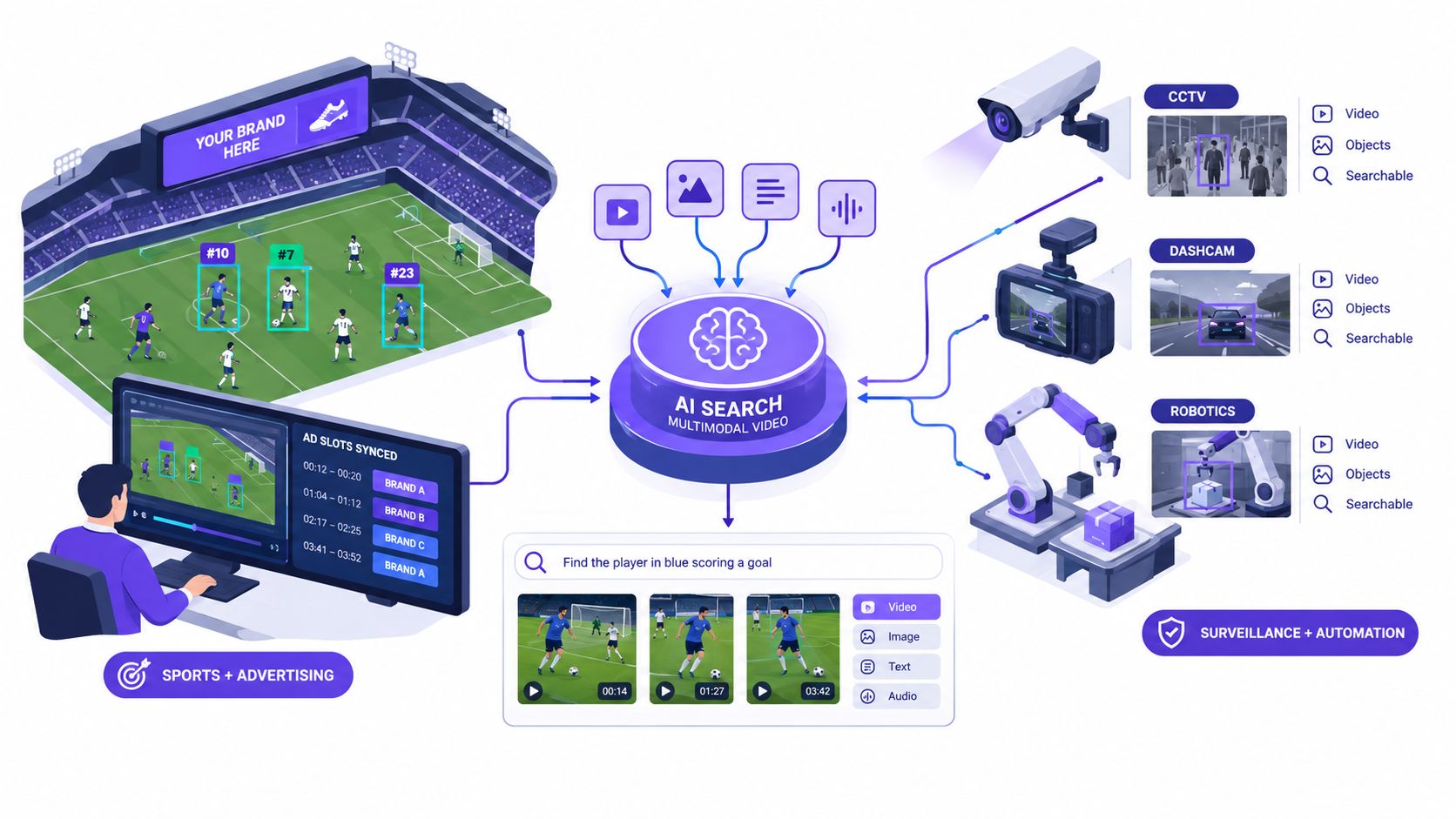
The same capability can find a sponsorship logo in a match replay, locate a collision warning in dashcam footage, connect a spoken instruction to a robot's visual field, or retrieve every clip where a player falls inside the penalty area. The Video Analytics ecosystem for Ads and Sport content Video is converging with robotics because both industries need reliable answers from long, unstructured streams.
Table of Contents
- Understanding the Multimodal Video Search Revolution
- From keywords to context
- Comparing Search Technologies and Approaches
- Media content and Physical AI
- Implementing Effective Video Search Patterns
- Choose the query around the job
- Industry Applications Across Physical AI and Media
- The same search layer, different decisions
- Building Mobile and Edge Deployment Solutions
- Design for failure
- Overcoming Metadata and Measurement Challenges
- Measurement is a stitching problem
- Planning Your Multimodal Search Implementation
Understanding the Multimodal Video Search Revolution
Video search becomes unreliable when filenames, folders, manual tags, and transcripts carry the full indexing burden. A producer looking for “the moment the striker celebrates after a corner” may find no useful filename match. A robotics engineer searching for clips where a spoken command coincides with an object entering the camera view faces the same problem. The evidence exists, but it is distributed across images, sound, speech, and time.
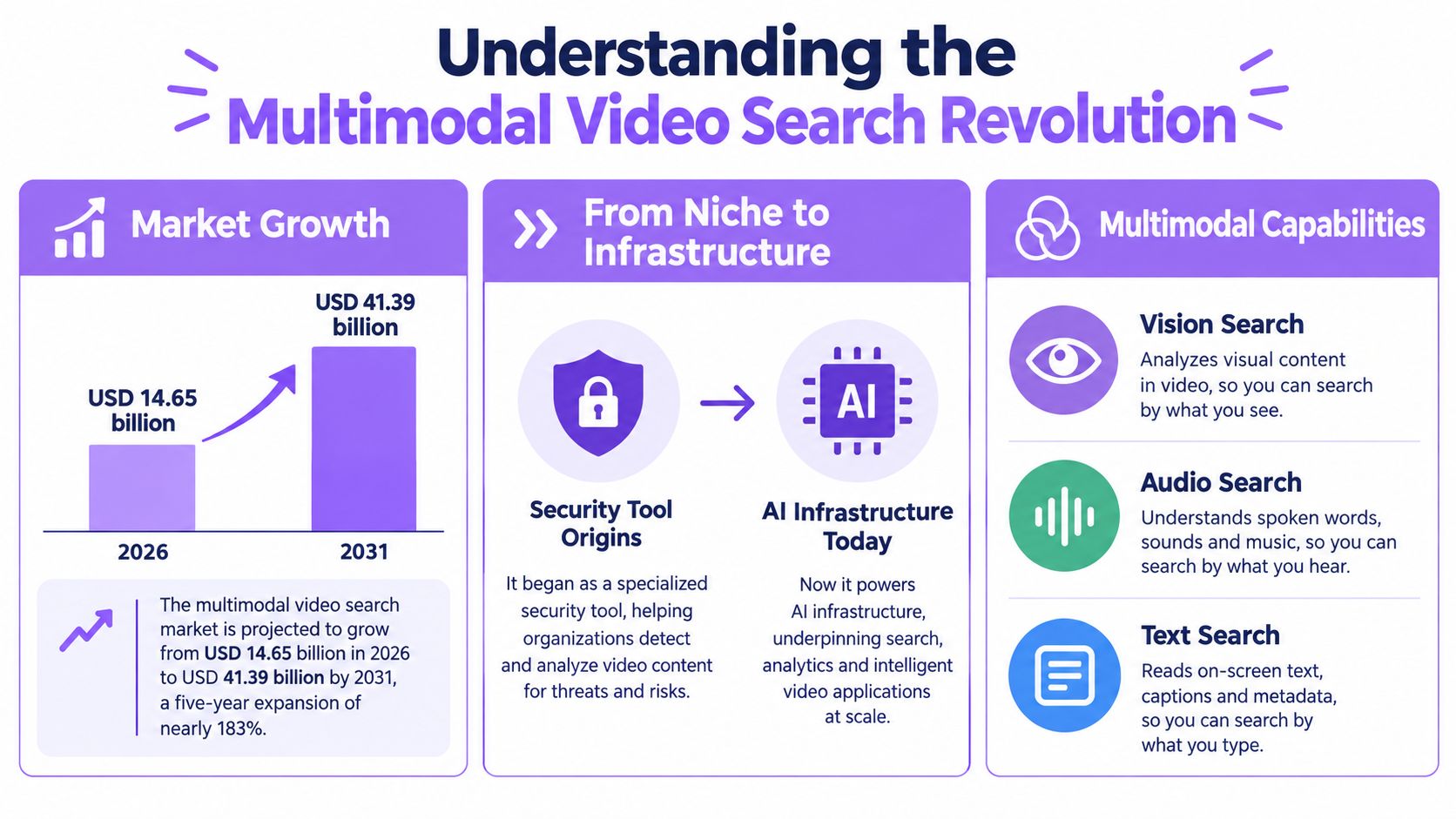
Market forecasts reflect this expanding role. One estimate projects growth from USD 15.04 billion in 2026 to USD 33.74 billion by 2030, at a 22.18% CAGR, according to this market analysis. The estimates differ in scope and methodology, so they should not be treated as interchangeable. Together, they indicate a shift from security-focused video analysis toward infrastructure for media intelligence, content operations, compliance, sponsorship verification, and audience segmentation.
From keywords to context
A multimodal search system indexes a video moment as a timed combination of visual evidence, speech, crowd noise, commentary, play-by-play information, and other signals. A query such as “show the replay where the goalkeeper saves a penalty while the commentator says it's key” therefore combines visual, auditory, and contextual requirements.
The video analytics ecosystem for ads and sports content is converging with robotics because both fields need dependable answers from long, unstructured streams. In advertising production, an editor can search for product visibility, crowd reactions, branded boards, or a particular athlete gesture instead of scrubbing through an entire match. The system returns candidate moments, while editors still verify image quality, rights restrictions, brand safety, and placement value.
Practical rule: Treat search as an operational layer over the media library, not as a replacement for editorial judgment.
Physical AI applies the same retrieval pattern to a different decision cycle. A media team retrieves footage to edit or monetize content. A robot, smart-glasses application, or autonomous vehicle retrieves prior evidence to interpret its environment and choose a next action. Production systems must therefore preserve timestamps and modality relationships, not merely attach labels to files. The shared requirement is to connect intent with evidence across time, while keeping human review where commercial or safety consequences demand it.
Comparing Search Technologies and Approaches
A keyword system and a multimodal system can receive the same footage and produce very different results.
| Approach | What it understands | Where it works | Where it fails |
|---|---|---|---|
| Filename and manual tags | Human-entered labels | Small, organized libraries | Inconsistent coverage and stale metadata |
| Transcript search | Spoken words | Interviews, commentary, commands | Silent actions and visual context |
| Computer vision only | Objects, scenes, and gestures | Detection and visual filtering | Spoken meaning, causality, and sound cues |
| Multimodal search | Linked visual, audio, text, and timing signals | Long-form media and physical environments | Requires careful evaluation and operational controls |
Separate models often create synchronization problems. A transcription service may identify a phrase, while a vision model identifies an event, but the application still needs to decide whether both refer to the same moment. In a sports workflow, “goal” in commentary may occur before the broadcast shows the replay. In a robotics workflow, a verbal command may arrive while the camera is pointed away from the object.
MIT researchers reported a method in 2025 that aligns audio and visual data from video clips without human labels, with improvements in audiovisual retrieval and action classification described in their research announcement. The practical lesson isn't that one alignment method solves every production problem. It's that audio and vision should be treated as related evidence rather than unrelated indexes.
Media content and Physical AI
Media systems usually prioritize discoverability, clipping speed, rights review, and monetization. Robotics systems prioritize perception, planning, safety, and action. Smart glasses sit between the two. They capture ambient content like a mobile device, but users expect immediate recall of what they saw, heard, or were told.
A unified search layer can support text-to-video, image-to-video, voice-to-audio, and environmental-state-to-video intents. That's more useful than forcing a user to choose between a transcript search box and a visual filter before they know which modality contains the answer.
The trade-off is governance. A broad multimodal result can be useful for discovery but still require human confirmation before an ad is edited, a safety event is escalated, or a robot uses the result for action. Precision, latency, storage, privacy, and explainability need to be evaluated together.
Implementing Effective Video Search Patterns
The most reliable production pattern is staged retrieval. Start with a broad search across the available footage, narrow the result to relevant time ranges, then apply event-specific review. This is faster and safer than asking a single model to make an irreversible decision about an entire archive.
SoccerNet provides a useful benchmark. It contains 500 full-match broadcast videos, totaling about 764 hours and 4 TB of footage, with events annotated at one-second resolution. Its reported baseline spotting result is 49.7% mAP, while a one-minute segment classifier reaches 67.8% mAP, as described in the SoccerNet benchmark paper. The comparison illustrates why coarse segmentation and precise spotting work better together than unrestricted moment hunting.
Choose the query around the job
A sports editor and a robotics operator may use similar language, but their query design should reflect the action that follows.
- Text-to-video works for semantic intent. Search for “all counterattacks followed by a shot” or “a person approaching the vehicle from the left.”
- Image-to-video helps locate visual recurrence. Supply a sponsor logo, uniform, product package, or known object to find related appearances.
- Voice-to-audio suits spoken commands, commentary, alarms, and environmental sounds. A dashcam team might search for a horn followed by hard braking.
- Environmental-state-to-video is useful when a physical system needs history associated with a condition, such as a door opening while a warning tone is active.
SVI-Bench evaluates multimodal sports understanding across basketball, hockey, and soccer. Its nine tasks span perception, reasoning, simulation, and agency, using aligned video, play-by-play logs, commentary, reports, and structured statistics, as documented in the SVI-Bench dataset. That design captures a common production issue: identifying the right clip isn't enough if the system can't connect the event to its surrounding evidence.
Evaluation principle: Test whether the result answers both “what happened?” and “why does this moment matter?”
For advertising video edition, keep humans in the final loop. Let search surface candidate clips, then let editors verify framing, rights, audio quality, sponsorship visibility, and narrative usefulness. For robotics, separate retrieval from control, so historical evidence can inform a decision without becoming an unsafe action on its own.
Industry Applications Across Physical AI and Media
Live sports concentrates high-value attention, making it an important environment for advertising and content intelligence. CTAM reported that 73% of advertisers planned to allocate budget to live sports streaming or CTV advertising over the next 6–12 months, while 79% of agencies planned to invest, according to Grand View Research's video analytics market coverage. The same source reports that almost two-thirds, or 64% of Americans, pay for a Sports SVOD subscription in 2026.
That demand creates practical work for search systems. A broadcaster needs to find highlights quickly. An advertiser needs to verify that a virtual board, jersey mark, or in-game placement appeared in the intended context. A rights team needs to locate clips before distribution. A sponsor needs evidence that an activation was visible and associated with the right event.
The same search layer, different decisions
In robotics, perception combines visual scenes with language, sound, and other sensor inputs so a machine can interpret an environment and plan an action. A 2025 survey in Frontiers describes this integration as essential for robots working with complex environments and human users. Audio for robotics can include spoken instructions, alarms, impacts, machinery noise, or changes in ambient sound.
Dashcams turn similar capabilities into driver and fleet workflows. Fortune Business Insights values the dashboard camera market at USD 5.86 billion in 2025 and projects USD 11.25 billion by 2034, with a 7.3% CAGR, in its dashboard camera market analysis. The source identifies use cases including distracted-driving, fatigue, harsh-braking, lane-departure, tailgating, forward-collision, pedestrian, and event-based video detection.
Vehicle CCTV has moved in the same direction. One 2026 estimate places that market at USD 26,132 million in 2025 and reports a 7.4% CAGR through 2033, while identifying fatigue detection, distraction monitoring, predictive maintenance alerts, and incident detection as AI-enabled applications in its vehicle CCTV report.
GoPro footage and smart-glasses recordings add a first-person perspective. Search can help a field technician retrieve the moment a tool was dropped, a coach find a particular drill, or a wearer recall a spoken instruction associated with what they were seeing. The hard part is not collecting more video. It's making the history usable without forcing people to watch it all again.
Building Mobile and Edge Deployment Solutions
Mobile deployment changes the design priorities. A phone, smart-glasses companion app, GoPro workflow, or dashcam can't assume continuous high-bandwidth connectivity, unlimited memory, or stable power. The application should capture locally, preserve timing, and move only the required content or derived signals when the network allows it.
A practical mobile stack often has three layers:
- Capture and transport: Use native Android components in Kotlin or a Flutter wrapper to manage camera input, local files, signed streaming URLs, and chunked multipart uploads.
- Search access: Expose text-to-video, image-to-video, and voice-to-audio queries through a stable client interface so the UI doesn't depend on one device type.
- Recall and playback: Return timestamped results that open the relevant segment rather than forcing users to download or scrub the complete recording.
Design for failure
Edge systems should assume that uploads pause, cameras disconnect, and users move between Wi-Fi and mobile networks. Chunked uploads reduce the cost of restarting a transfer. Local queues preserve capture order. Signed URLs limit the need to expose permanent media locations to a client application.
Smart glasses need a particularly careful balance. Continuous capture can drain power and overwhelm storage, while aggressive filtering may remove the context that makes a later query useful. A better pattern is to preserve short rolling windows and promote relevant segments when the user speaks a command, taps the frame, or triggers an environmental event.
For dashcams and CCTV, edge processing can reduce the amount of raw footage sent to the cloud. The system can retain searchable event references locally, then retrieve the original segment only when an operator requests it. That approach won't eliminate privacy, retention, or access-control obligations, but it can reduce unnecessary movement of sensitive footage.
V-Modal AI offers a Multimodal Video, Audio Search API, a robotics edge memory layer, native Android and Flutter SDKs, and media utilities for signed streaming URLs and chunked uploads, as described in its public repository. Teams evaluating it should test retrieval quality, offline behavior, device resource use, and integration effort against their actual mobile and Physical AI workflows.
Overcoming Metadata and Measurement Challenges
More dashboards won't fix missing context. SportsVideo.org reports that live-sports metadata remains “missing or inadequate” for programmatic transactions and describes the need for richer program- and scene-level metadata in its coverage of live sports monetization. A clip may be detectable, but advertisers still need to know what happened, who appeared, which rights apply, whether a brand was visible, and whether the surrounding scene is suitable for placement.
The supply side is also becoming more granular. The same report says that in H1 2025, video creation rose 52% year over year to 8 million clips, vertical video represented 63% of output, average length fell to 62 seconds, and automated clips rose 19%. Those figures describe a production environment where teams generate and distribute moments faster than traditional metadata operations can reliably describe them.
Measurement is a stitching problem
Sports audiences don't stay inside one platform. Viewers move among streaming services, social clips, second-screen experiences, out-of-home venues, and co-viewing situations. CIMM identifies nine measurement challenges, including unauthorized streaming, second-screen engagement, out-of-home viewing, co-viewing, and multicultural measurement. Its report says out-of-home viewing can represent 10–15% of viewership for many sporting events, while local-viewing undermeasurement may reach 20–30% in fragmented digital and streaming environments, as detailed in CIMM's sports media measurement report.
That creates a contrarian but practical conclusion. The highest-value improvement may not be another engagement metric. It may be cross-platform identity, context stitching, deduplication, and a consistent definition of what counts as an exposure.
Measurement rule: Don't confuse a larger reporting surface with a more complete view of the audience.
For ad edition, semantic metadata should connect a short sports moment to its event, participants, rights status, sponsor context, language, and distribution format. For CCTV and Physical AI, the equivalent context may include device identity, location, sensor state, and the event that caused the clip to be retained. Search becomes useful only when the surrounding meaning travels with the moment.
Planning Your Multimodal Search Implementation
Start with a decision, not a platform. Choose one operational problem where retrieval speed and context directly affect cost or revenue. Sports advertising teams might begin with sponsorship verification or highlight clipping. A fleet operator might begin with harsh-braking review. A robotics team might begin with spoken-command recall linked to the robot's visual history.
Use a short evaluation sequence:
- Define the evidence. Write the queries operators use, including visual, spoken, and environmental references.
- Select the response. Decide whether the result should open a clip, create a review queue, generate metadata, or trigger a downstream workflow.
- Set human boundaries. Require review before publishing an ad edit, escalating a surveillance event, or using historical context in robot control.
- Test device realities. Measure behavior during weak connectivity, interrupted uploads, long recordings, and constrained memory.
- Measure operational value. Track retrieval usefulness, review time, false positives, missed moments, and the quality of metadata attached to each result.
Provider comparisons should include more than model accuracy. Examine query modes, timestamp precision, multimodal coverage, SDK maturity, edge support, storage controls, auditability, and the effort required to connect results to existing media or fleet systems.
The strongest architecture usually grows from a narrow workflow. A production editor can prove value with searchable sports footage before expanding into ad versioning and rights operations. A robotics team can validate memory recall on one device before connecting smart glasses, mobile applications, environmental sensors, and autonomous behavior.
Avoid building a universal archive before defining the questions users need answered. The Video Analytics ecosystem for Ads and Sport content Video becomes valuable when a search result changes a real decision, such as which clip gets published, which sponsorship gets verified, which incident gets reviewed, or which physical action receives context.
V-Modal AI provides a search layer for Physical AI that connects multimodal video, audio, visual, and environmental memory across mobile devices, edge hardware, robotics, smart glasses, dashcams, and CCTV workflows. Explore the V-Modal AI repository to evaluate its APIs and SDKs for natural-language video retrieval, timestamped recall, and practical edge integration.