Analyze Fashion Trend in Fashion Video Content
Your fashion team has a feed full of videos, a dashboard full of views, and still can't explain why one look is spreading while another disappears. Hashtags show what people label. Engagement shows how distribution performed. Neither reliably identifies the silhouette, fabric, color combination, or styling behavior that viewers are adopting.
To analyze fashion trend in fashion video content, treat every clip as searchable visual and audio evidence. A runway edit, a creator's styling tutorial, a phone recording, or a boutique camera feed can reveal the same garment signal, but only if the system can find the relevant moment instead of treating the video as one undifferentiated file.
Table of Contents
- Why Fashion Video Trend Analysis Starts at the Frame
- Start with visual evidence, not platform summaries
- What the index should preserve
- The Two-Stage Detection and Summarization Pipeline
- Stage one captures attributes and context
- Stage two turns evidence into a report
- From Detected Attributes to Forecastable Trend Signals
- Four steps make the signal actionable
- Don't use engagement as the forecast
- Cross-Platform Format Differences That Change the Trend
- Tune the detector to the surface
- Physical AI and Multimodal Audio in Fashion Capture
- Audio supplies context vision misses
- Match processing to the endpoint
- Mobile SDK Patterns for Indexing Fashion Video
- Build ingestion for interruption
- Keep the app responsive
- Pain Points That Break Most Fashion Trend Pipelines
- Bandwidth destroys texture first
- Recommender systems create sampling bias
- Audio and vision fall out of sync
- Device history remains fragmented
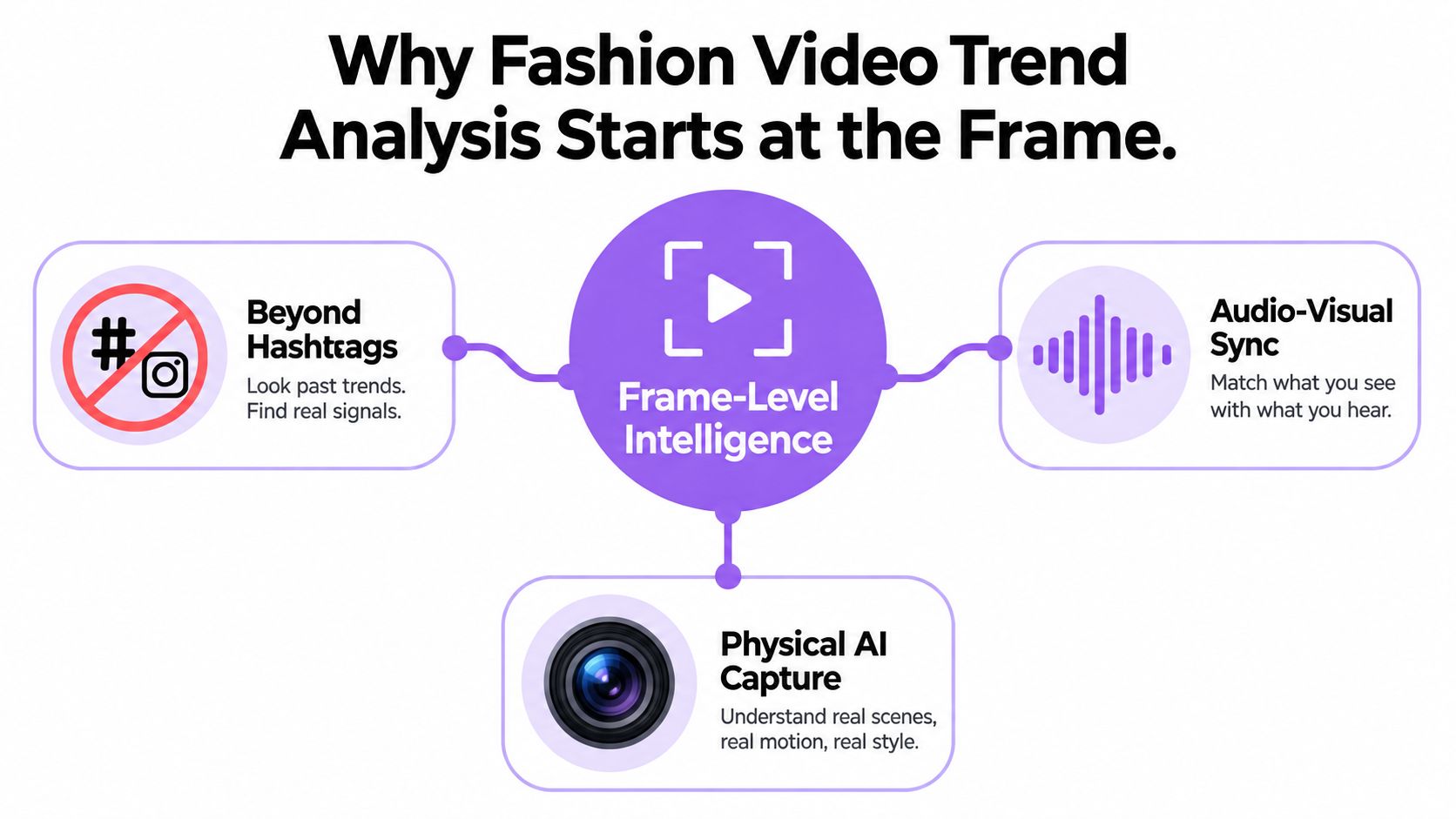
Why Fashion Video Trend Analysis Starts at the Frame
The first useful question isn't “How many views did this video receive?” It's “Which frames contain the look people are responding to?” A video can attract attention because of a creator, soundtrack, location, or opening transition while the actual fashion signal appears briefly in the middle. Aggregate metrics hide that distinction.
Frame-level indexing separates the garment from the distribution context. It can identify a jacket's shoulder shape, a skirt's length, a repeated color pairing, a visible texture, a layer beneath an outer garment, or an accessory that appears across unrelated uploads. Captions and hashtags can support discovery, but they can't reliably describe what the camera captured.
Start with visual evidence, not platform summaries
A practical workflow begins by locating usable frames, then identifying fashion attributes within them. The system should distinguish clothing from background objects, overlay text, lighting effects, and camera movement. A close-up of a sleeve may be valuable for fabric analysis but useless for judging the full silhouette, so the index needs to preserve the relationship between partial views and complete outfits.
A published fashion-video methodology uses Python and pandas to count detected attribute frequencies and matplotlib to visualize categories. It also includes moving fashion-model videos, rather than limiting analysis to still runway images, and recommends separating attribute detection from trend summarization because shot changes can introduce noise. The methodology is described in the Business of Fashion Insights Pulse research.
Practical rule: A view is an outcome. A frame is evidence.
What the index should preserve
For each relevant moment, retain the attribute evidence needed to answer later questions:
- Silhouette: fitted, oversized, structured, draped, cropped, or elongated.
- Surface: smooth, ribbed, glossy, quilted, patterned, or visibly textured.
- Color: dominant hue, secondary hue, contrast, and tonal relationships.
- Styling: layering, footwear, bags, jewelry, headwear, and garment combinations.
- Context: runway, street, tutorial, advertisement, boutique, or user-generated clip.
- Audio cues: spoken product names, styling instructions, brand references, and meaningful ambient events.
This foundation supports more than editorial reporting. It can power e-commerce discovery, advertisement video edition, visual merchandising, and search across physical environments. The core product decision is simple: don't ask the trend team to scrub every clip manually when the relevant fashion moment can be returned through a visual or natural-language query.
The Two-Stage Detection and Summarization Pipeline
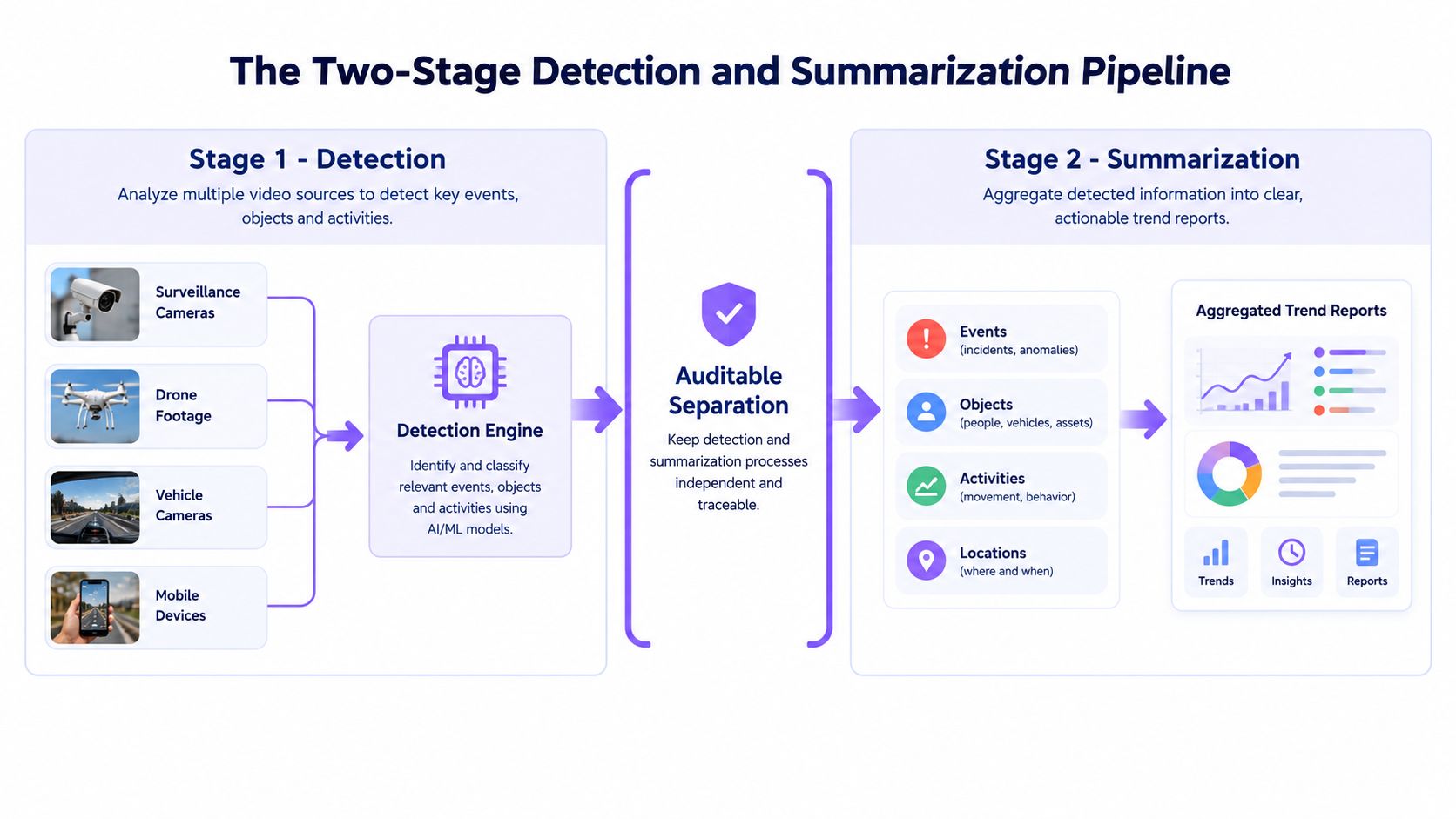
A reliable system separates what was detected from what the team concludes about the trend. Combining both jobs in one opaque model makes errors difficult to inspect. If a report says a texture is rising, analysts need to know whether the model misread lighting, duplicated frames, or identified the attribute across independent videos.
Stage one captures attributes and context
The first stage processes source media into evidence. It samples useful frames, detects people and garments, separates clothing regions from their surroundings, and assigns attributes such as color, print, fabric appearance, silhouette, and accessories. Video quality matters. Weak focus, incomplete body coverage, rapid movement, and inconsistent framing can corrupt the extracted attributes before any trend calculation begins.
Audio belongs in the same evidence layer, but it shouldn't be forced into the visual representation. Automatic speech recognition can capture a spoken brand mention or styling instruction, while audio classification can identify meaningful non-speech signals. The timestamp relationship matters more than the transcript alone. A creator may describe a coat before showing it, and a runway soundtrack may continue across multiple looks.
Stage two turns evidence into a report
The second stage aggregates detected attributes across uploads and time windows. It can group co-occurring features, compare sources, and produce a summary that links each conclusion back to representative frames and audio moments. This gives an editor a way to inspect why a result appeared instead of accepting an unexplained score.
A useful separation also makes iteration safer. Engineers can improve the summarizer without inadvertently changing the underlying detections, and analysts can audit a detection change before it affects a seasonal report. Teams that collapse these stages often create a system that is fast to demo but hard to trust in production.
| Layer | Primary question | Useful output |
|---|---|---|
| Detection | What appears in each usable moment? | Timestamped garment and audio attributes |
| Normalization | Are equivalent attributes represented consistently? | Comparable feature labels |
| Summarization | Which combinations recur across sources? | Trend groups and supporting examples |
| Review | Can a human verify the result? | Linked frames, clips, and transcript moments |
The same structure applies to video surveillance, product footage, and runway media. A security platform such as VIDIZMO's video search solution demonstrates the broader operational requirement: organizations need to find faces, license plates, vehicles, and conversations inside long recordings. Fashion systems face a different vocabulary, but the indexing problem is similar. The answer must point to the moment, not just the file.
From Detected Attributes to Forecastable Trend Signals
Fine-grained recognition is more useful than broad labels such as “dress” or “streetwear.” A serious trend system needs a feature space that can represent shape, attribute, fabric, texture, print, and color together. A major fashion AI methodology analyzes more than 2,000 fashion details, according to the published fashion trend methodology. That level of granularity matters because trends often emerge through combinations, not isolated garments.
Four steps make the signal actionable
1. Normalize the attribute space. Map equivalent visual observations into consistent labels. A relaxed blazer, an oversized blazer, and a deliberately dropped shoulder may overlap, but analysts need a controlled vocabulary that preserves useful distinctions.
2. Cluster visual features. Group videos by recurring combinations, such as a particular proportion paired with a surface treatment and styling pattern. This reveals aesthetic systems instead of producing a flat list of popular objects.
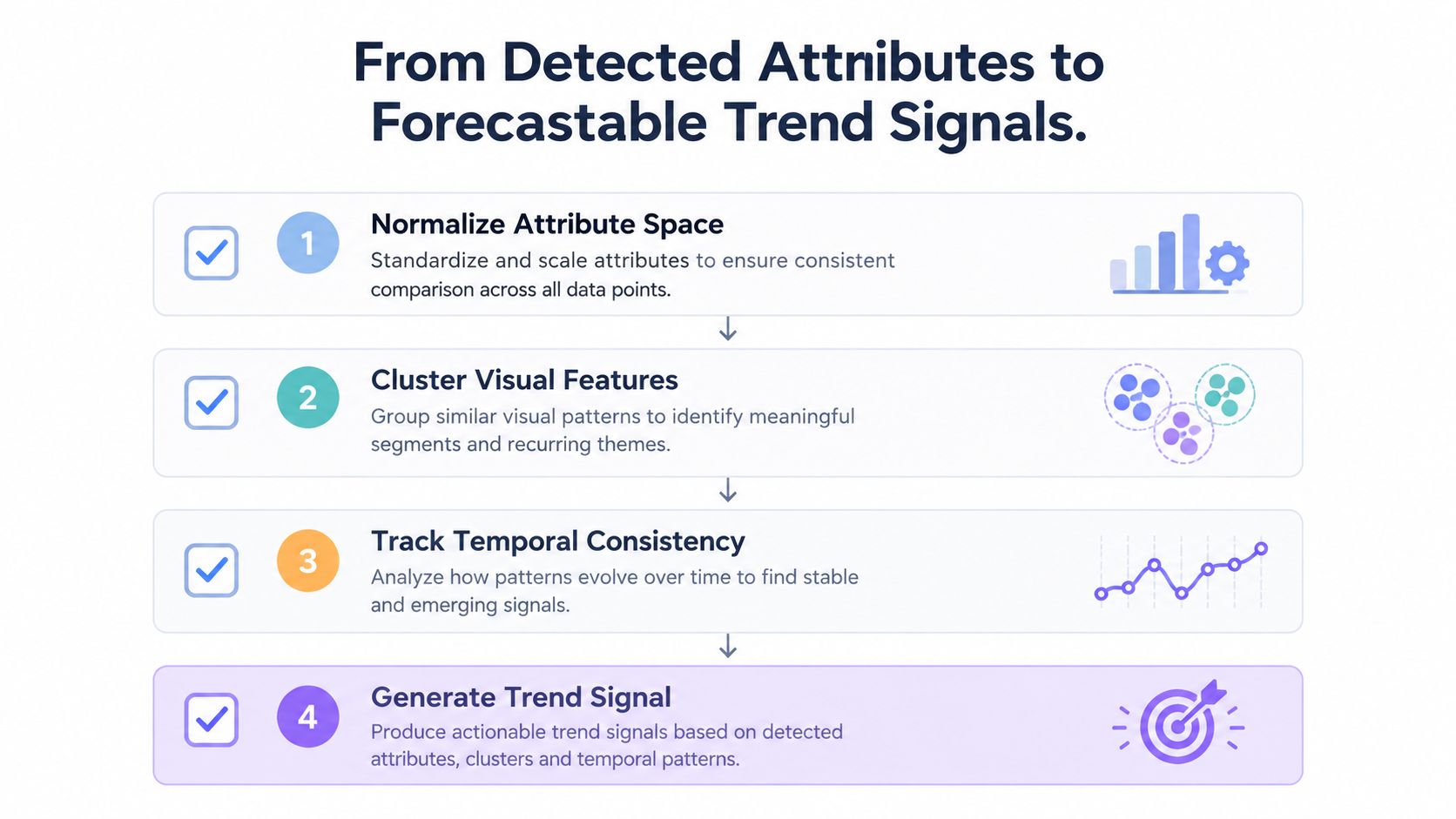
3. Track temporal consistency. Compare whether an attribute appears across separate uploads and evolving time windows. A feature that exists in one highly distributed creator video shouldn't automatically outrank a quieter pattern appearing across independent sources.
4. Generate a trend signal. Combine visual feature volume, source mix, and forecasting methods into a result that communicates both direction and reliability. The published methodology builds audience panels from publicly accessible social accounts, performs large-scale visual recognition, measures growth in individual features, and selects multiple machine-learning forecasting methods through a master algorithm.
Don't use engagement as the forecast
Engagement remains useful for distribution and content planning, but it shouldn't be the only trend proxy. A creator's audience, recommendation placement, paid promotion, and format can inflate interaction without proving that viewers are adopting a look. The expert methodology treats visual feature volume and forecasting as central, with engagement as a secondary signal.
A product team can turn this into a reviewable decision model:
- Emergence: Is the feature appearing in new, independent sources?
- Persistence: Does it recur beyond one content burst?
- Transfer: Does it appear in different formats or environments?
- Evidence quality: Are the frames clear enough to verify the attribute?
- Actionability: Can merchandising, editorial, or advertising teams use the result?
The output should never be a mysterious “trend score” with no supporting media. Return the frames, timestamps, detected attributes, source context, and audio evidence that allow a human forecaster to accept, reject, or refine the conclusion.
Cross-Platform Format Differences That Change the Trend
The same outfit can look stable on Reels, explosive on Shorts, and insignificant in a longer runway edit. Format changes what the camera shows, how often the viewer sees it, whether sound carries meaning, and how much visual information survives cropping.
A vertical transition may reveal a blazer for only a few key moments. A longer editorial clip may hold the garment in a full-body shot, then cut to a close-up of the lapel. Those media types shouldn't share identical sampling or detection thresholds.
| Dimension | TikTok Shorts | Instagram Reels | YouTube Shorts | Editorial Video (Runway / YouTube long-form) |
|---|---|---|---|---|
| Capture shape | Vertical, fast transitions, creator overlays | Vertical, styling-led edits, prominent overlays | Vertical, loop-friendly short scenes | Often wider framing, longer takes, planned camera movement |
| Visual handling | Prioritize transition boundaries and readable outfit frames | Preserve full-body styling moments and product overlays | Track repeated loop frames and opening hooks | Segment scenes before attribute extraction |
| Audio role | Trending sounds, spoken styling, music-led context | Sound often supports the visual edit and creator narration | Audio can be secondary when autoplay begins muted | Scripted commentary and runway sound need transcription |
| Main detection risk | Motion blur, stickers, rapid cuts | Cropping and product tags obscuring details | Loop duplication can overrepresent one moment | Sparse but information-rich scenes |
| Practical indexing choice | Keyframes around cuts and beat changes | Keyframes plus speech-aligned moments | Deduplicate looped frames | Scene segmentation followed by attribute extraction |
A quiet-luxury blazer presented as a short transition may appear trend-stable on Reels but trend-surging on Shorts because the loop repeatedly emphasizes a small set of micro-frames. That isn't necessarily a contradiction. It's a format effect.
Tune the detector to the surface
Short-form video benefits from keyframe selection around cuts, gestures, and visible outfit changes. A 2 to 3 minute runway or editorial clip needs scene segmentation first, otherwise repeated camera moves and background changes can distort attribute counts. Caption density also matters. Creator text can cover a neckline or sleeve, while a watermark can resemble a garment detail.
Audio handling needs separate policies too. Short clips may rely on music or visual captions, while longer editorial content often uses scripted commentary that must be transcribed and aligned with the relevant scene. Cropping, watermarks, overlays, and platform compression all change silhouette accuracy.
Never reuse one detector configuration across every surface without retuning thresholds, sampling, and deduplication.
Fashion benchmarks reinforce the importance of separating formats. A 2026 Dash Social fashion benchmark reported that fashion brands averaged 156,800 YouTube views per post in the second half of 2025, with Shorts averaging 80,700 views and 201 engagements per video, while on-demand videos averaged 311,600 views and 45 engagements. The benchmark also reported YouTube views rising 68% year over year and Shorts views rising 121%, so short and long video should be evaluated as different discovery environments rather than interchangeable feeds.
Physical AI and Multimodal Audio in Fashion Capture
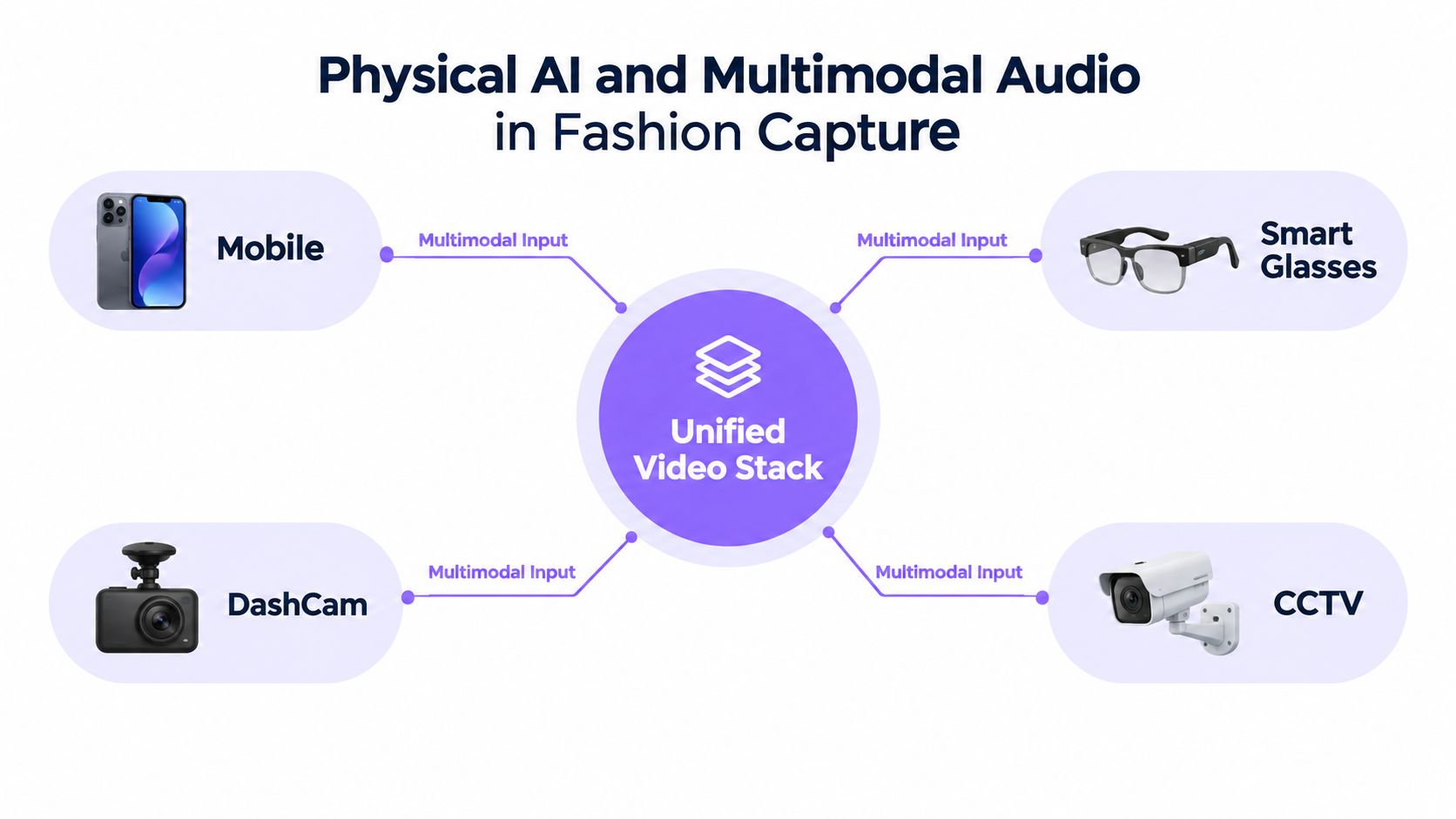
A street-style trend doesn't originate in one convenient dataset. Someone may record a trench coat with a phone, capture it incidentally through smart glasses, pass it with a dashcam, or record the same garment inside a boutique through CCTV. Each endpoint has different framing, privacy requirements, connectivity, and processing constraints, but the fashion event can remain one searchable object.
Physical AI changes the architecture. NVIDIA describes omni-models as suited to systems that must work across text, images, audio, video, actions, and 3D data, because physical systems need to perceive, predict, and act across modalities. Its omni-model overview provides the relevant comparison with robotics and autonomous machines. A mobile fashion application may not control a robot, but it still needs to connect what a camera saw, what a microphone heard, and what a user asks afterward.
Audio supplies context vision misses
A phone video can show the cut of a coat while the audio says its brand or material. A smart-glasses recording may include a passer-by's comment. A dashcam captures street ambience and movement, while boutique CCTV provides a fixed angle that may preserve the full outfit but lack useful speech.
Audio cues shouldn't be treated as decoration. Background music tempo, footsteps on pavement, crowd noise, spoken styling guidance, and product mentions can help classify the content context. NVIDIA's real-time multimodal XR video-search example processes audio and video as synchronized but separate streams, using vision-language analysis for video and ASR for segmented audio. That separation reflects a real engineering constraint. Sound and image often arrive with different quality, timing, and failure modes.
Match processing to the endpoint
- Mobile: Run lightweight feature extraction locally when possible, then synchronize richer results when connectivity returns.
- Smart glasses: Favor low-latency capture and compressed feature transfer, because heat, battery, and wireless bandwidth constrain continuous processing. Qualcomm describes smart glasses AI as accepting image, video, and sound inputs in its smart-glasses perspective.
- Dashcam and GoPro: Preserve event boundaries and motion context. A passing garment may be visible for a short interval, so aggressive compression can erase the useful evidence.
- CCTV: Ingest server-side where appropriate, with privacy redaction and access controls considered before broad search.
- Robotics: Store environmental observations as reusable memory, not isolated files, so visual and audio events can support later navigation or inspection.
The goal is one retrieval layer that can locate the same pattern whether it came from an 8-second vertical clip, a smart-glasses capture, or a CCTV frame. Teams can then trace a silhouette across surfaces instead of reconciling four disconnected datasets.
Mobile SDK Patterns for Indexing Fashion Video
Mobile applications fail when ingestion assumes stable connectivity, unlimited battery, and a server that can process every original file immediately. A fashion discovery app should treat capture, transfer, playback, and indexing as separate jobs with clear recovery behavior.
Build ingestion for interruption
Chunked uploads make a practical starting point. Split a source into 4 to 8 MB segments, transfer them resumably to object storage, and let the service assemble the asset before downstream processing. Signed streaming URLs keep playback private while allowing a CDN to fetch the media without exposing the source bucket. The V-Modal AI repository documents a mobile and edge-oriented approach that includes a multimodal search API, signed streaming URLs, chunked multipart uploads, and native Android support.
A solid upload flow looks like this:
- Prepare locally. Create a proxy or keyframe preview when the device can do so without disrupting capture.
- Upload resumably. Retry failed chunks rather than restarting the entire video.
- Transcode selectively. Don't re-encode a proxy that already meets the required playback and indexing profile.
- Index in parallel. Begin visual attribute processing while audio transcription continues.
- Expose partial results. Let the user search available visual evidence before every enrichment task finishes.
Signed URLs should have limited lifetimes and should be issued only after authorization. They also need a renewal path, because a user may return to a trend result after the first playback window expires.
Keep the app responsive
On Android, WorkManager suits deferred indexing that should survive process restarts. On iOS, BGProcessingTask can handle background work when the operating system grants execution time. Neither guarantees immediate completion, so the interface needs explicit states such as queued, uploading, visually indexed, audio pending, and searchable.
A lightweight on-device encoder can produce keyframe thumbnails and a cached embedding in IndexedDB or SQLite, depending on whether the application is browser-based or native. This supports fast local queries when the network is unavailable, but it also creates storage pressure and cache invalidation work. The trade-off is not merely speed versus accuracy. It is freshness versus battery, local privacy versus centralized control, and immediate discovery versus complete multimodal context.
Avoid two common integration mistakes. Don't block ingest on full transcription when the user's query only needs visual attributes, and don't force the server to perform work the client has already completed successfully. A mobile stack feels fast when each stage can provide useful output independently.
Pain Points That Break Most Fashion Trend Pipelines
Teams often start with views, likes, and hashtag volume because those fields are easy to collect. They then discover that distribution luck, creator reach, recommendation systems, and paid promotion can make a video look like a trend signal even when the underlying aesthetic hasn't spread.
The harder problems are inside the media pipeline.
Bandwidth destroys texture first
Upload limits encourage aggressive downsampling. That may preserve a jacket's outline while removing the surface detail needed to distinguish one textile appearance from another. A proxy that looks acceptable to a person scrolling can be inadequate for attribute extraction.
Mitigation: create a quality policy by query type. Preserve higher-detail regions for fabric and print analysis, while using lighter representations for broad silhouette search. Let the app upload an initial proxy and enrich selected moments later instead of treating every frame equally.
Recommender systems create sampling bias
A platform feed shows what its ranking system already favors. Niche communities, smaller creators, and regional styles may be underrepresented even when their visual language is influential within a relevant audience.
Mitigation: diversify the source panel deliberately. Compare creator tiers, regions, content contexts, and platforms, then record source coverage beside every trend summary. A trend report without sampling provenance is difficult to interpret.
Audio and vision fall out of sync
ASR may capture someone describing a garment while motion blur, occlusion, or a cut hides it from the visual detector. The transcript can be accurate and the frame analysis can be accurate, yet the combined result can still point to the wrong moment.
Mitigation: preserve timestamps as first-class evidence. Review a window around each audio cue, distinguish spoken claims from visible confirmation, and mark uncertain alignment rather than merging the streams automatically.
Device history remains fragmented
A creator's smart-glasses capture, phone B-roll, GoPro footage, dashcam recording, and boutique CCTV may live in separate systems. Without a shared retrieval layer, analysts can't follow how the same silhouette appears across personal, commercial, and ambient media.
Mitigation: use stable event and source identifiers, retain capture context, and normalize visual attributes before aggregation. Privacy controls should be part of ingestion, especially for CCTV and street footage, not an afterthought added when someone requests a report.
The useful metric isn't only how much media you indexed. It's how confidently a reviewer can move from a trend claim to the exact visual and audio evidence behind it.
The same engineering choices support adjacent use cases. Advertisement video editors can search for shots containing a specific garment or logo. Robotics teams can query vision for a physical object and audio for a spoken instruction. Fleet operators can locate dashcam incidents, while CCTV teams can retrieve relevant scenes without manually scrubbing hours of footage. Fashion trend analysis becomes more reliable when it adopts that operational discipline: searchable moments, synchronized context, explicit uncertainty, and one history across devices.
V-Modal AI provides a Search Layer for Physical AI with multimodal video and audio retrieval, timestamp-aware search, and SDK support for mobile and edge devices. Use the V-Modal AI project to evaluate fashion discovery workflows that connect frame-level attributes, audio cues, smart glasses, dashcam, GoPro, and CCTV media in one searchable experience.