Technical Challenges in Traffic Road Video Analytics
The popular advice is simple: train a better object detector, raise precision, and traffic road video analytics will work in production. That advice misses the failure mode that matters most. A model can perform well on a benchmark and still fail when a city adds more cameras, the weather changes, a PTZ camera shifts position, or edge hardware runs out of memory.
Technical challenges in traffic road video analytics are therefore less about a single model score and more about maintaining useful, interpretable results across hardware, environments, camera networks, privacy workflows, and operational decisions. Detection is only one component in a system that must observe the physical world continuously, preserve context, and deliver timely information to traffic operators, robots, mobile applications, and search tools.
Table of Contents
- Why Detection Accuracy Is Not Enough
- The deployment gap is systemic
- What production teams should measure
- Environmental and Hardware Bottlenecks
- Moving cameras break stable assumptions
- Edge hardware creates a three-way compromise
- Comparing Capture Stacks and Data Signatures
- Traffic Video Capture Stack Comparison
- Solving Retrieval with Multimodal Search Layers
- Design retrieval around operator questions
- Edge memory changes the operating model
- Industry Use Cases for Physical AI
- Vision for Robotics and Audio for Robotics
- Search for surveillance and media operations
- Navigating Privacy and Compliance Burdens
- Build privacy into retrieval
Why Detection Accuracy Is Not Enough
A traffic system doesn't operate on isolated images. It operates on changing scenes, overlapping road users, unreliable lighting, shifting viewpoints, network interruptions, and long-running streams. A detector may identify a car in one frame, but a production system must determine whether that car is the same object seen moments earlier, whether it crossed a relevant zone, whether it stopped unexpectedly, and whether the event matters to an operator.
The historical record makes the benchmark problem clear. A 2011 IEEE review found that urban traffic video analysis had no commonly used dataset or benchmark challenge, making direct algorithm comparison difficult. The review also noted that evaluation in rain, fog, and darkness was rarely performed, while low camera angles and dense traffic produced heavy overlap among vehicles, pedestrians, and other road users through occlusion. These findings are documented in the IEEE review of computer vision techniques for traffic analysis.
The deployment gap is systemic
Occlusion isn't a small visual defect. It changes the evidence available to the entire pipeline. A pedestrian can disappear behind a van, a motorcycle can merge into a cluster of vehicles, and a vehicle's path can become ambiguous at the exact moment when a planner needs to understand a conflict.
Open-world conditions create another problem. Traffic scenes contain visually similar objects, unfamiliar vehicle types, reflections, temporary signs, construction equipment, and unusual events. An expert traffic-video system paper describes low precision and recall under occlusion and lighting changes, while noting that traffic scenarios generate petabytes of data daily. The paper's discussion of scale appears in this traffic video intelligence system research.
A model that recognizes objects but can't maintain stable tracks, confidence, timestamps, and scene context doesn't produce dependable traffic intelligence. It produces a stream of plausible guesses that operators still have to verify manually.
Practical rule: Treat detection as an input to traffic intelligence, not as the product itself.
What production teams should measure
A useful evaluation plan tests the complete operational path:
- Scene robustness: Measure behavior across clear weather, rain, fog, darkness, glare, shadows, and seasonal changes.
- Identity continuity: Test whether tracking remains coherent when vehicles overlap, leave the frame, or reappear from another camera.
- Latency under load: Observe response time as more streams share the same edge device or network.
- Interpretability: Confirm that alerts include enough temporal and visual context for an operator to act.
- Failure recovery: Disconnect feeds, restart devices, rotate credentials, and verify that the system resumes without losing history.
The field's foundational challenge has always been comparability and consistency, not detection quality alone. Better combined detectors and classifiers remain useful, but they must be evaluated as part of a system that survives real roads.
Environmental and Hardware Bottlenecks
Traffic cameras live outdoors, often in the worst possible conditions for computer vision. Rain creates streaks and reflections, fog reduces contrast, low light removes texture, and headlights introduce glare. Dense urban traffic compounds the problem because road users overlap from low camera angles, leaving only partial silhouettes or brief glimpses.
The result isn't merely lower confidence. Weather and occlusion can alter classification, tracking, counting, and event interpretation at the same time. A system that detects a vehicle but loses its trajectory may still fail to identify a stopped vehicle, queue spillback, wrong-way movement, or a near conflict.
Moving cameras break stable assumptions
Many deployments also rely on PTZ cameras. A recent technical paper notes that most agency cameras are PTZ and explains that shifting viewpoints can break automated analytics unless systems self-calibrate and preserve stable longitudinal analysis. The paper cites New York using about 1,000 traffic cameras daily, illustrating why viewpoint drift becomes a network-scale problem rather than a laboratory edge case. These observations appear in the Frost & Sullivan video analytics whitepaper.
A fixed-camera model can learn a stable roadway geometry. A PTZ camera changes the geometry while the system is working. Zoom changes object scale, pan changes the visible lanes, and a small calibration error can invalidate zones, directions, and longitudinal measurements. Self-calibration isn't an optional refinement when the camera itself moves.
Edge hardware creates a three-way compromise
Real-time processing near the camera reduces dependence on cloud transmission, but edge devices have finite memory, storage, and energy efficiency. The traffic-monitoring literature describes scalability as processing more video streams without proportionally degrading performance, while edge-based research identifies cloud transmission latency and local resource constraints as central challenges. The traffic monitoring review on real-time scalability explains why adding feeds isn't just a matter of connecting more cables.
High-resolution camera, LiDAR, and radar streams can overwhelm local units, causing delayed signal responses and forcing cities to balance edge processing with interoperability and cost. This trade-off is discussed in research on urban edge traffic analytics.
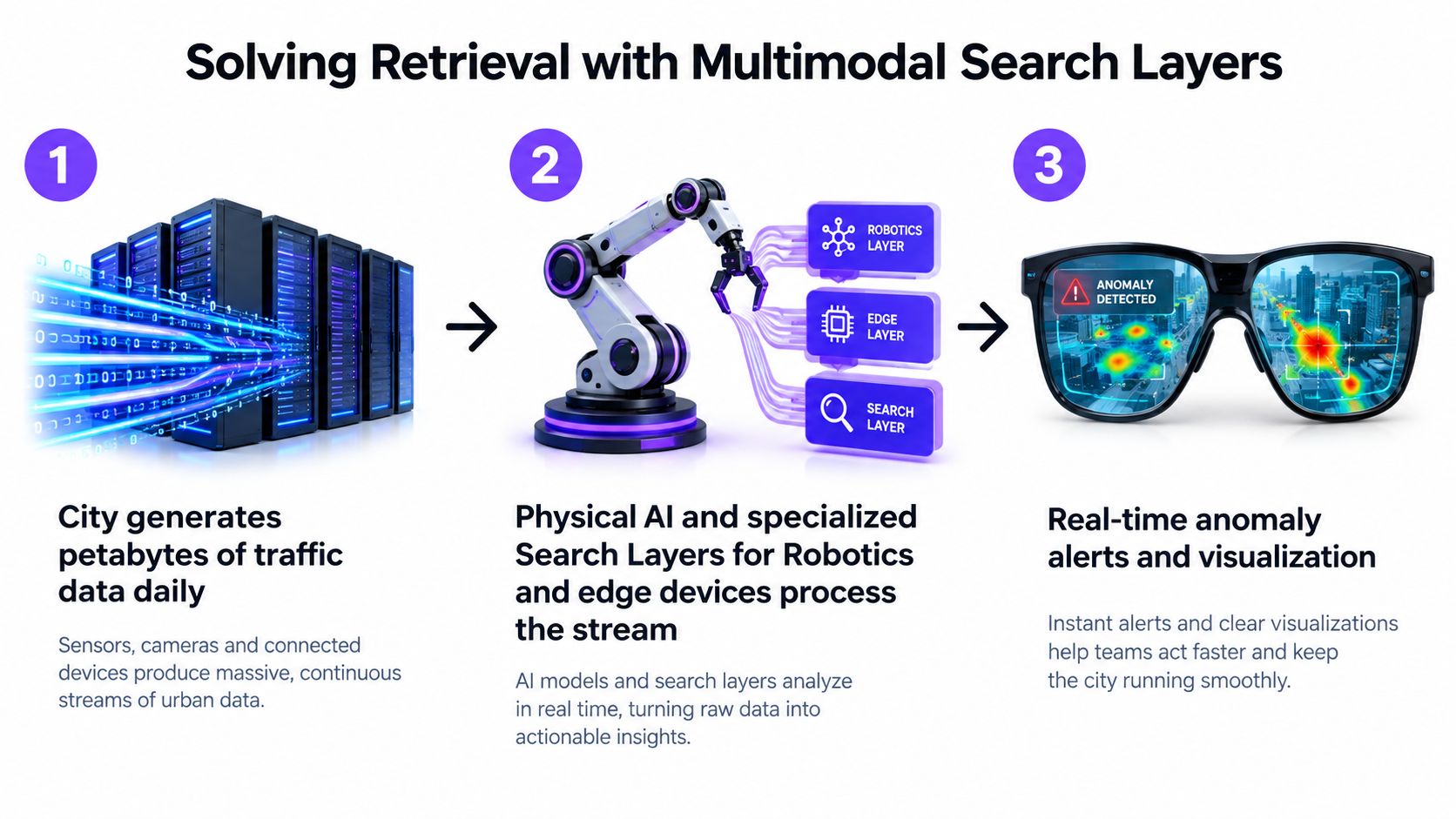
A workable architecture usually assigns fast decisions to the edge and longer-term coordination to centralized services. The edge can emit compact events, retain selected context, and continue operating through intermittent connectivity. Central systems can support cross-camera views, fleet health, reporting, and broader analysis without requiring every raw stream to travel continuously.
What doesn't work is treating edge compute as a universal bandwidth fix. Teams still need policies for degraded weather, privacy, storage pressure, legacy cameras, and graceful fallback. The practical design question isn't whether to process locally. It's which information must be available immediately, which can wait, and what evidence operators need when the system is uncertain.
Comparing Capture Stacks and Data Signatures
The capture device determines the shape of the problem. A fixed CCTV camera provides a broad overhead view but may introduce compression, blur, and limited detail. A DashCam or GoPro moves through the scene and captures ego-motion, while a smart-glasses device adds first-person video, audio, and sometimes a display for immediate interaction.
These streams shouldn't share identical preprocessing, retention, or search assumptions. A traffic model designed around a fixed camera can misread a moving camera's changing geometry. A dashcam workflow that preserves rich context can create a heavier privacy and storage burden. Smart glasses can add spoken observations and environmental sound, but their field of view and battery constraints differ from both CCTV and vehicle-mounted cameras.
Traffic Video Capture Stack Comparison
| Hardware Stack | Primary Analytics Challenge | Data Signature |
|---|---|---|
| Fixed CCTV | Compression, motion blur, low resolution, changing weather, and limited scene detail | Elevated, fixed, broad-view footage with weak ego-motion cues |
| PTZ CCTV | Camera movement invalidates stable zones and longitudinal measurements | Dynamic viewpoint, changing zoom, pan, and tilt |
| DashCam | Ego-motion, windshield reflections, changing perspective, and privacy handling | Forward-facing mobile video with vehicle movement and road context |
| GoPro | Stabilization, wide-angle distortion, rapid viewpoint changes, and large media files | High-resolution action footage with strong motion and broad field of view |
| Smart glasses | Narrow first-person framing, audio synchronization, battery limits, and user privacy | Wearable video, microphone input, speaker output, and sometimes display feedback |
| Mobile software stack | Upload interruptions, device heat, memory pressure, and inconsistent connectivity | Local recordings, live streams, sensor context, and application metadata |
CCTV has a specific benchmark history. The CityFlow benchmark spans 40 cameras across 10 intersections and documents failures involving fisheye radial distortion, fast vehicle motion blur, and viewpoint variation. Its authors also state that earlier datasets lacked original videos and calibration information, which made multi-target, multi-camera tracking evaluation harder. See the CityFlow benchmark paper.
DashCam footage brings the opposite advantage and risk. It includes ego-motion cues that help explain what the vehicle experienced, but it also captures bystanders, number plates, homes, and other personal data. GoPro footage can be visually rich, yet wide-angle lenses and rapid movement complicate geometric interpretation. Smart glasses add multimodal audio, so a spoken observation, horn, siren, or road noise can provide context that a frame alone can't.
Mobile stacks should therefore support resumable transfers, local buffering, hardware-aware processing, and explicit synchronization between video, audio, and sensor events. The right stack isn't the one with the highest nominal resolution. It's the one that preserves the evidence needed for the use case without exhausting the device or creating an unmanageable compliance workload.
Solving Retrieval with Multimodal Search Layers
Once a city accumulates continuous footage, manual scrubbing stops being a realistic operating model. Operators don't want to watch every recording from a camera network to find a stopped truck, a siren, a pedestrian crossing, or a vehicle entering a restricted area. They need to ask a question and receive the relevant moments with enough context to verify the result.
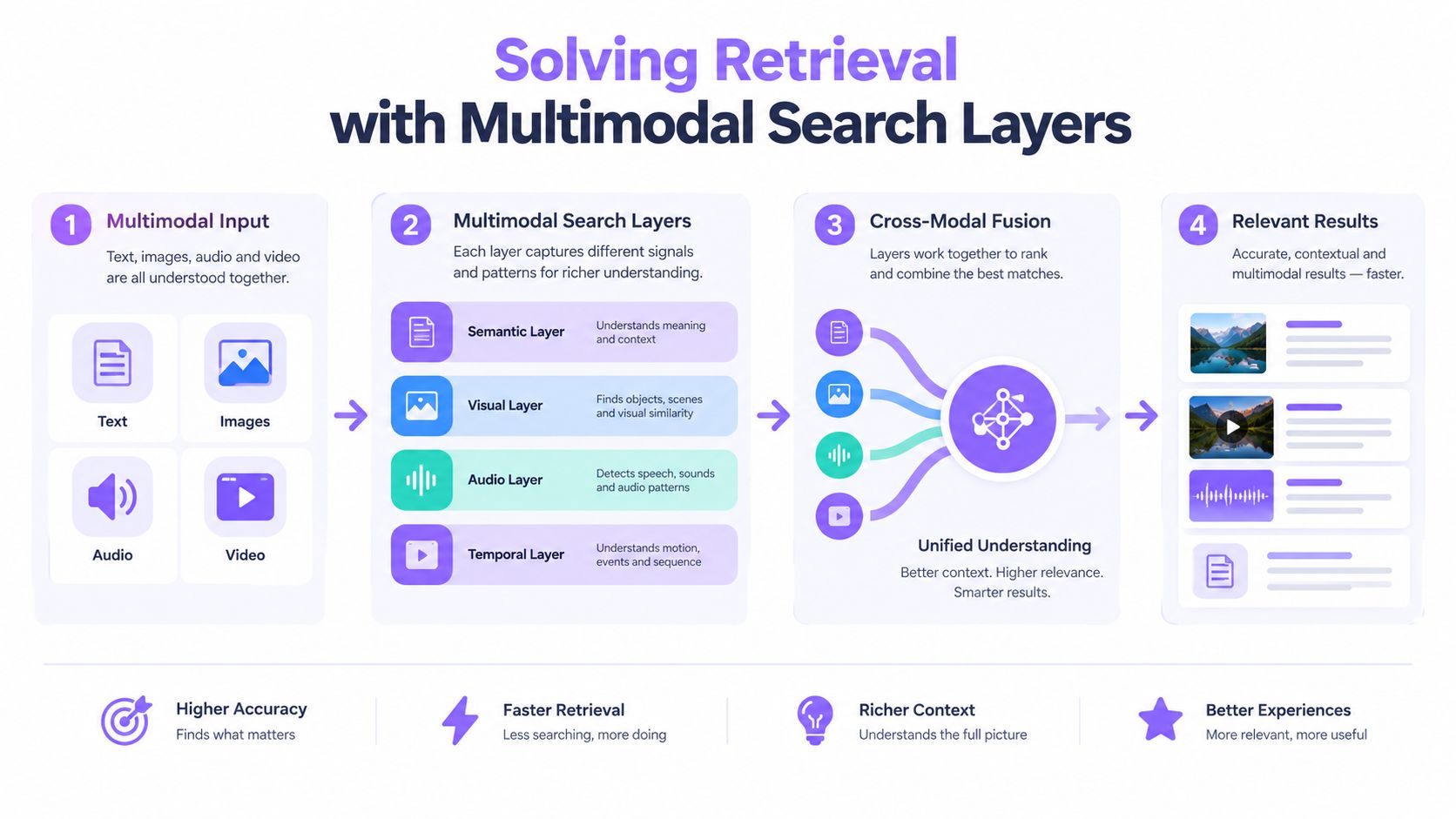
A multimodal search layer connects visual, auditory, textual, and environmental signals. Instead of treating video and audio as unrelated archives, it lets a query combine what happened, where it happened, and what it sounded like. This matters for traffic because many incidents are easier to identify through combined evidence. A visible emergency vehicle and an audible siren are more informative together than either signal alone.
Design retrieval around operator questions
A practical workflow starts with the questions people ask:
- Describe the event: “Find clips showing a vehicle stopped in the right lane during heavy rain.”
- Add a sound or context cue: “Show moments with a siren near the stopped vehicle.”
- Constrain the scene: Select a camera, route, time range, or intersection.
- Return reviewable segments: Provide precise time ranges, nearby context, and a way to inspect the original media under the appropriate permissions.
This is not a request to expose proprietary backend mechanics. The important engineering boundary is functional: the system should convert long media into searchable, timestamped evidence while respecting edge memory, bandwidth, and privacy constraints.
Edge memory changes the operating model
A robotics or edge memory layer can retain useful historical context close to the device instead of forcing every query through a remote archive. That can reduce dependence on continuous cloud access and make mobile workflows more resilient when connectivity is poor. It also introduces hard questions about retention, deletion, storage quotas, and what happens when the device reaches capacity.
The strongest implementations separate immediate operational memory from long-term archival policy. An intersection controller may need recent context for an alert, while a central traffic team may need selected events for trend analysis. A DashCam application may need local search during a journey but shouldn't retain sensitive footage indefinitely by default.
Multimodal search also connects adjacent industries. In advertisement video edition, an editor can locate a road sequence with a particular vehicle, spoken phrase, engine sound, or visual transition without reviewing an entire shoot. For Physical AI, the same principle gives a robot or smart-glasses application a way to recall relevant environmental moments instead of treating every observation as disposable.
Industry Use Cases for Physical AI
Traffic analytics becomes more valuable when it supports decisions beyond a dashboard. A traffic operator needs an incident alert, but a robot navigating a loading area may need a continuously updated memory of vehicles, sounds, and changing access routes. A security integrator may need to retrieve evidence from CCTV, while an editor may need to find a specific visual or audio cue in advertisement footage.
Vision for Robotics and Audio for Robotics
Robotics systems need more than object labels. Vision for Robotics helps a machine interpret lanes, vehicles, pedestrians, barriers, and free space. Audio for Robotics adds sirens, horns, spoken instructions, impacts, and other signals that can be difficult to infer from a frame.
A multimodal memory layer is useful when the robot must answer questions such as whether a route was recently blocked, whether a warning sound occurred before an observed event, or whether a vehicle approached from outside the current field of view. The answer depends on continuity, not just the latest frame.
Smart glasses occupy a related position. They combine cameras, microphones, speakers, and sometimes displays, while accepting multimodal inputs such as images, video, and sound. This makes them a practical bridge between mobile software and physical-world interaction, as described in coverage of smart glasses as multimodal intelligence devices.
Search for surveillance and media operations
For CCTV and video surveillance, retrieval reduces the time spent searching across fixed cameras, PTZ feeds, and compressed recordings. It can help operators locate a vehicle entering an area, a pedestrian event, a collision-related sequence, or an unusual sound, provided the workflow returns evidence for human review rather than presenting uncertain inference as fact.
DashCam search has a different operating pattern. A driver, fleet manager, or investigator may search for a near miss, road obstruction, siren, or spoken note across footage captured from multiple vehicles. GoPro footage can support incident review or field documentation, while mobile applications can let users upload, review, and search media without moving the entire workflow to a desktop.
Advertisement video edition is another practical case. Editors often search by meaning rather than filename. A query for “urban road at night with a passing bus and audible braking” is closer to the editorial task than a folder of camera IDs and timestamps.
The value isn't only finding a frame. It's connecting the frame, the sound, the time, and the surrounding context into something a person can verify.
These applications also expose different trade-offs. Robotics prioritizes low latency and local memory. Surveillance prioritizes auditability and access control. Advertisement editing prioritizes expressive search and fast review. A shared multimodal foundation can serve all three, but deployment policies, hardware budgets, and retention rules still need to be shaped for each environment.
Navigating Privacy and Compliance Burdens
Traffic footage often contains personal data, even when the original purpose is safety or operations. DashCams and CCTV can capture faces, number plates, pedestrians, homes, and bystanders who weren't part of the event being investigated. A privacy guide explains that businesses may need to redact faces and number plates, handle access requests, and manage footage distributed across vehicles and locations. Those operational requirements are described in the privacy technology guide for DashCam and CCTV workflows.
Build privacy into retrieval
A practical compliance workflow begins before search:
- Minimize collection: Define which feeds, time windows, and media types are necessary.
- Redact by default: Apply face and number-plate protection before broad review or sharing.
- Control access: Separate operators who detect events from investigators who can inspect sensitive originals.
- Track provenance: Record the source camera, device, time range, and access history.
- Handle requests deliberately: Support authorized retrieval, review, export, and deletion processes.
- Set retention rules: Keep operational evidence for a defined purpose rather than allowing indefinite accumulation.
Edge processing can reduce exposure by producing anonymized events locally and transmitting only the context required for a task. It doesn't remove legal obligations, though. A searchable index can still reveal sensitive information if access controls, deletion workflows, or query logs are poorly designed.
CCTV and DashCam footage also differ technically. CCTV is typically fixed, raised, and broad-view, but benchmark research identifies lower resolution, compression artifacts, motion blur, variable lighting and weather, and the absence of ego-motion cues as recurring problems. DashCam systems preserve vehicle movement context but create wider privacy exposure because the camera travels through public spaces. These distinctions are documented in recent benchmark work comparing CCTV and dashcam video.
V-Modal AI provides a Visual Memory Layer for Physical AI with multimodal video and audio search, edge-oriented memory, natural-language queries, and mobile integrations for Android and Flutter. Teams evaluating such a platform should test redaction, permissions, retention, offline behavior, and auditability alongside retrieval quality. Visit V-Modal AI to evaluate its search layer and SDK options for traffic video, CCTV, DashCam, smart-glasses, and robotics workflows.