What Is Indexing in Physical AI and Multimodal Search
A warehouse robot has just clipped a pallet. Nobody was hurt, but the operator now needs to review hours of RGB video, microphone audio, LiDAR traces, and navigation logs to answer a simple question: what happened in the few seconds before the near miss? Without indexing, the team scrubs through files, guesses at timestamps, and asks several systems for fragments of the same event.
That's the practical starting point for understanding what indexing is in Physical AI. It isn't merely a catalog of files, and it isn't the same as storing media. Indexing creates a usable memory layer that helps people and machines locate meaningful moments across video, audio, text, and sensor streams.
Information retrieval has followed this pattern for decades. The field emerged formally in the 1950s, the term “information retrieval” was coined in 1952, and the 1958 International Conference on Scientific Information helped establish its direction. Coordinate indexing, proposed by Mortimer Taube and colleagues in 1952, shifted attention from broad subject categories toward individual words and terms. Later milestones, including the first fully searchable web index in 1995 and PageRank in 1996, helped move indexing from library-centered cataloging toward large-scale web search infrastructure (historical overview of information retrieval).
For Physical AI, the searchable unit is changing again. A system may need to retrieve a precise frame, a timestamped sound, a robot pose, or a synchronized sensor window rather than an entire document. The index becomes the memory layer that connects what a machine saw, heard, and sensed.
Table of Contents
- What Indexing Really Means for Physical AI Systems
- Three properties matter most
- How Indexing Evolved From Library Catalogs to Memory Layers
- The retrieval unit keeps shrinking
- Indexing Across Text, Video, Audio, and Sensor Streams
- Why the indexes need to work together
- On-Device Versus Cloud Indexing Tradeoffs
- When the edge should lead
- When the cloud adds value
- Indexing in Action Across CCTV, Dashcams, Smart Glasses, and Robots
- CCTV and video surveillance
- DashCam and GoPro footage
- Smart glasses and mobile software
- Robots and Physical AI
- Common Pain Points When Multimodal Indexing Is Missing
- The recurring failures
- Shallow indexes create their own problems
- Searchability affects more than operations
- Choosing the Right Indexing Approach and Key Takeaways
- A practical decision sequence
- Short FAQ
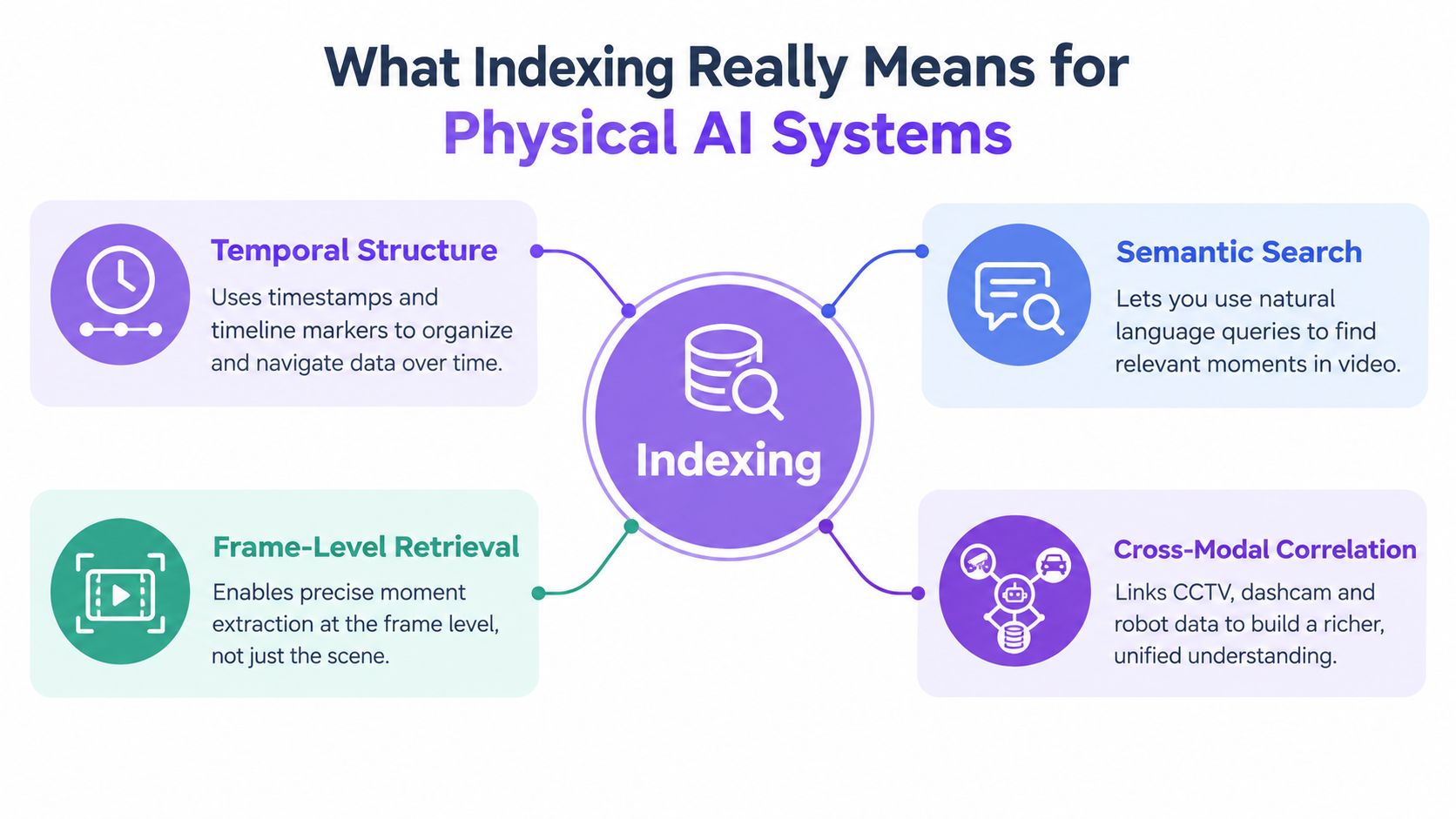
What Indexing Really Means for Physical AI Systems
The operator reviewing the warehouse incident doesn't need “the video from Tuesday.” They need the moment when a robot slowed beside a conveyor, the pallet entered its path, the motor sound changed, and the robot's pose shifted. Those details may exist in separate streams, recorded by different devices and governed by different clocks.
Indexing turns those raw streams into references that a person or an AI system can retrieve. A document index might help someone find a paragraph containing a word. A Physical AI index should help a fleet engineer find a small time window containing a visual object, an acoustic event, a location, and a change in motion.
That difference changes the design target. The index is not a passive catalog that says a file exists. It's a structured memory layer that represents what happened and where it happened in time.
Three properties matter most
Temporal precision determines whether retrieval lands on the event or merely on the surrounding recording. “The robot hesitated” is useful only if the result points to the relevant moment, not an hour-long file that still requires manual review.
Cross-modal alignment connects different evidence types. A camera may show an obstruction, a microphone may capture a warning tone, and telemetry may show a sudden velocity change. If those signals can't be aligned, the system may find each clue separately but fail to present one coherent event.
Retrievability under partial failure acknowledges how physical systems behave in practice. A camera can be blocked, a microphone can drop out, a mobile device can lose connectivity, and a sensor can report incomplete data. A useful memory layer should still return qualified results from the streams that remain available, rather than pretending that missing evidence is complete evidence.
Practical rule: A Physical AI index should identify the moment, the available evidence, and the uncertainty around that evidence.
This also explains why frame-level retrieval and timestamped retrieval matter. A CCTV operator, robotics developer, or smart-glasses wearer usually cares about an event, not a file. The system needs to return a relevant segment, frame, pose, or sensor window that a human can inspect and a machine can use.
The rest of the problem is operational. Teams must decide what to index, how fresh the memory should be, where processing should happen, how devices synchronize, and what happens when one stream fails.
How Indexing Evolved From Library Catalogs to Memory Layers
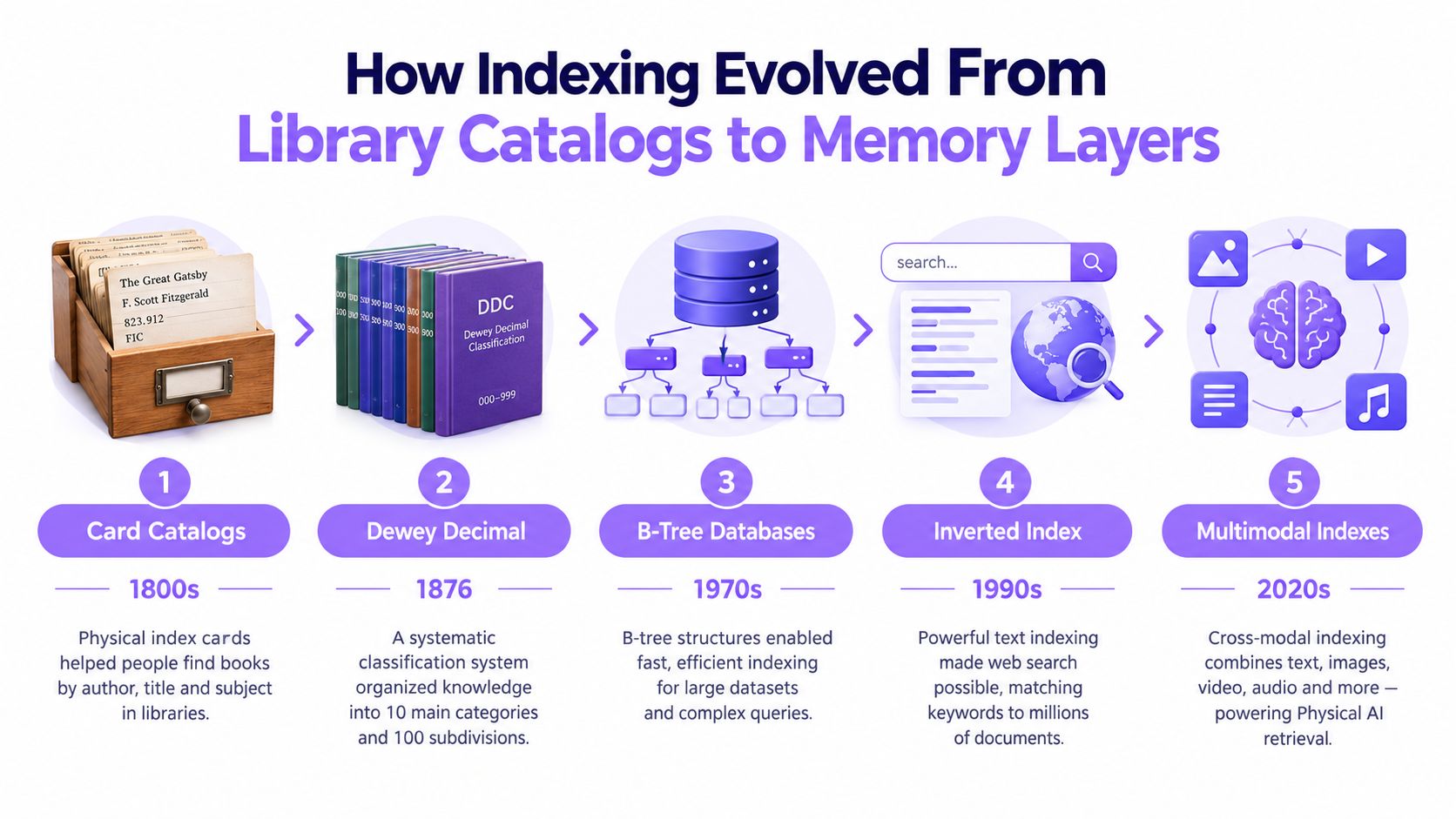
The original indexing problem was physical. A library needed a way to help visitors locate a book without inspecting every shelf. Card catalogs introduced a structured pointer between a concept and a location. Classification systems such as the Dewey Decimal System added a consistent organizational scheme.
Database systems later applied similar thinking to structured records. A B-tree can organize values so a database can locate matching records without scanning every row. Web search pushed the idea further with inverted indexes, where terms point to documents that contain them. The index became a reusable representation of a large collection, allowing the system to answer queries against prepared structures rather than raw records.
The technical details vary, but the conceptual movement is clear:
- A library index points to a book.
- A database index points to a record or value range.
- A web index points to a document or page.
- A multimodal memory layer points to a moment, object, event, or aligned signal window.
Modern information retrieval describes indexing as an offline process that analyzes a collection and builds structures for faster query-time retrieval. In an inverted index, a term can point to a posting list containing document identifiers, positions, and frequency information. Those choices affect what a system can recall and how it ranks candidates (IEEE overview of information retrieval).
The retrieval unit keeps shrinking
A long video is continuous, not discrete. Each moment may contain several objects, a spoken phrase, a sound, a camera movement, and a sensor state. The system must represent those signals in a way that supports combinations such as “the box fell after the robot turned left,” rather than only broad labels such as “warehouse footage.”
This is where multimodal indexes differ from traditional catalogs. A learned representation can place related visual, textual, and auditory signals near one another in a search space. In practical terms, a developer can move from manually assigned keywords toward queries that describe meaning, appearance, sound, or context.
The transition creates new design choices. Should the system retrieve a frame or a clip? Should a voice query match a transcript, a visual event, or both? Should the memory preserve the original source, a compact representation, or a link to evidence that can be replayed?
Indexing used to organize things people wanted to read. Physical AI indexing organizes things machines and people need to remember.
A robot's memory may need to connect a pose to a LiDAR observation and an RGB frame. A smart-glasses application may need to connect an object to the wearer's route. A media editor may need to find every moment where a product appears while a particular phrase is spoken. The index is no longer one drawer of cards. It's a set of linked memories built around time, meaning, and evidence.
Indexing Across Text, Video, Audio, and Sensor Streams
A useful Physical AI stack rarely relies on one index. Each stream offers a different view of an event, and each view has blind spots.
| Index Type | Source Stream | Typical Key | Captures | Blind Spot |
|---|---|---|---|---|
| Text index | ASR transcripts, operator notes, system logs | Word, phrase, or log event | Spoken language, labels, commands, and recorded state changes | It may miss silent visual actions, accents, overlapping speech, or events nobody described |
| Video frame index | Camera frames from CCTV, mobile devices, GoPro cameras, or robots | Frame identifier or time window | Objects, scenes, movement, spatial relationships, and visual appearance | It can miss hidden objects, poor lighting, occlusion, and sounds that explain the event |
| Audio timestamp index | Microphone or device audio | Millisecond offset or audio event window | Speech, alarms, impacts, motor sounds, and acoustic changes | It doesn't establish what caused a sound or what was visible when it occurred |
| Sensor index | IMU, GPS, LiDAR, tactile data, and telemetry | Sensor window, pose, or measurement time | Motion, location, orientation, contact, and machine state | It may lack semantic context and can drift from camera or audio time |
The text index is often the easiest entry point. A transcript can help a team find when an operator said “stop,” or when a log recorded a fault. But text alone can't tell you whether the robot stopped, whether the camera was facing the conveyor, or whether the warning came from a human or a machine.
Video provides spatial context. A frame-level index can identify a person, vehicle, package, tool, or obstacle. It still needs timing and context, because an object appearing in a frame doesn't prove that it caused a system response.
Audio fills a different gap. A DashCam may capture an impact that the camera misses because the event happens outside the field of view. In robotics, an audio signal may reveal a motor strain or a collision before a visual classifier can identify the cause. Audio is evidence, not a complete explanation.
Sensor data adds state. An IMU can indicate abrupt motion, GPS can place a DashCam event on a route, and telemetry can show a speed or actuator change. Those measurements become much more useful when they point to the same time window as the visual and audio evidence.
Why the indexes need to work together
Consider the query, “Find the moment the robot arm hesitated near the conveyor.” A text search might find a maintenance note. Video might find an arm near a conveyor but not recognize hesitation. Audio might reveal a motor change. Telemetry might show a pause or reversal.
A system like this treats these as stream-specific indexes joined around a shared timeline. That doesn't mean every result has equal confidence. It means the operator can inspect the visual clip, hear the relevant sound, and compare the machine state without assembling the evidence manually.
This pattern applies across mobile software stacks. Android or iOS devices may capture camera, microphone, location, and motion data. Smart glasses add first-person video and spatial context. A GoPro offers rich footage but may need companion telemetry. CCTV provides persistent viewpoints, while robots combine RGB, LiDAR, tactile signals, and navigation state.
The practical question isn't “Which index should we use?” It's “Which signals must agree before this event is useful?”
On-Device Versus Cloud Indexing Tradeoffs
Where indexing happens changes the behavior of the entire product. An edge device can create a local memory that responds even when connectivity is weak. A cloud service can process broader archives and coordinate information across devices. Neither location is automatically correct.
| Dimension | On-Device Indexing | Cloud Indexing |
|---|---|---|
| Latency | Fast response when the required representation is local | Depends on upload, processing, and retrieval connectivity |
| Bandwidth | Sends fewer raw streams or selected events | May require sustained transfer of video, audio, and sensor data |
| Privacy | Keeps sensitive footage closer to the source | Centralizes data under cloud access and governance controls |
| Connectivity | Can continue working during network loss | Retrieval and processing may degrade when the link fails |
| Storage ceiling | Limited by device capacity and power constraints | Better suited to deep archives and cross-device collections |
| Model capacity | Usually favors compact or optimized models | Can support heavier multimodal processing |
| Fleet coordination | Harder to compare many devices locally | Natural fit for cross-fleet and multi-site search |
When the edge should lead
On-device indexing is a strong fit for safety-critical loops, real-time retrieval, and sensitive footage. A robot may need to recall a recent obstruction without waiting for a cellular uplink. Smart glasses may need to answer a wearer's question while offline. A body-worn camera may need local event detection before a connection becomes available.
The edge does impose constraints. Compute, battery, thermal capacity, and local storage are finite. Developers often use compact representations and selective retention rather than attempting to preserve every possible interpretation of every stream.
When the cloud adds value
Cloud indexing is useful for archival depth, cross-fleet investigations, and heavyweight multimodal processing. A security team may need to search CCTV feeds across several locations. A fleet manager may compare DashCam events across vehicles. A media team may search a large library for a product appearance, spoken phrase, or visual transition.
Hybrid designs usually provide the most practical balance. The device can maintain a coarse local index for immediate recall, while the cloud maintains a deeper index for long-range search and broader re-ranking. The device can upload selected segments or compact representations when bandwidth allows.
Two failure modes deserve early testing:
- Clock drift: Edge and cloud timestamps can diverge, causing an audio event to point to the wrong video moment.
- Bandwidth exhaustion: Cellular uploads can stall or exceed available quotas, leaving the cloud index incomplete while the local device continues recording.
Keep the evidence close to the decision when delay or connectivity can create risk. Use the cloud when breadth, history, and cross-device context matter more than immediate response.
A good architecture also makes uncertainty visible. If the cloud has only a low-resolution proxy, the result should identify that limitation. If the device lost audio, the system should return a visual match without implying that the acoustic evidence was checked.
Indexing in Action Across CCTV, Dashcams, Smart Glasses, and Robots
The value of indexing becomes clearer when the same idea is applied to different devices. Each stack captures a different relationship between a user and the physical world.
CCTV and video surveillance
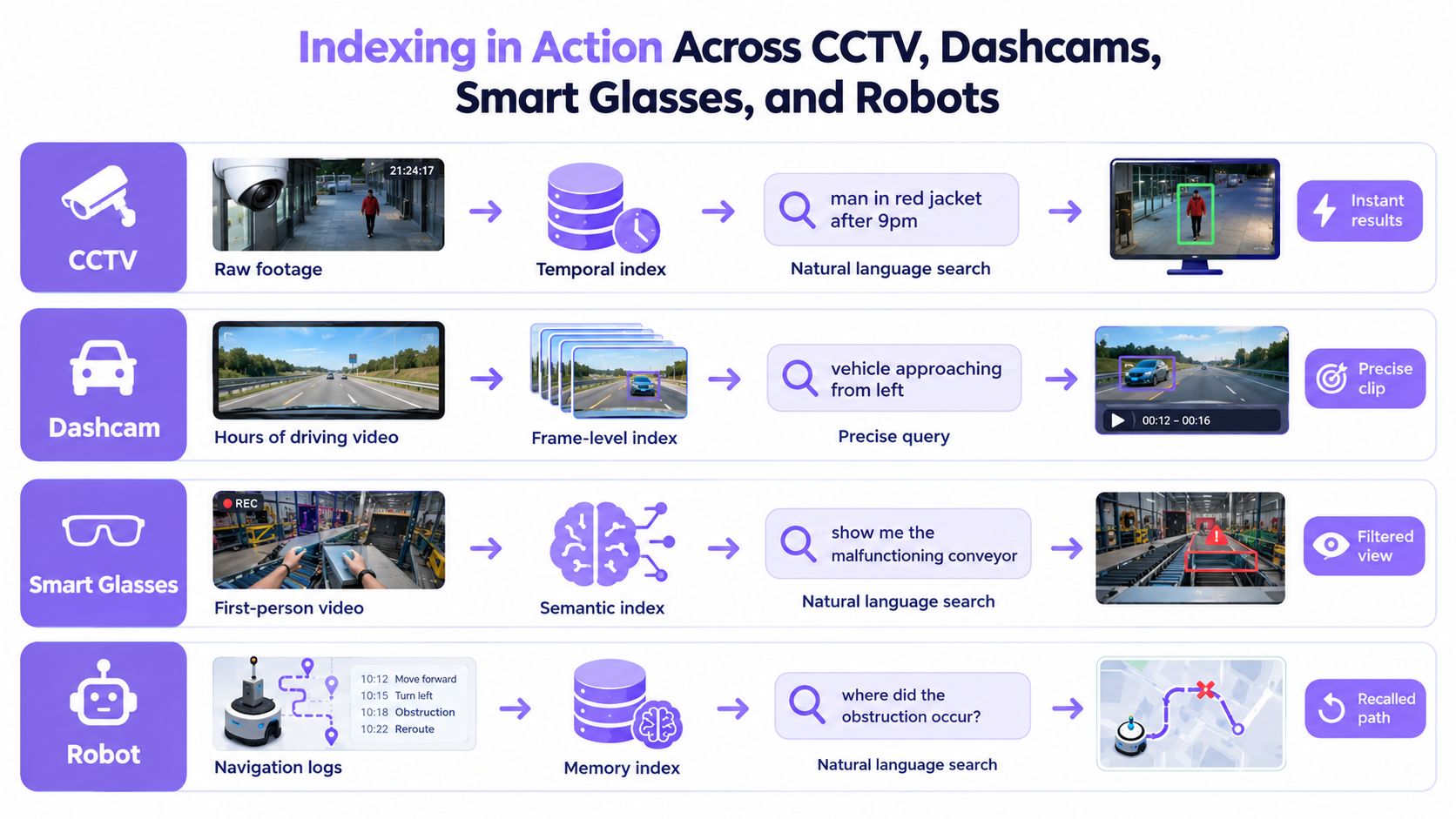
A security operator searches for “man in red jacket near gate after 9pm.” A useful index should narrow the result to relevant time windows, identify the person's appearance, and show the gate context. The operator can then review a short clip with the relevant bounding region rather than scrubbing through an entire camera archive.
The same pattern supports incident response, access review, and multi-camera investigation. A person may leave one camera's field of view and appear on another. The index doesn't need to claim identity to provide value. It can connect visual descriptions, locations, and time windows for human review.
DashCam and GoPro footage
A fleet manager asks, “Show me hard-braking events on Highway 280 last Tuesday.” The result should combine driving video with IMU and location windows. Video can show traffic conditions, while motion data can identify the abrupt change that made the event operationally important.
GoPro footage presents a related challenge in a different setting. A production or field team may want to find every moment where a tool was used, a vehicle passed, or a camera moved through a particular environment. A semantic index can turn long recordings into searchable moments, while a timestamp link preserves the original footage for review.
Smart glasses and mobile software
A wearer asks, “Where did I leave my keys?” Smart glasses can use first-person video, object observations, and a spatial or route history to identify the last plausible moment. The answer needs to communicate uncertainty. “Last seen on the workbench” is different from proving that the keys remain there.
Mobile stacks matter because the phone may act as the camera companion, network gateway, display, and local memory. Android applications, iOS applications, and Flutter-based products must manage uploads, background processing, battery use, and playback without making the user wait for every operation to complete.
Robots and Physical AI
A warehouse robot may ask, “Where did we drop the box near the conveyor?” Its memory layer can connect RGB frames, LiDAR observations, tactile signals, navigation poses, and task state. The useful result is not just a video segment. It's a moment with a location estimate, a path context, and a confidence value that helps the operator decide what to inspect.
Here is where Physical AI differs from a media archive. A robot's memory supports action and diagnosis. The system must retrieve what happened in the environment, not merely locate a file that contains pixels.
Common Pain Points When Multimodal Indexing Is Missing
Teams usually notice the absence of an index through operational friction. The footage exists, but nobody can find the relevant evidence quickly or confidently.
The recurring failures
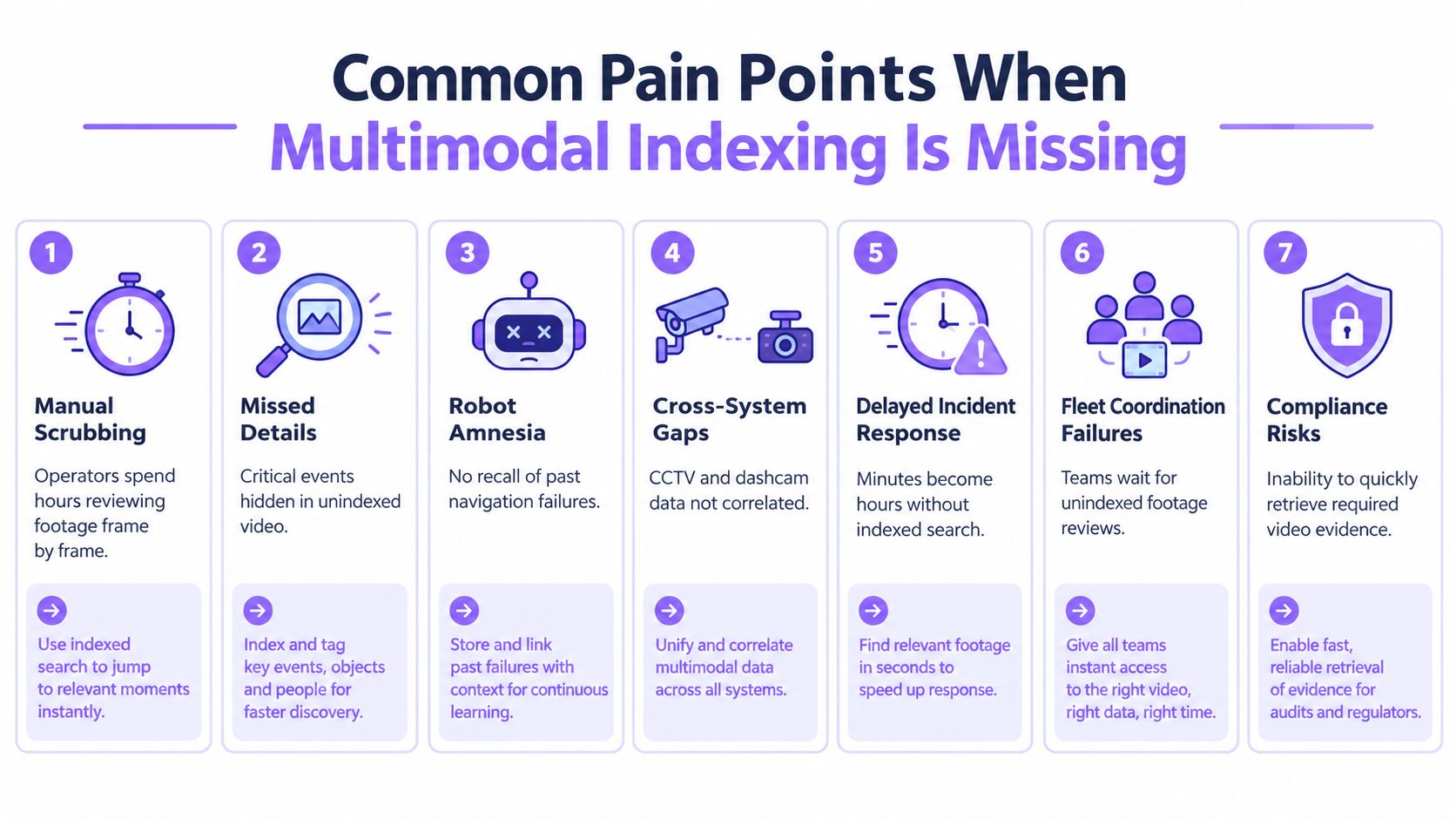
- Manual scrubbing: Operators drag through long DashCam, CCTV, GoPro, or robot recordings because file names and basic metadata don't identify the event.
- Missed details: Critical actions remain hidden when the system stores video but doesn't make objects, sounds, and moments searchable.
- Robot amnesia: Engineers can't reconstruct a navigation failure efficiently, so each incident feels disconnected from previous failures.
- Cross-system gaps: CCTV, mobile, DashCam, and robot data remain in separate tools, even when they describe the same physical event.
- Delayed incident response: A team spends its response window locating footage instead of evaluating what happened.
- Fleet coordination failures: Engineers, operators, and safety teams wait for separate reviews because nobody can query the shared evidence.
- Compliance risks: Auditors may request a specific event, but the organization can't retrieve the relevant video and supporting context quickly.
Shallow indexes create their own problems
A basic metadata index may know that a file came from Camera 4 at a certain time. That helps with inventory, but it doesn't answer whether a person crossed a gate, whether a vehicle approached from the left, or whether a robot arm contacted a box.
Audio and video synchronization is another common failure. A transcript may correctly identify a spoken phrase but point to a timestamp the video player can't resolve. Small clock differences, dropped frames, variable frame rates, and device buffering can all make a result feel unreliable.
Broken multimodal joins are more serious. A query may match the words “vehicle approaching,” while the camera was occluded at that moment. If the interface presents the spoken phrase as proof of the visual event, the system encourages a false conclusion.
Searchability affects more than operations
Unsearchable archives also weaken model development. Engineers may know that valuable training examples exist somewhere in a large collection, but locating the precise labeled windows becomes too expensive. The team then retains more raw data while extracting less usable knowledge from it.
Storage alone doesn't create memory. A searchable representation, clear provenance, and honest handling of missing streams determine whether the archive can support investigation, retraining, and accountability.
Choosing the Right Indexing Approach and Key Takeaways
Start with the questions users and machines already ask. Don't begin by choosing a database or a model. Write down the queries that must work in the field, then identify the evidence each query requires.
A practical decision sequence
First, define the retrieval unit. If the user needs a short video segment, design around time windows. If a robot needs a pose and obstacle state, include spatial and sensor references. If a media editor needs a product appearance while a phrase is spoken, preserve the relationship between visual and audio moments.
Next, identify the minimum evidence. A CCTV query may need appearance, camera location, and time. A DashCam query may need video, IMU, GPS, and route context. A robotics query may need RGB, LiDAR, tactile signals, and task state. Avoid treating one stream as authoritative when the event depends on several.
Then, choose the execution location. Keep low-latency robotics and smart-glasses retrieval close to the device when network delay or privacy is important. Push deep CCTV archives and cross-fleet investigation to the cloud when broad history matters. Use a tiered design when users need both immediate local recall and richer historical search.
Finally, test freshness and failure behavior. A new recording isn't useful if the index becomes available much later than the operational need. A result also needs to say whether it came from complete streams, partial streams, or a lower-quality representation.
Tooling usually falls into several categories: vector databases for semantic similarity, time-series stores for sensor and telemetry history, object or media stores for original evidence, and multimodal embedding pipelines for connecting visual, textual, and auditory meaning. The important architectural choice is how these components preserve time, provenance, and uncertainty together.
V-Modal AI is one example of a platform designed around this memory-layer approach. Its APIs and SDKs support multimodal video, image, audio, and spatial sensor indexing, natural-language retrieval, frame-level results, audio timestamps, and edge-oriented workflows across mobile devices, smart glasses, robotics, and IoT cameras. Its Android and Flutter tooling is aimed at integrating searchable physical-world memory into mobile and embedded applications (V-Modal AI).
Short FAQ
Is indexing the same as embedding?
No. An embedding is a representation of content or an event that can support similarity-based retrieval. Indexing is the broader process of organizing representations, timestamps, metadata, source references, and retrieval relationships so a system can find and return usable evidence.
Does indexing mean storing the original video?
Not necessarily. A system may store original media separately from searchable representations. The index should preserve enough reference information to return the source moment and make its limitations clear.
Why does frame-level retrieval matter?
Whole-file retrieval leaves a person or agent to perform the expensive review. Frame-level or timestamped retrieval points closer to the event, which is essential for incident response, robotics diagnosis, media editing, and surveillance investigation.
Should every stream use one universal index?
Usually not. Text, video, audio, and sensors have different structures and blind spots. A federation of stream-specific indexes joined through time and context is often more practical than forcing every signal into one representation.
How does freshness affect retrieval?
A stale index can hide recent events even when the raw recording exists. For Physical AI, freshness is operational because a new observation may be needed for a current decision, not merely for later archive search.
What should a system do when evidence is missing?
It should return the available evidence with an explicit limitation. A visual match without audio is not the same as a fully corroborated event, and a missing camera view should not be treated as proof that nothing happened.
The simplest definition is also the most useful: indexing is the organization of memory for retrieval. In Physical AI, that memory spans time, images, sound, language, location, motion, and machine state. The best design is the one that helps the right user or system retrieve the right moment, with enough context to act and enough transparency to trust the result.
If your mobile app, smart-glasses workflow, DashCam fleet, CCTV platform, or robot needs searchable multimodal memory, explore how V-Modal AI can provide a Search Layer for Physical AI, including video and audio retrieval, edge memory, and natural-language access to specific moments. Visit V-Modal AI to review the open platform and begin evaluating an integration for your device or robotics stack.