Musical Information Retrieval Explained: Methods and Uses
Why can a music app find a song by its title, yet struggle to find the moment when the singer enters over a quiet guitar? Knowing which file contains music isn't the same as understanding what happens inside it. That gap is the starting point for musical information retrieval, and it also explains why searching robotics footage or a dashcam recording requires more than filenames.
Table of Contents
- What Musical Information Retrieval Means
- From catalog descriptions to musical content
- MIR Tasks at a Glance
- Match the output to the need
- How Audio Becomes Searchable Through Features
- Understand the description before the method
- Features aren't interpretations
- Fingerprinting, Embeddings and Matching Techniques Compared
- Identification isn't resemblance
- Add context when sound isn't enough
- Measuring Retrieval Quality With the Right Metrics
- Evaluate the listener's intention
- Physical AI, Robotics and Video Search Use Cases
- Physical AI needs more than media discovery
- Road and mobile footage need contextual review
- Pain Points Teams Face and How to Work Around Them
- Pair each challenge with a mitigation
- Make uncertainty reviewable
- Pick a Multimodal Search Platform and Start Testing
- Compare candidates on shared evidence
What Musical Information Retrieval Means
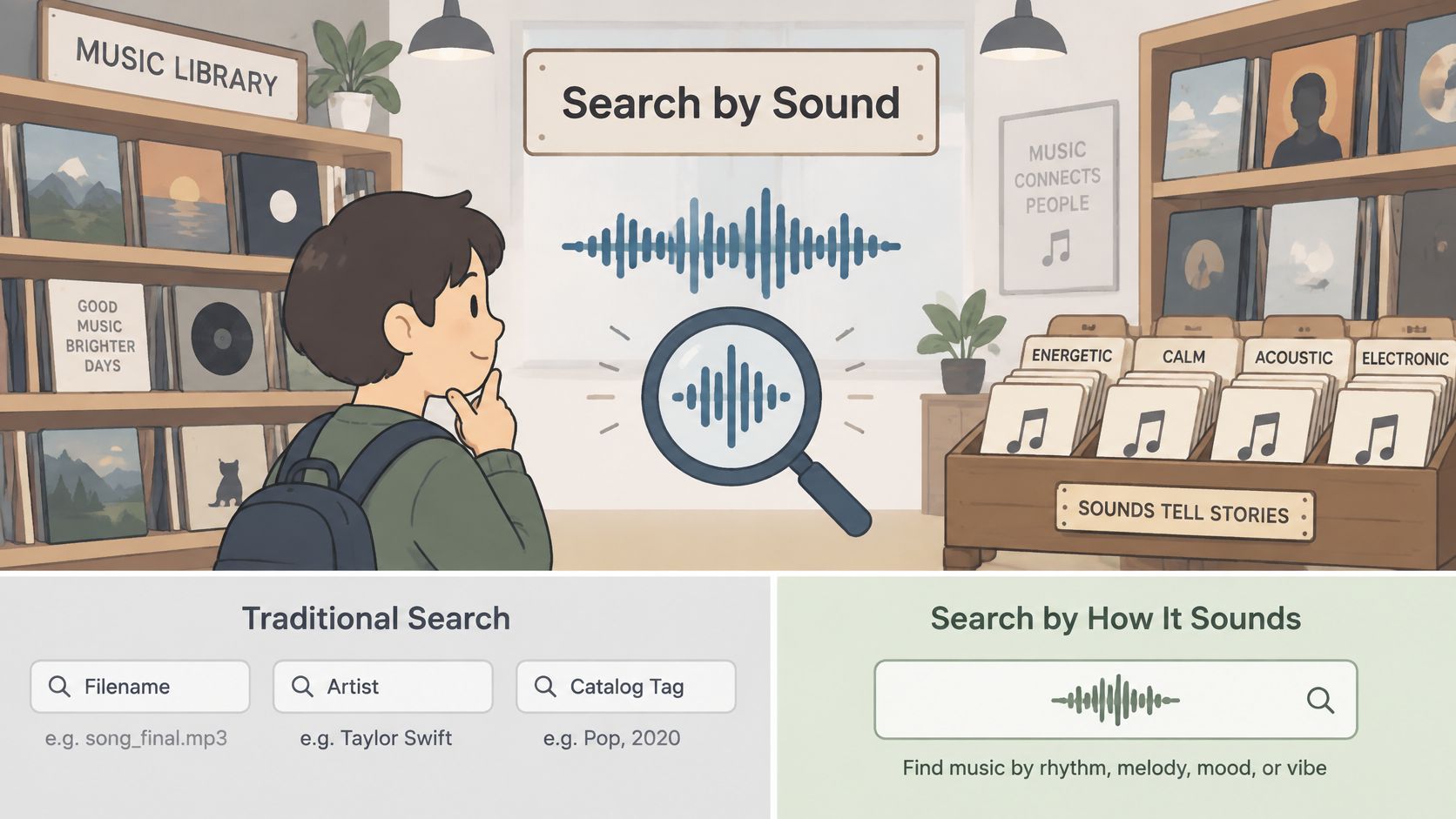
Musical information retrieval (MIR) is the work of making music searchable by what it sounds like, not only by its filename, artist, or catalog tags. Think of a library: a catalog card identifies a book, but it won't tell you where a character changes their mind. Finding that passage requires attention to the content.
Say an editor needs a passage where an acoustic guitar gives way to an energetic chorus. A filename such as final_mix offers no help. Even an accurate genre tag doesn't identify the transition. The editor needs a system that can recognize musical properties and locate an event within a recording.
From catalog descriptions to musical content
A recording is a continuous signal containing overlapping voices, instruments, rhythms, and room sounds. MIR researchers develop representations that let computers compare meaningful aspects of that signal. These representations aren't complete accounts of what a listener hears or feels.
The field gained an organized research forum when the ISMIR conference began in 2000; a bibliometric review of ISMIR documents 2,458 papers from 2000 through 2024, finds disproportionate representation from Western countries and the Global North, and reports increasing cross-institutional collaboration. That geographic imbalance matters when developers ask whose musical traditions their systems understand.
Early approaches emphasized measurable properties such as tempo, loudness, and tonal content. Contemporary approaches can also incorporate learned representations, language, and listening behavior. Neither approach makes musical meaning universal: an interpretation still depends on repertoire, context, and the listener's purpose.
The useful distinction: Identifying a recording and finding an intended moment inside it are different problems.
That distinction reaches beyond music. A vocal entrance, a pedestrian stepping into traffic, and a robot gripper slipping are all events within continuous media. Choosing a useful system starts with separating the task, the evidence it needs, and the way success should be judged.
MIR Tasks at a Glance
| Task | Question it answers | Typical output | Common metric |
|---|---|---|---|
| Music search | Which recordings match this query? | Ranked list of tracks | Precision at k |
| Automatic tagging | Which tags describe this track? | Set of labels | Macro-F1 |
| Genre and mood classification | What genre or mood is this? | One or more labels | Accuracy, macro-F1 |
| Recommendation | What should a listener hear next? | Ranked list of tracks | nDCG |
| Audio similarity | Which sounds resemble this one? | Ranked matches | Mean average precision |
| Beat tracking | Where do the beats fall? | Beat timestamps | F-measure |
| Transcription | Which notes are played, and when? | Note events with start times | Note-level F-measure |
| Moment localization | Where in the recording does this happen? | Timestamped segment | Recall at k |
Music search starts with an explicit request. Recommendation predicts what a listener might want without requiring that request. Both return ranked lists, but relevance means something different: matching an instruction isn't the same as anticipating taste.
Automatic tagging supplies descriptive labels, while genre and mood classification assign categories. A tag such as piano describes audible content; a mood label such as reflective involves more interpretation. Neither necessarily tells the user where that property occurs.
Audio similarity returns examples that resemble a reference sound. Beat tracking and transcription instead describe musical timing: the former locates beats, while the latter estimates notes and their start times. A system can identify a strong pulse without correctly transcribing the melody.
Match the output to the need
Moment localization is closest to audio and video event search. Someone asking for the part where the singer starts the chorus needs a playable segment, not merely the correct album.
The output determines the evaluation. A correct label doesn't prove that a ranked list is useful, and retrieving the correct track doesn't prove that its passage boundaries are accurate. For timing tasks, evaluators must also define how close a predicted timestamp must be to count as correct.
Write the user's actual question before choosing a method. Then select the row whose output matches what the user needs to see or hear.
How Audio Becomes Searchable Through Features
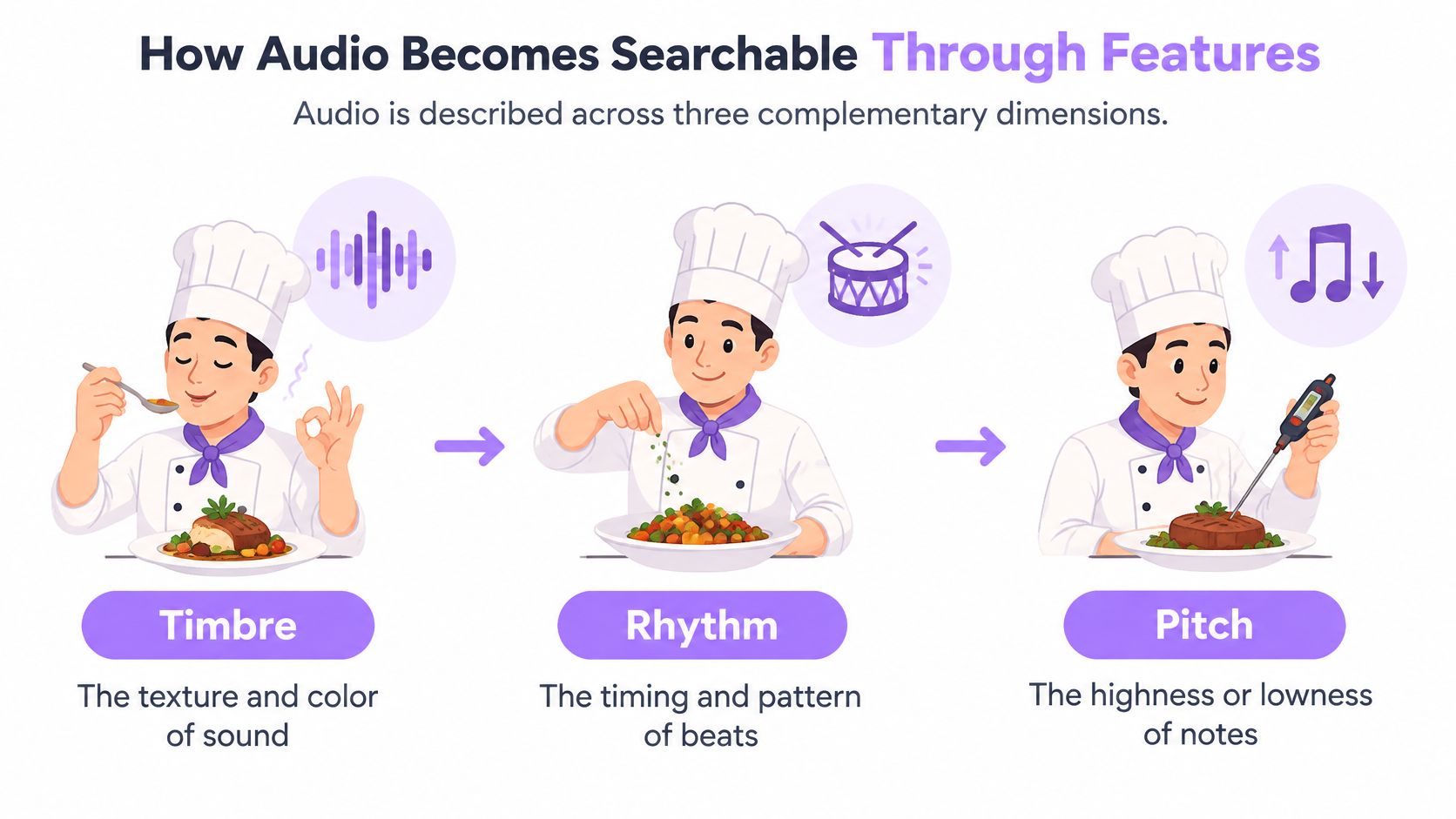
A chef describes a dish through taste, texture, and temperature, not just its recipe name. Audio needs a similarly complementary description. Timbre, rhythm, and pitch or tonal content capture different aspects of what listeners hear.
Timbre is the texture or color of sound. It helps distinguish a piano from a guitar playing the same chord. Rhythm concerns timing, including beat patterns and tempo. Pitch and tonal content concern notes, melodies, and harmonic relationships.
Understand the description before the method
A conceptual walkthrough helps explain why these dimensions matter without exposing search-system internals:
- Start with continuous audio. A microphone captures the combined sound, not neatly separated instrument names or musical events.
- Describe short passages. Consider their texture, timing, and tonal content. A distorted guitar chord has different descriptive properties from a softly played piano chord.
- Relate descriptions to musical timing. Beats and note onsets provide reference points, so passages aren't compared only by elapsed clock time.
- Build a compact musical description. Preserve useful information across the complementary dimensions rather than treating a single number as a complete account.
A survey of musical feature representations explains why these dimensions complement one another and reports that beat-aligned feature sequences can improve classification over unordered frame statistics by preserving musical temporal structure.
Consider a guitar riff played slowly in rehearsal and faster during a performance. Its duration changes, but the relationships between musical events may remain recognizable. Beat-aware descriptions can help account for that difference. They don't guarantee a match if the performer also changes the phrasing, harmony, or instrumentation.
Features aren't interpretations
A fast tempo doesn't automatically mean happiness. A dark musical texture doesn't prove that lyrics express sadness. Features describe evidence; the task determines how that evidence should be interpreted.
Likewise, a compact representation may retain useful similarities while losing details a musician considers essential. Ask whether ornamentation, expressive timing, or an instrument interaction is central to the request before accepting a broad resemblance as success.
When a search fails, ask which musical dimension the query depends on before assuming the whole system is ineffective.
That question makes troubleshooting concrete. An instrument mismatch suggests a texture problem; a missed riff may concern melodic content or timing; a misunderstood lyrical theme requires evidence beyond sound texture alone.
Fingerprinting, Embeddings and Matching Techniques Compared
| Technique | What it captures | Best for | Main limit |
|---|---|---|---|
| Spectral and timbre descriptors | Texture and instrumentation | Instrument and style similarity | Blind to meaning and lyrics |
| Rhythm and tempo features | Beat pattern and tempo | Tempo and dance-style matching | Weak on free-time or rubato music |
| Pitch and chroma features | Melody and harmony | Chord and cover-version matching | Struggles with dense or noisy mixes |
| Audio fingerprinting | Compact signature of a known recording | Identifying an exact track from a short clip | Can fail on live, remixed, or heavily altered versions |
| Learned embeddings | Similarity learned from many examples | Query by example and mood search | Needs substantial training data and can inherit its gaps |
| Text and metadata | Lyrics, tags, and descriptions | Searching by theme, scene, or context | Relies on labels that may be missing or inconsistent |
Identification isn't resemblance
Audio fingerprinting answers an identity question: which known recording is this? Think of recognizing a particular printed edition, rather than finding every book with a similar plot. A short excerpt can be enough when it retains the identifying characteristics of the reference recording.
A live performance or substantial remix may no longer match that reference. Fingerprinting isn't the natural choice when the goal is to find another performance of a melody or music with a comparable atmosphere.
Learned embeddings support a different question: what resembles this example or description? Conceptually, they represent learned relationships between sounds. They can support query-by-example and mood-oriented discovery without requiring identical recordings.
Their limits follow from what they learned. A system may recognize familiar production styles while treating an unfamiliar instrument or musical tradition poorly. A plausible result isn't evidence that the representation captured the specific relationship the user intended.
Add context when sound isn't enough
Two tracks can share instrumentation and tempo while expressing different lyrical ideas. Text, lyrics, and cultural metadata can help separate them. A survey of music classification and retrieval describes advantages of combining audio with symbolic information, lyrics, or cultural metadata rather than relying on audio alone.
Large, standardized collections also matter when evaluating learned methods. The Million Song Dataset supplies audio features and metadata for 1,000,000 contemporary popular music tracks, illustrating the scale at which methods can be tested rather than demonstrated on handpicked examples. Its scope shouldn't be mistaken for coverage of every musical tradition.
Choose fingerprinting for recording identity, embeddings for resemblance, and text or metadata for theme and context. A blended approach may be appropriate, but adding modalities isn't automatically an improvement. Missing lyrics, inconsistent tags, or an irrelevant visual cue can complicate an otherwise clear request.
The practical test is whether each added source of information resolves an ambiguity the user faces.
Measuring Retrieval Quality With the Right Metrics
Suppose a classifier assigns 85 correct labels to 100 hypothetical clips. Its accuracy is 85%, but that invented example tells us nothing about which labels it missed. It could perform well on common categories while overlooking a rare mood that matters to an editor.
Accuracy is useful only when it matches the task. Ranked retrieval, uneven label sets, and timestamped events require additional measures.
| Metric | Use it when | Worked example |
|---|---|---|
| Accuracy | Each item has one correct label | In the hypothetical example above, 85 correct labels divided by 100 clips gives 85% |
| Macro-F1 | Classes are uneven in size | Calculate F1 separately for each mood, then give rare and common moods equal weight |
| Precision at k | You care about the top results shown | Divide relevant results displayed by the number displayed |
| Recall at k | You need most relevant items found | Divide relevant results displayed by all known relevant items |
| Mean average precision | You rank results across many queries | Average precision at each relevant hit, then average across queries |
| nDCG | Relevance has degrees and order matters | Give greater credit when highly relevant results appear above partly relevant results |
Here, k means the chosen cutoff in the displayed list. Precision asks whether the returned results are useful; recall asks how much relevant material the system found. Neither alone establishes that a returned segment starts and ends at useful points.
Evaluate the listener's intention
The Transactions of ISMIR collection on multimodal MIR emphasizes connections across modalities and human-machine interaction. That perspective matters because musical relevance can be subjective, and a correct clip-level label can still fail a musician seeking a particular entrance or interaction.
Use a practical evaluation routine:
- Define real query types. Separate requests for instruments, lyrical ideas, transitions, rhythmic patterns, and visible performance events.
- Label relevant moments. Mark useful passage boundaries, not only the recordings containing them.
- Measure both passage and catalog performance. Report segment-level precision alongside ranking quality, with an explicit rule for acceptable temporal overlap.
- Inspect meaningful groups. Break results down by genre, tempo, recording quality, and query type.
- Include human review. Ask listeners or editors to assess unfamiliar repertoire, explain disagreements, and record how much correction a result needs.
For ambiguous requests, allow reviewers to distinguish clearly useful, partly useful, and irrelevant passages. Record uncertainty rather than forcing every disagreement into a binary label.
Evaluation safeguard: A strong average can conceal poor results on rare styles or noisy recordings.
Read the breakdown and inspect the failures. A useful system should help someone complete a musical task, not merely produce an attractive headline score.
Physical AI, Robotics and Video Search Use Cases
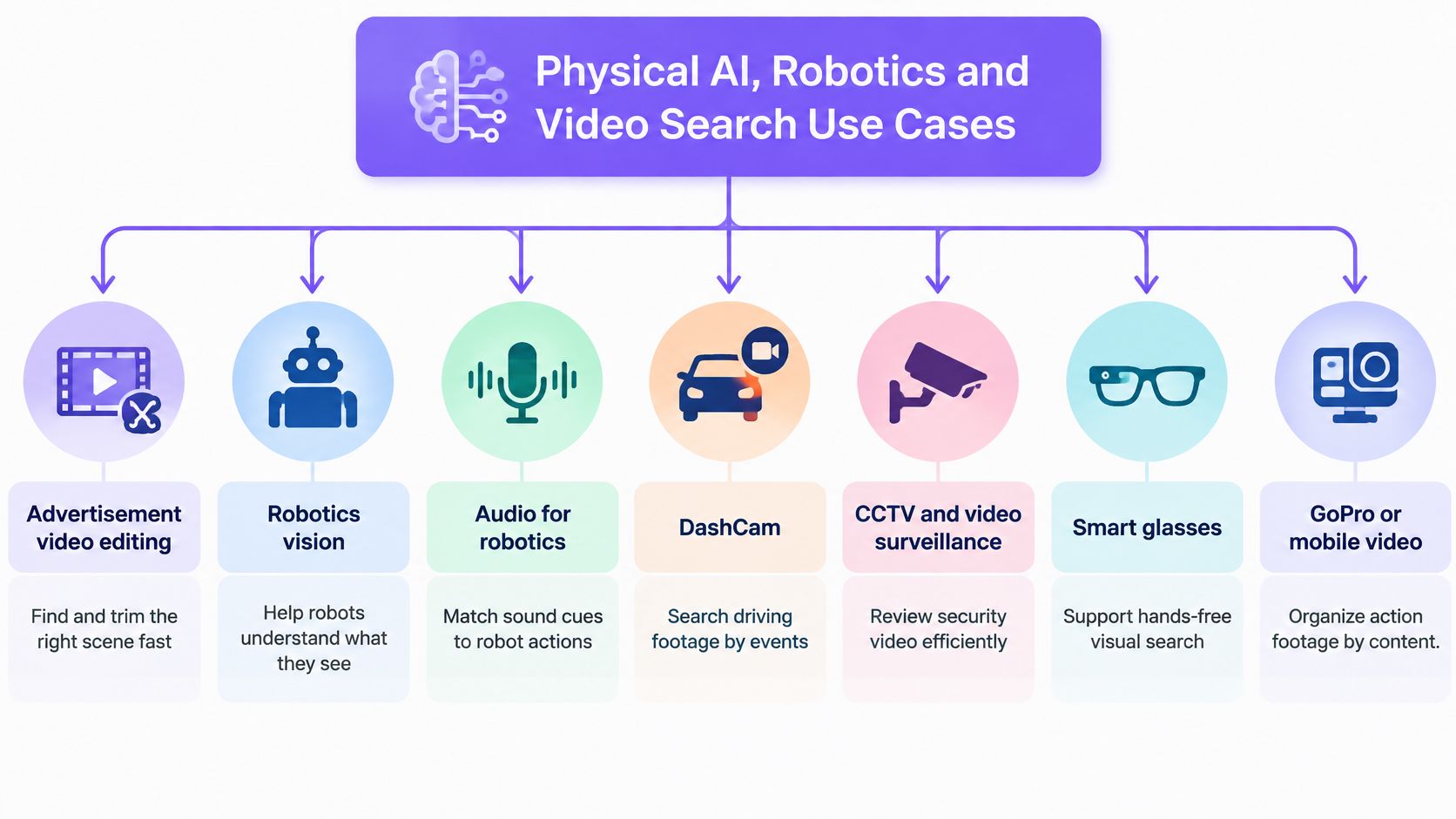
Multimodal audio connects sound with other evidence, such as speech, images, or sensor readings. Multimodal video connects visible events with sound and context. Music search becomes a useful model for both when the desired answer is a specific moment.
| Use case | What users search for | Main pain point |
|---|---|---|
| Advertisement video editing | Compelling clips, spoken lines, and music beds | Finding usable clips quickly across large libraries |
| Robotics vision | Moments of misgrasp, hesitation, or collision | Real-time safety and sensor synchronization |
| Audio for robotics | Alarms, impacts, horns, and spoken commands | Noisy environments and overlapping sound sources |
| DashCam | Near-crashes, pedestrians, and sudden weather change | Changing light, camera vibration, and privacy |
| CCTV and video surveillance | Restricted-area entries and escape routes | False positives and retention rules |
| Smart glasses | Things seen earlier in the day | Battery limits, offline memory, and privacy |
| GoPro and mobile video | Action moments and named scenes in long footage | Large uploads and slow playback |
For advertisement video editing, an editor might seek a product demonstration followed by an upbeat musical transition. Robotics vision concerns physical events, while audio for robotics adds cues that may be difficult to see, such as an alarm behind an obstruction.
DashCam and CCTV users need reviewable incident evidence. Smart glasses introduce personal visual recall, while GoPro and mobile applications help users find relevant moments in long recordings without watching everything again.
Physical AI needs more than media discovery
The Physical AI technology stack joins sensing, interpretation, and action. Deloitte's physical-AI white paper reports more than 500,000 industrial robots deployed globally in 2024 and identifies vision cameras, force-torque sensors, gateways, and edge-computing nodes as stack components.
Say a gripper slips. A useful review connects the visible movement to the corresponding force reading and surrounding operational context. Unlike selecting an attractive advertising clip, diagnosing this event requires synchronized evidence and clear limits on what the system can infer.
A 2026 Capgemini survey of 1,678 executives describes onboard edge inference combining vision, force, and touch sensing so robots can act without continuous cloud connectivity. Historical search should support diagnosis without disrupting safety-critical control.
Road and mobile footage need contextual review
A peer-reviewed review of dashcam analysis describes 15,900 images prepared for crash-likelihood classification and processing video from 12,679 bus-related crashes in Hong Kong to track pedestrians. These are concrete analysis tasks, not proof that every driving event is automatically understood.
Horns, sirens, and impact sounds can help reviewers locate candidate moments in DashCam or GoPro footage, but sound alone doesn't establish what happened. Mobile software stacks also need usable playback, permissions, upload handling, and offline behavior; a search demonstration doesn't test those requirements.
When reviewing a visual video search SDK listing, connect its capabilities to the user's next decision. Editing a clip, diagnosing a machine, and reviewing an incident require different acceptance tests.
Pain Points Teams Face and How to Work Around Them
A 2026 Asia Today report citing South Korea's Ministry of the Interior and Safety and local governments states that approximately 650,000 CCTV cameras were monitored across 217 local governments, with AI deployed on 37.5% of them. At that scale, continuous human viewing and manual timeline scrubbing aren't workable review strategies.
Automating retrieval doesn't remove the need for judgment. It changes the reviewer's job from watching everything to assessing candidate evidence. Poorly chosen settings can replace a long timeline with a long list of misleading matches.
Pair each challenge with a mitigation
- False positives in busy scenes. Review candidate matches against a labeled sample before rollout. Include lookalike events, such as someone approaching a restricted doorway without entering it.
- Camera quality and lighting shifts. Test each camera model separately, including glare, darkness, compression artifacts, and changing viewpoints. Don't assume results from a clear indoor camera transfer to an exposed outdoor installation.
- Audio and video drifting out of sync. Check timestamps using an event that is both visible and audible. Preserve enough surrounding footage to establish whether the sound preceded or followed the action.
- Bandwidth and offline operation. Decide which footage stays on the device and which material can leave it. Test disconnections deliberately rather than treating connectivity as a constant.
- Privacy and retention rules. Establish deletion schedules, access permissions, and access logs before making an archive searchable. Consider whether retrieved segments expose bystanders or private conversations.
- Weak evaluation. Measure performance on your own footage, including difficult and irrelevant examples. Vendor demonstrations show selected capabilities, not your expected error rate.
Make uncertainty reviewable
A search result should expose the relevant segment, its surrounding context, and the evidence associated with the request. If an explanation is available, it should describe observable cues rather than invent an account of a person's intentions.
For surveillance, auditability matters as much as accuracy. Record who reviewed a result, what they concluded, and whether they rejected an automated suggestion. Keep the original evidence accessible under the applicable access and retention policy.
A retrieved match is a reason to inspect evidence, not a substitute for inspecting it.
This distinction also protects robotics teams from confusing a correlated sound with the cause of a failure. Reviewers need enough context to challenge the system's suggestion, not just accept it.
Pick a Multimodal Search Platform and Start Testing
Choose a platform against a defined application, not a feature count. Use this checklist before comparing candidates:
- Which media must be searchable? Specify audio, video, images, and any required sensor context.
- Where must search run? Distinguish cloud, edge, and on-device requirements, including what must work offline.
- Which SDKs fit your stack? Check Kotlin for native Android, Swift integration needs for iOS, and Flutter for cross-platform applications.
- How are privacy and retention handled? Document permissions, deletion behavior, and access controls.
- Can you test your own footage? Require representative inputs and inspectable outputs before committing.
Compare candidates on shared evidence
Include V-Modal AI in that comparison: our Visual Memory Layer for Physical AI provides multimodal video and audio search, with Visual Search for Mobile, Edge devices, Smart Glasses, and Physical AI devices. We deliver small, typed SDKs that fit existing apps and devices, and our CCTV capability can scan hours of footage for a specific visual indicator.
Treat that capability, like every vendor claim, as something to verify on your application. Check SDK documentation in our developer hub, including the native Android and Flutter offerings; don't assume every platform has an equivalent integration path.
For a manageable pilot, select 50 representative clips or queries as a proposed test set, not an industry benchmark. Include obvious matches, ambiguous requests, and cases where no relevant result exists. Compare every candidate using the same precision-at-k cutoff and human review, and record playback usefulness, missed events, and reviewer effort before deciding.
V-Modal AI offers multimodal video and audio search for applications that need to retrieve meaningful moments rather than just files. Visit V-Modal AI to explore developer resources, review the SDK examples, and begin a pilot using your own footage and evaluation criteria.